Via Francigena in Tuscany: Stages, Tips and Where to Stay
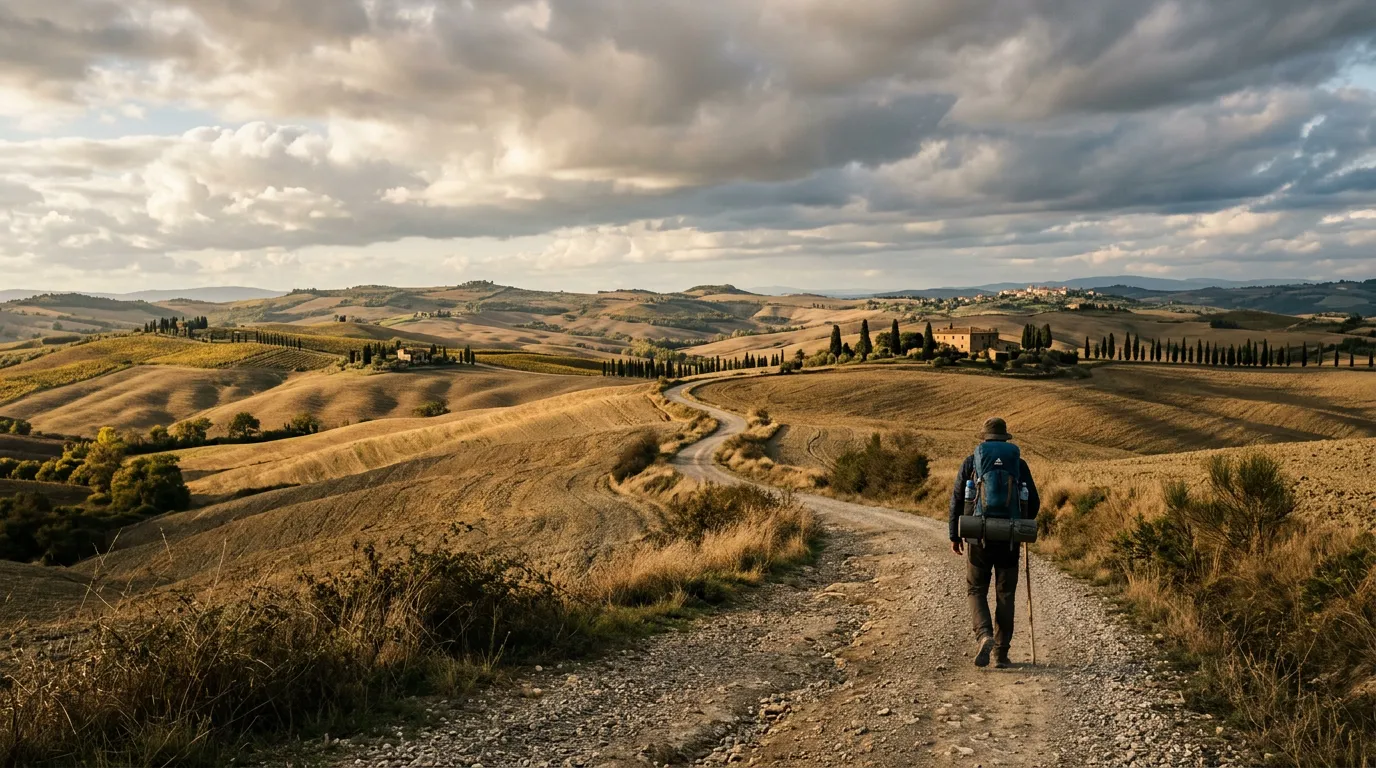
The Via Francigena Tuscany stages is one of the most searched topics among those planning a walk in central Italy. The Tuscan section of the Via Francigena - the ancient pilgrimage route from Canterbury to Rome - is considered among the most beautiful on the entire route: it crosses iconic landscapes, passes through intact medieval villages, and retains for long stretches the rural and silent character that medieval pilgrims would have known. This guide describes the main Tuscan stages, with practical information on distances, difficulty and points of interest.
The Via Francigena in Tuscany: introduction to the route
The Via Francigena enters Tuscany from the Ligurian Apennines, descends towards Pontremoli and crosses the Lunigiana before moving into the Pisan plain and the Sienese hills. The Tuscan section covers approximately 380 km, from Pontremoli to San Quirico d’Orcia, and is divided into about 20 stages of varying length between 15 and 30 km.
The route is officially signposted with the Council of Europe markers (white cross on yellow background) and regional Tuscan waymarking. Digital mapping is available on the official Via Francigena app. Many walkers complete the Tuscan stretch in 14–18 days, but it is possible to walk only individual stages as day excursions or multi-day walks without covering the entire route.
The main stages: from Lucca to the Val d’Elsa
Stage 1: San Miniato and the Valdera
San Miniato is one of the first important stages after the Pisan plain. The medieval hilltop village dominates the Valdera with a view reaching to the Valdarno. The Federiciana Rocca, rebuilt after the Second World War bombing, is the highest and most panoramic point. The Via Francigena passes through the historic centre of the village before descending towards the lower Valdarno.
San Miniato is also known for its white truffle: the November fair is one of the most important gastronomic events in central Tuscany.
Stage 2: Gambassi Terme
Gambassi Terme is a moderately demanding stage, with a route that crosses the Val d’Elsa woods on dirt paths. The village has a Romanesque church of great interest - the Pieve di Santa Maria a Chianni, one of the rare well-preserved examples of rural Romanesque architecture in the territory. The Gambassi thermal baths, with their sulphurous waters, have been a traditional resting place for pilgrims for centuries.
Stage 3: San Gimignano
San Gimignano is the most celebrated stage of the Via Francigena Tuscany route. The 14 medieval towers are visible from a distance along the path: arriving on foot from the west, with the towers growing on the horizon as you approach, is an emotional experience that no coach tour can replicate.
Archbishop Sigeric of Canterbury, who in 990 AD made the journey from Rome to Canterbury and noted the stages, cited San Gimignano as a stop on his pilgrimage. The village offers several hostels for pilgrims, with the Via Francigena credenziale allowing access at reduced prices.
Stage 4: Colle Val d’Elsa
From San Gimignano the Via Francigena descends towards Colle Val d’Elsa, crossing the open countryside of the Val d’Elsa with its cultivated fields and rows of vines. Colle Val d’Elsa is a convenient stage for those who need supplies: the modern lower town has supermarkets, pharmacies and several accommodation options. The medieval upper town is worth a one-hour detour.
Stage 5: Barberino Val d’Elsa and Poggibonsi
The stretch between Colle Val d’Elsa and Poggibonsi passes through Barberino Val d’Elsa, one of the most authentic villages in the area. The Via Francigena crosses the countryside between vineyards and olive groves, with views over the Chianti hills to the east. Barberino is an ideal place for a lunch stop: the medieval square, the Palazzo Pretorio with its coats of arms, the tranquillity of the village.
Poggibonsi is the largest town on the itinerary, with a railway station connecting to Florence and Siena. For pilgrims it is an important resupply point. The modern town is not particularly attractive, but the Castello della Magione, a short distance from the centre, is worth a visit.
Stage 6: Monteriggioni
Monteriggioni is the most scenic stage of the Via Francigena Tuscany route. The medieval castle appears suddenly from the plain, with its 14 towers seeming to rise out of the flat countryside. Cited by Dante in the Inferno, Monteriggioni has been a resting place for pilgrims for centuries. Today the hostel inside the walls welcomes Francigena walkers.
The stretch from Monteriggioni descending towards Siena is considered one of the most beautiful on the Italian route: 15 km through cypress-lined hills, country churches and views of Siena advancing on the horizon.
Stage 7: Siena
Siena is the natural arrival point of the central Tuscan section. Entering the city through Porta Camollia, after days of walking through the hills, is one of the most moving moments of the entire route. The Duomo, Piazza del Campo, the Palazzo Pubblico: everything seems even more beautiful after having earned it on foot.
Siena has a centuries-old tradition of welcoming pilgrims. The Ospedale di Santa Maria della Scala, one of the oldest hospitals in Europe, was originally dedicated to assisting wayfarers and pilgrims: today it is a museum, but its history is inseparable from the Via Francigena.
Difficulty and preparation
The Tuscan section of the Via Francigena is of medium difficulty. It requires no mountaineering equipment but good physical fitness to tackle stages of 20–25 km with varying gradients. Trekking boots with a robust sole are essential, especially on wet dirt paths.
The pilgrim’s credenziale can be requested from the Associazione Italiana Via Francigena or at parishes and hostels along the route. It allows you to stay at affiliated accommodation at reduced prices and to collect stamps at each stage. The Testimonium - the final document certifying completion of the route - is collected in Rome.
The best time to walk is spring and autumn: summer heat can be heavy on the more exposed stages, while winter brings mud and short days.
Where to stay
Homelink Sogno d’Oro is located directly on the Via Francigena, in Barberino Val d’Elsa, and is an ideal stage for walkers. The property offers rooms with private bathroom for those who want to rest in greater comfort after a demanding stage. From the garden you can see the hills the pilgrim has just crossed and those that await the following day. The next morning you set off fresh towards Poggibonsi or return towards Colle Val d’Elsa, with the Val d’Elsa hills changing colour in the morning light.
Related property: Homelink Sogno d’Oro Link: /sogno-doro/
Where to stay
Dove dormire: Homelink Sogno d'Oro - Val d'Elsa · tra Firenze e Siena
Controlla la disponibilità