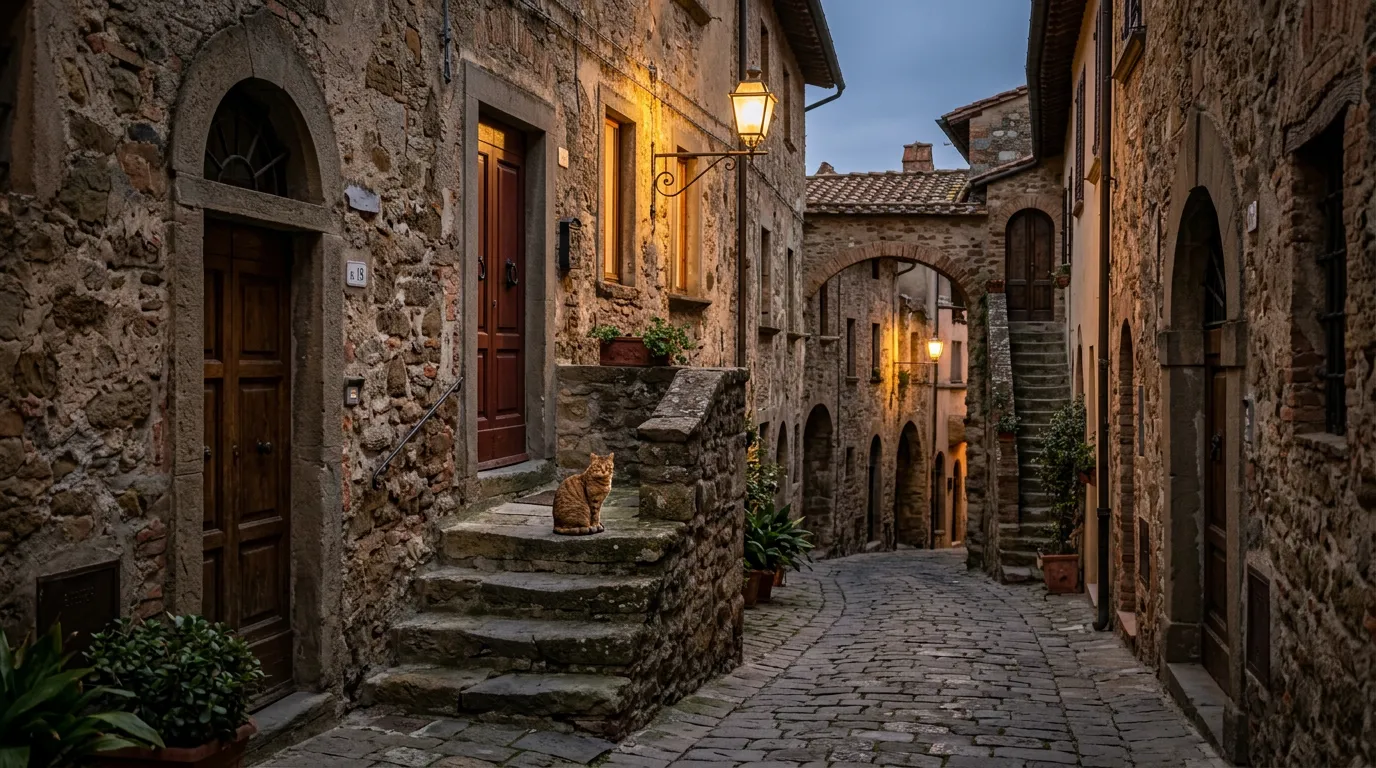
Medieval Villages of the Val d'Elsa: A Complete Guide
The Val d’Elsa is a treasure chest of medieval history. Travelling through this valley that divides the Chianti hills from the Sienese countryside, you encounter the medieval villages that shaped the history of Tuscany for centuries. San Gimignano with its towers, Monteriggioni with its intact walls, Barberino with its Palazzo Pretorio, Colle Val d’Elsa with the secrets of Arnolfo di Cambio, Certaldo with the memory of Boccaccio: each village is a chapter of a centuries-old story well worth reading slowly, one after another.
San Gimignano: medieval Manhattan
San Gimignano is the best-known medieval village in the Val d’Elsa - and rightly so. Its 14 surviving medieval towers, once more than 70 in number, rise against the Tuscan sky creating a skyline unique in the world. The city has been a UNESCO World Heritage Site since 1990 and welcomes millions of visitors every year, yet it still manages to maintain an authentic soul, especially in the evening hours when the organised tour groups have gone.
Piazza della Cisterna and Piazza del Duomo form the heart of the village. The Collegiata di Santa Maria Assunta houses frescoes by Ghirlandaio and Taddeo di Bartolo that alone justify the visit. Vernaccia di San Gimignano, a DOCG white wine with an eight-century history, is the perfect accompaniment for a stop at the wine bars in the centre.
How to visit San Gimignano without the crowds
The secret is to arrive early in the morning, before 9am, or in the late afternoon. The best months are April, May, September and October. In summer the village is beautiful but hot and crowded: if you go in July or August, it is worth staying nearby and visiting in the first hours of the morning.
Monteriggioni: Dante’s castle
Monteriggioni is one of the most evocative and photographed medieval villages in the Val d’Elsa. The castle has remained virtually unchanged since the thirteenth century: a perfect circle of walls with 14 towers, built by the Sienese Republic as a defensive bulwark against Florence. Dante Alighieri cited it in the Inferno, comparing the giants of the thirty-first canto to the towers that “crown” the castle.
The village inside the walls is tiny - a square with a Romanesque church and a few dwellings. But the experience of walking around the perimeter of the walls, with the towers silhouetted against the open sky of the Sienese countryside, is something difficult to forget. The best time to visit is during the July medieval festival, when the castle hosts a historical re-enactment with period costumes, artisan stalls and performances.
Monteriggioni is 20 minutes by car from Barberino Val d’Elsa, along the Via Cassia heading towards Siena.
Barberino Val d’Elsa: the authentic village
Barberino Val d’Elsa is the least well-known of the medieval villages mentioned in this guide, and perhaps for that very reason the most authentic. The medieval walls are intact, the Palazzo Pretorio with its podestà coats of arms is one of the most complete heraldic documents in Tuscany, and village life unfolds at the slow rhythm of the Tuscan countryside.
The village can be walked in less than an hour, but this slowness is a richness. There is no pressure to see everything quickly, no museum queues, no souvenir vendors on every corner. Barberino is a place to sit in the square, drink a coffee, watch the children playing while the old men chat on the bench: a Tuscany that endures.
The property is just a few minutes’ walk from the village, on the Via Francigena that has crossed these hills for centuries.
Colle Val d’Elsa: the city of crystal and Arnolfo
Colle Val d’Elsa is divided into two distinct parts: the modern lower town, commercial and contemporary, and the medieval upper town, reachable on foot or by car via a panoramic road. It is the upper town that deserves a visit.
The medieval village of Colle Alta runs along a long, narrow hilltop ridge, with a single main axis from which side alleys descend steeply towards the countryside. Here was born Arnolfo di Cambio, the thirteenth-century architect and sculptor responsible for Florence Cathedral, Santa Croce and part of the Palazzo Vecchio.
The Casa-Torre Arnolfo is still open to visitors and houses a collection of works connected to the master. But Colle Alta is also famous for another excellence: crystal. Colle Val d’Elsa is the leading European producer of handcrafted crystal glass, with a craft tradition dating back to the eighteenth century. The Museo del Cristallo tells this fascinating story through ancient techniques and contemporary design.
Colle Val d’Elsa is just 10 minutes by car from Barberino - reachable even by bicycle for those who enjoy cycle touring.
Certaldo: Boccaccio’s city
Certaldo lies in the northern part of the Val d’Elsa, near the border with the Florentine Valdelsa. It is the birthplace of Giovanni Boccaccio, the father of modern Italian narrative prose and author of the Decameron. The upper town of Certaldo, reachable by funicular from the lower town, is one of the most charming in the area: the red brick houses create a warm, unusual palette compared to the grey stone of the Sienese villages.
The Casa del Boccaccio, where the great writer spent his final years, is now a museum housing ancient editions of the Decameron and documents about the author’s life and works. The church of Santi Jacopo e Filippo contains Boccaccio’s cenotaph.
Certaldo is about 25 minutes by car from Barberino Val d’Elsa, heading north towards Florence.
How to organise a visit to the medieval villages
For those who want to visit all the Val d’Elsa medieval villages efficiently, it is worth planning at least three days and staying in a central position. Barberino Val d’Elsa is geographically the perfect balance point between all the destinations described.
A logical itinerary might be: first day, Barberino on foot and Colle Val d’Elsa in the afternoon; second day, San Gimignano in the morning and Certaldo in the afternoon; third day, Monteriggioni with a possible visit to Siena in the afternoon.
All the distances are manageable by car in under 30 minutes, and the roads connecting the villages pass through a landscape of hills, vineyards and olive groves that is itself part of the experience. In spring, when the vines have just budded and the cypresses are fresh green, driving these roads is a pleasure in its own right.
Practical tips
The medieval villages of the Val d’Elsa are generally open year-round, with some variation in museum hours. The low season months, from November to March, offer lower prices and an almost complete absence of crowds. The winter landscape, with mist wrapping the hills and smoke rising from chimneys, has a particular charm. Spring and autumn remain the ideal periods for enjoying both landscape and climate.
Where to stay
Homelink Sogno d’Oro is located in Barberino Val d’Elsa, in the heart of the Val d’Elsa, and is the ideal base for exploring all the medieval villages described in this guide. San Gimignano is 15 minutes away, Monteriggioni 20, Colle Val d’Elsa 10, Certaldo 25. Every morning begins with breakfast overlooking the Chianti hills, and every evening you return through vineyards and cypresses.
Related property: Homelink Sogno d’Oro Link: /sogno-doro/
Where to stay
Dove dormire: Homelink Sogno d'Oro - Val d'Elsa · tra Firenze e Siena
Controlla la disponibilità