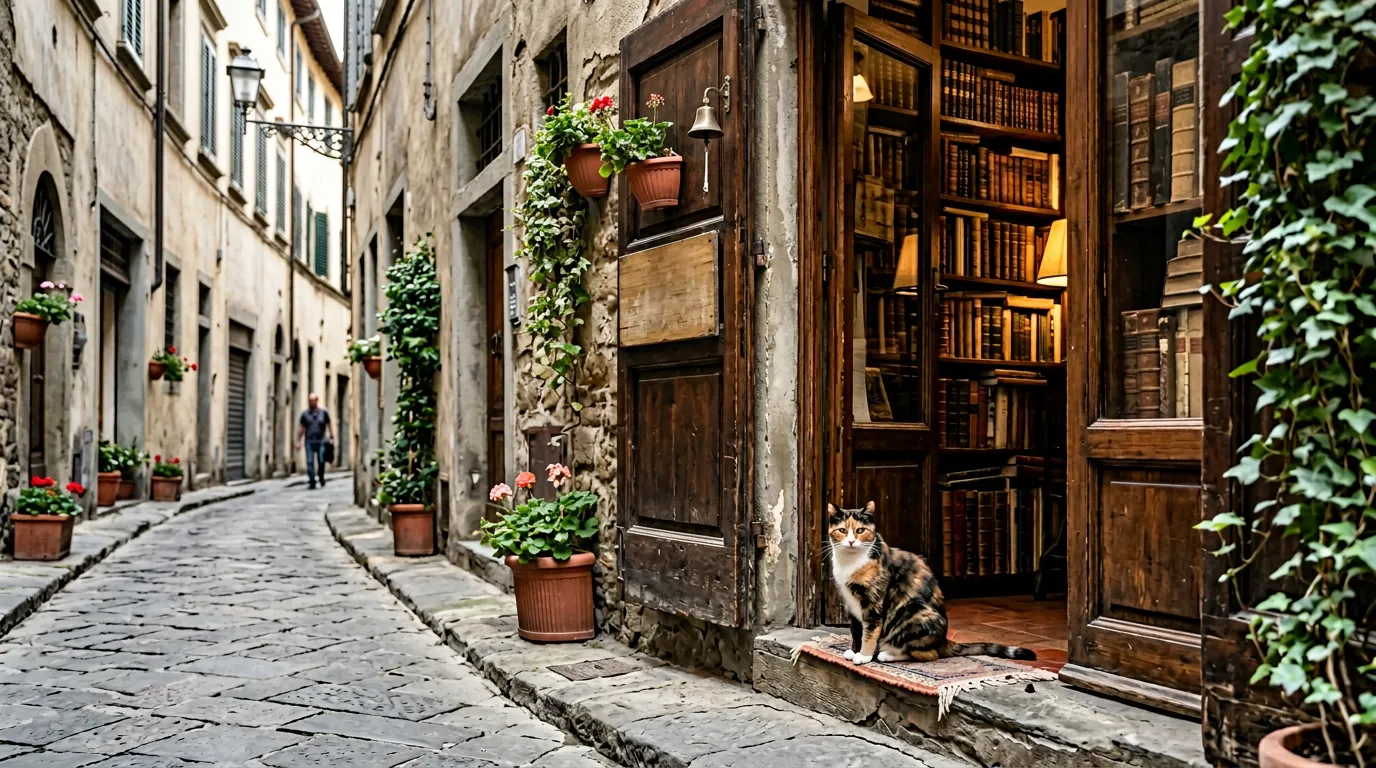
The Less-Touristy Side of Florence
The less-touristy Florence exists, and it is often more fascinating than the one described in traditional guidebooks. You only need to cross the Arno, slip into the Oltrarno’s alleyways or venture towards neighbourhoods like San Frediano and Santo Spirito to find a different city: quieter, more authentic, with trattorias where you eat as people did generations ago and artisan workshops where craftspeople still work with traditional methods.
Oltrarno: the Florence tourists forget
The Oltrarno, literally “the part beyond the Arno”, is the neighbourhood that above all others preserves the historical soul of Florence. Not that it is unknown, but compared to the historic centre around the Duomo, tourist flows thin out rapidly as soon as you move away from Ponte Vecchio and Palazzo Pitti.
Walking along Via dei Serragli, Via Sant’Agostino or Via dell’Orto means coming across furniture restoration workshops, bookbinding studios, picture framers and luthiers who work with the same tools used in Renaissance workshops. Many of these craftspeople are happy to welcome those who stop to watch: curiosity is always well received.
Piazza Santo Spirito
Piazza Santo Spirito is the heart of the Oltrarno: an irregular square, shaded by large trees, with the unfinished facade of the Basilica of Santo Spirito as a backdrop. By day it is tranquil, frequented by university students and residents. On Monday mornings a small neighbourhood market takes place. In the evening, with the outdoor tables of bars and trattorias, it becomes one of Florence’s most pleasant spots.
The Basilica of Santo Spirito is one of Brunelleschi’s masterpieces: built in the second half of the fifteenth century, it has a perfectly rational floor plan and houses works by Filippino Lippi and other Renaissance masters. It is often silent and almost empty - the opposite of the Duomo.
Local markets away from the tourists
One of the best ways to understand the less-touristy Florence is to visit the neighbourhood markets, very different from the souvenir markets of San Lorenzo.
The Mercato di Sant’Ambrogio, in Piazza Sant’Ambrogio near the Santa Croce neighbourhood, is Florence’s most authentic food market: fruit and vegetables from Tuscan farmers, cheeses, cured meats, flowers, fresh morning fish. Inside the covered market is a trattoria that opens only for lunch, frequented almost exclusively by Florentines.
The Cascine Market takes place every Tuesday morning along the Cascine park. It is the largest market in Florence by size: fabrics, clothing, household items, food products. It is attended almost entirely by residents.
The Piazza dei Ciompi market, in the Santa Croce neighbourhood, is Florence’s flea market: antiques, old books, vinyl records, curious objects. It runs every day (except Monday), with a larger market on the last Sunday of the month.
The authentic trattorias of the Oltrarno
The less-touristy Florence is also found at the table. The historic trattorias of the Oltrarno and San Frediano barely appear in major international guides, yet they have been frequented by Florentines for decades.
An authentic Florentine trattoria can be recognised by certain features: a handwritten menu or chalkboard, tables without embroidered linen cloths, house wine served in a carafe, reasonable prices. The dishes are those of Tuscan cucina povera: ribollita, pasta e fagioli, lampredotto, tripe, pork liver.
On Via dei Serragli, Via Pisana and Via dell’Orto you find some of the neighbourhood’s most genuine trattorias: places where Monday lunch is still like grandma used to make it, where the owner comes to ask if you enjoyed your meal and where conversation with the people at the next table is part of the experience.
Artisan workshops: what to buy in the Oltrarno
The Oltrarno’s craftsmanship is among the finest in Italy. Florence has a centuries-old tradition in leatherwork, bookbinding, silversmithing and wood restoration. Some of the most interesting workshops:
Florentine marbled paper (carta da Firenze) is found in small shops along Via dei Serragli and Via Guicciardini. The techniques date back to the eighteenth century and every sheet is unique. Diaries, albums and writing paper are among the most original souvenirs you can bring back from Florence.
Furniture restoration workshops are found on every street in the Oltrarno. Many craftspeople are happy to show their work to those who ask politely: it is a different and valuable experience.
Fiesole and the hills above Florence
For a less-touristy Florence in the literal sense, just 8 kilometres towards the hills will do. Fiesole is an Etruscan-Roman village at 300 metres altitude, reachable by bus 7 from SMN station in 30 minutes. It has a quiet centre, a first-century BC Roman theatre, an Etruscan museum and a view over the Arno valley that is one of Tuscany’s finest. In summer it is cooler than Florence and far less crowded.
Settignano, Arcetri and Bellosguardo are other hillside villages a few kilometres from the centre, reachable by bus, where you find historic villas, olive groves and vineyards. The typical Tuscan landscape begins right here, just outside the city.
Where to stay
Homelink De’ Medici is located at Via Pisana 191, in the heart of the Oltrarno: 5 minutes on foot from Piazza Santo Spirito and San Frediano, 12 minutes from Palazzo Pitti and 15 minutes from Ponte Vecchio. It is the perfect base for exploring less-touristy Florence without unnecessarily crossing the historic centre every day.
Related property: Homelink De’ Medici Link: /de-medici/
Where to stay
Dove dormire: Homelink The Key - Porta al Prato / Santa Maria Novella
Controlla la disponibilitàDove dormire: Homelink Charlotte - Centro storico · Santa Maria Novella
Controlla la disponibilitàDove dormire: Homelink De' Medici - Oltrarno · San Frediano / Santo Spirito
Controlla la disponibilità