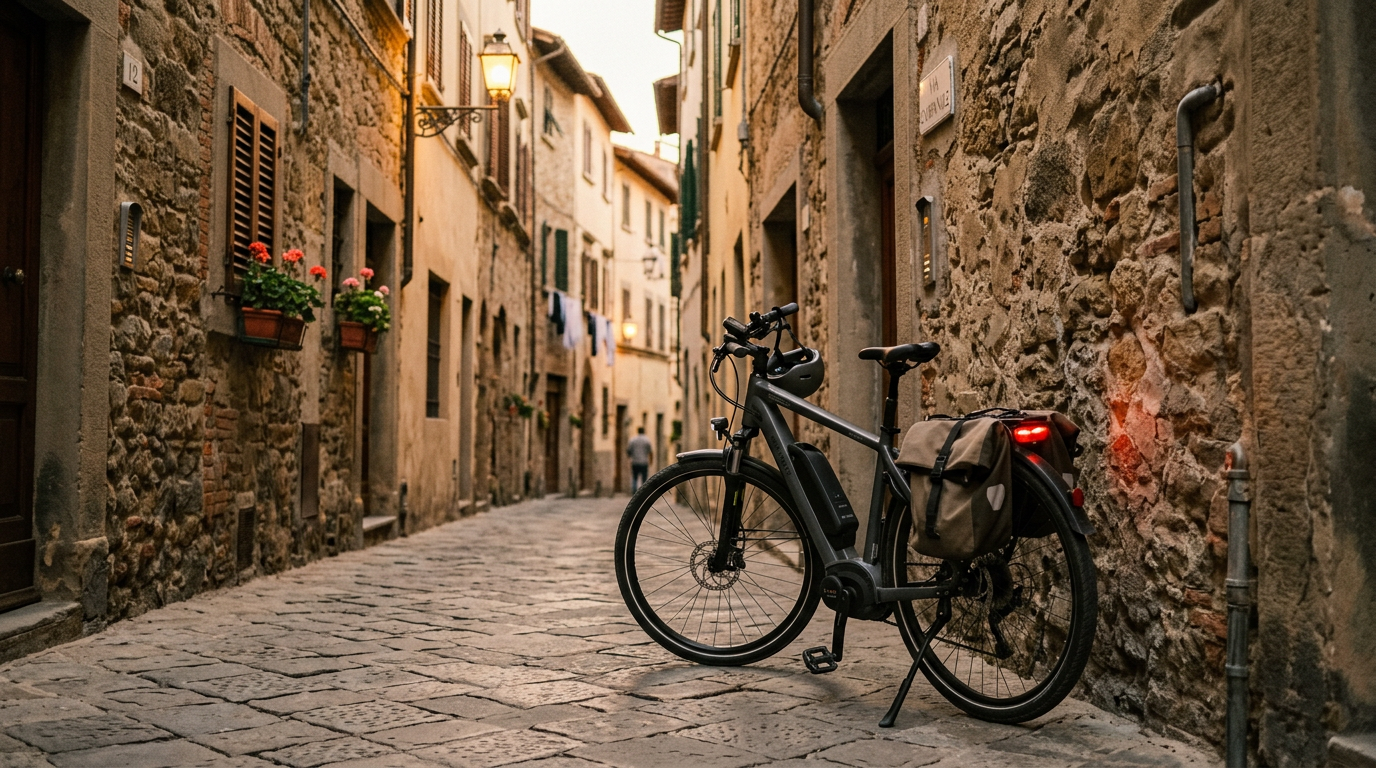
Florence Electric Bike Tour: Routes, Rentals and Practical Tips
Florence by e-bike: does it make sense
Florence is a compact city. The historic centre is roughly 3 km from east to west, and most major sights sit within a 20-minute walk of each other. So does renting an electric bike make sense.
The answer depends on what you want to do. If you plan to stay within the walled centre and visit museums, walking is perfectly adequate and often faster than dealing with bike parking.
But if you want to explore areas that are less covered on foot, like the hills above Fiesole, the Oltrarno hillside up to Piazzale Michelangelo, or the long stretch of the Cascine park, an e-bike changes the equation significantly. It removes the effort of the hills, extends your range beyond the centre, and lets you cover more ground without being exhausted by the heat.
Florence’s terrain is the key factor. The city centre is relatively flat along the river, but the hills begin abruptly at the city’s edges. The climb from the Arno to San Miniato al Monte, for example, is a 7% to 10% gradient over about 1.5 km. Manageable on an e-bike. Uncomfortable on a standard bicycle in August.
Where to rent and how much it costs
Several rental shops operate in Florence and the process is straightforward. You need a valid ID, a credit card for the deposit, and a brief explanation of how the electric assist works if you have not used one before.
Rental prices in 2025 and 2026 range from about 15 to 25 euros for a half day (4 hours) and 25 to 40 euros for a full day (8 hours). Some shops offer hourly rates starting at 5 to 7 euros per hour for the first hour.
Most rental shops are concentrated near the station and in the centre of the city. Look for shops on Via Nazionale, Via Alamanni (near Santa Maria Novella), and Via Ghibellina near Santa Croce. A few operate near Piazzale Michelangelo for riders who want to use the Arno riverside routes.
Guided e-bike tours with a group and a leader are also available. These typically cost 35 to 65 euros per person and last 3 to 4 hours. They can be useful if you want someone to explain what you are seeing, but they move at a group pace, which may feel slow if you prefer to linger or accelerate freely.
When renting independently, ask the shop specifically about which roads or areas are restricted to bikes. Parts of the historic centre are ZTL zones (Zona a Traffico Limitato) and while bicycles are generally not restricted in the same way as cars, some piazzas and pedestrian streets require you to dismount and walk.
Best flat routes
The flattest and most pleasant cycling route in Florence is the Lungarno, the road and path system that runs along both banks of the Arno. The full length of the city’s Lungarno routes covers about 8 to 10 km round trip.
Starting from the Ponte alle Grazie and cycling west along the south bank to the Cascine park takes about 25 minutes at a gentle pace. The route passes under the trees lining the river, crosses past Ponte Vecchio and Ponte Santa Trinita, and eventually arrives at the open parkland of the Cascine.
The north bank route from the station area to Ponte Vecchio is about 2 km. It is busier with traffic but the section near the Uffizi and Santa Croce has dedicated cycling infrastructure.
For a longer flat route, continue past the Cascine park into the western suburbs. The Parco delle Cascine itself has internal paths suitable for cycling, and you can loop around the park’s perimeter, roughly 5 km, without returning to main roads.
Another flat option: the road between the Piazzale Michelangelo parking area and the San Miniato al Monte church plateau is mostly flat once you reach that level. If you use the e-bike to climb the hill, the top rewards you with a 3 to 4 km road with good views and minimal traffic on weekday mornings.
The hills around Florence by e-bike
The hills surrounding Florence are where an e-bike genuinely earns its rental fee. The most accessible hill route for visitors is the climb from the south bank of the Arno up to Piazzale Michelangelo and then continuing to San Miniato al Monte.
The climb starts near Ponte San Niccolo. The gradient increases steadily over about 1.5 km. On an e-bike at full assist, you cover it in 8 to 12 minutes. On a standard bicycle in summer, the same climb takes 20 minutes and arrives hot.
From Piazzale Michelangelo, you can continue east along Viale Galileo Galilei toward the Forte di Belvedere and then down into the Boboli Garden area. This loop is about 5 km and stays mostly at elevation, giving you sustained views over the rooftops of the city.
For a longer hill excursion: the road to Fiesole climbs from the northern edge of the city through the Via Vecchia Fiesolana or Via Giovanni Boccaccio. The ascent is about 7 km with a total elevation gain of around 290 metres. On an e-bike this is a comfortable 30 to 40 minute ride. The views from Fiesole over the Arno valley and the city below are among the best in the region.
The descent back is where you need to be careful. Roads are narrow in places, and the gradient means you build speed quickly. Use the brakes progressively and be aware of cars coming uphill on blind bends.
Practical tips for the traffic
Florence’s traffic is chaotic by northern European standards and moderate by Italian standards. A few specific points are useful to know before you set off.
The ZTL zones in the historic centre are monitored by cameras. Bicycles are generally exempt from ZTL restrictions but the roads within the ZTL can be narrow, have cobblestones, and carry pedestrian traffic in both directions. Ride slowly through the centre and be prepared to stop frequently.
Cobblestones (selciato or sampietrini) cover many streets in the historic centre. They are manageable at walking speed but can be rough at cycling speed, especially on thinner tyres. Most e-bikes available for rent have tyres wide enough to handle them reasonably well.
Helmets: rental shops are legally required to offer them but not always required to enforce their use. Wearing one is sensible, especially on the hills.
The best time to cycle in Florence’s streets is between 07:00 and 09:00 before traffic builds, or after 19:30 when many cars have cleared the centre. Midday cycling in summer is possible but the heat is intense; carry at least 750 ml of water and plan to stop in the shade every 30 to 40 minutes.
Lock your bike whenever you leave it. Use the lock provided by the rental shop and attach it to a fixed object, not just to the bike itself.
Where to stay
The Key is located on Via Cittadella 22, approximately 5 minutes on foot from Santa Maria Novella station in Florence. Several e-bike rental shops operate within a 10-minute walk. The Lungarno riverside routes and the Cascine park are both easily reachable from this position.
The hill routes to Piazzale Michelangelo and San Miniato are roughly a 15-minute ride south from the guesthouse.