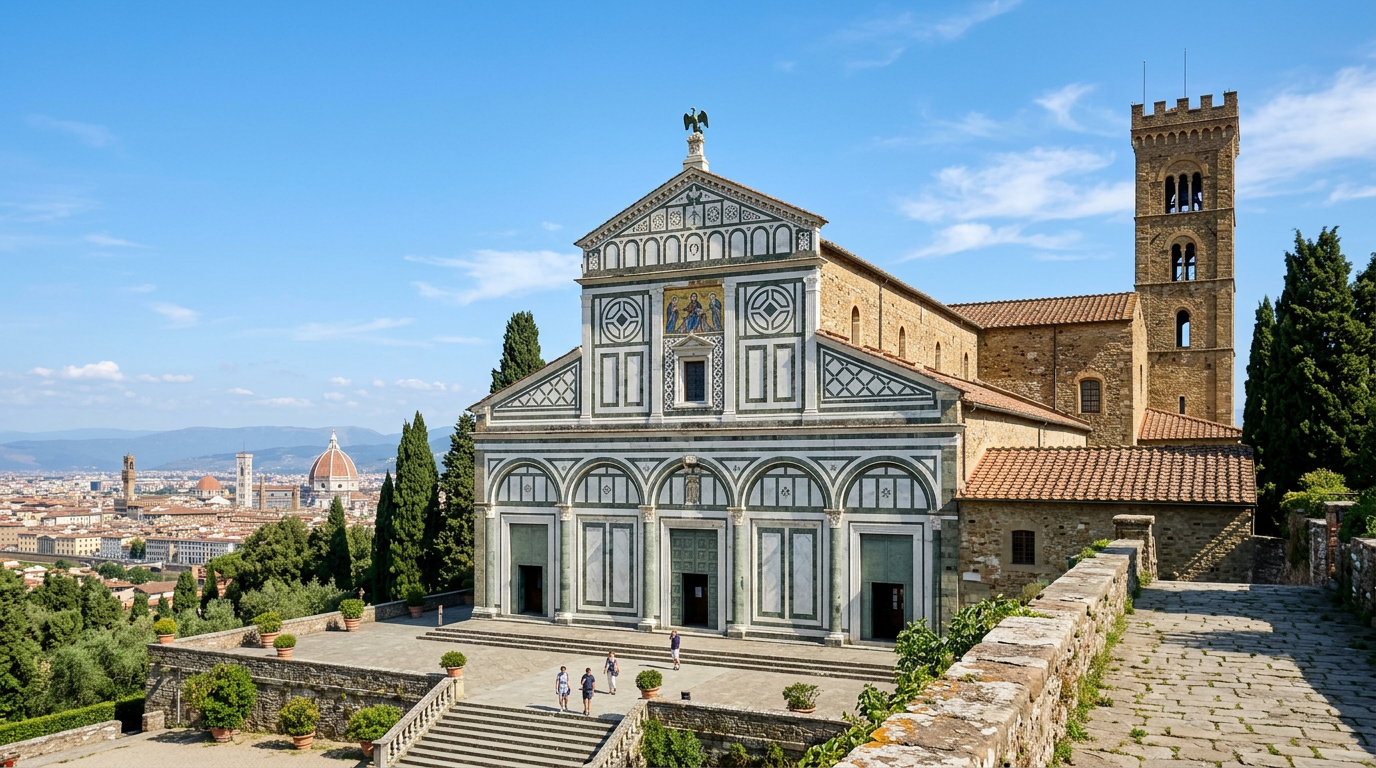
San Miniato al Monte Florence: Why It Is Worth the Climb
San Miniato al Monte: why it is worth the climb
San Miniato al Monte sits on the hill south of the Arno, roughly 100 metres above the city. Getting there requires a climb of about 20 minutes on foot from the river, or a shorter climb from Piazzale Michelangelo if you have already ascended by other means.
The effort is entirely worth it. San Miniato is not just one of the oldest and most beautiful churches in Florence; it is one of the finest Romanesque buildings in Italy, and its position above the city gives you a view that is among the most honest representations of what Florence actually looks like.
Unlike Piazzale Michelangelo, which faces directly west and gives you the famous panoramic view, San Miniato faces north and slightly west. The perspective is slightly higher and further east, which means you see more of the Arno valley to the east and a different relationship between the city’s hills and rooftops.
The history of the basilica
San Miniato was the first Christian martyr of Florence. According to tradition, he was a 3rd-century Christian of Armenian origin who was executed by the Roman authorities and whose head rolled to the hilltop site, where he then walked with it. The site became a place of pilgrimage.
A small oratory was built on the hill in the early Christian period. The current basilica was begun in 1018 under the patronage of Bishop Hildebrand of Florence and the Holy Roman Emperor Henry II. Construction continued through the 11th and 12th centuries. The monastery that accompanies the church was established in 1373 by the Olivetan order of Benedictine monks, who still occupy it today.
The building has remained in nearly continuous use since the 11th century. It has been repaired, restored, and maintained but never fundamentally altered in structure. This continuity of use and care is one reason it is so well preserved.
The Olivetan monks at San Miniato are worth acknowledging as living occupants rather than historical background. About 20 monks live and work in the monastery adjacent to the basilica. They maintain the church, run a small shop selling honey, liqueurs, and herbal products made on the premises, and sing Gregorian chant at daily vespers.
The mosaics and the crypt
The interior of San Miniato has three elements that deserve specific attention.
The first is the floor. The inlaid marble pavement was completed in 1207 and runs the length of the nave in geometric and zoological panels. The designs include stylised lions, doves, and signs of the zodiac, all inlaid in marble of different colours. It is in excellent condition for its age and is best appreciated by looking down frequently as you walk toward the altar, rather than keeping your eyes on the ceiling.
The second is the apse mosaic. At the far end of the nave, above the altar, a large semi-circular mosaic depicts Christ enthroned between the Virgin and Saint Miniato. It dates from 1297 and is one of the major examples of late medieval mosaic work in Florence. The gold ground and the formal symmetry of the composition are typical of Byzantine influence in Italian religious art of this period. The figures are static in the Byzantine manner, but the quality of the tesserae and the integration with the architecture are exceptional.
The third is the crypt. You descend to it from the nave via staircases on either side. The crypt dates from the 11th century and holds the remains of Saint Miniato. The columns are spoils from earlier Roman and early medieval structures: they are different heights, different materials, and were not designed together. This ad-hoc quality is characteristic of early medieval building and gives the crypt a density and texture that the nave, despite its perfection of proportion, does not quite match.
How to get there on foot from the centre
The most satisfying route to San Miniato on foot takes about 25 to 30 minutes from the south bank of the Arno at Ponte Vecchio.
From Ponte Vecchio, walk south through Piazza Santa Felicita and continue along Via dei Guicciardini, then turn left onto Costa San Giorgio. This climbs steeply for about 500 metres, passing the Forte di Belvedere on your right. At the top of Costa San Giorgio, turn left onto Via del Forte di San Giorgio and follow the signs south to San Miniato.
An alternative route via the steps: from the Ponte alle Grazie, walk south along Via dei Bardi and turn right onto Via dell’Erta Canina. This is a long staircase that climbs through the hillside gardens and joins the road to Piazzale Michelangelo about 200 metres below the basilica.
Bus 13 from the city centre stops at Piazzale Michelangelo, from which San Miniato is an additional 10-minute walk uphill along Viale Galileo Galilei. The bus runs from Lungarno Benvenuto Cellini approximately every 15 to 20 minutes.
By taxi or rideshare: the road to San Miniato passes Piazzale Michelangelo and continues to the church entrance. Journey time from Santa Maria Novella station is about 15 minutes. Cost by taxi is approximately 12 to 18 euros depending on traffic.
The view from the terrace: when to go
The terrace in front of San Miniato gives you a view over Florence that is different from but comparable to the view from Piazzale Michelangelo below. You are 30 to 40 metres higher, and slightly further east, which shifts the composition of the panorama.
Looking north, you see the Arno valley clearly, with the Ponte Vecchio and the other bridges strung across the river. The Duomo is visible but not as dominant as from Piazzale Michelangelo; it sits in the mid-ground rather than commanding the skyline. The hills to the north and east, including the Fiesole ridge, are more clearly visible from this height.
The best light for the view hits Florence from the west in the late afternoon. From around 16:00 to 18:00 in autumn and 18:00 to 20:00 in summer, the sun illuminates the terracotta rooftops and stone facades from the ideal angle. The terrace is significantly less crowded than Piazzale Michelangelo at all times of day.
For an ideal visit: arrive at 15:30 or 16:00, spend an hour inside the basilica including vespers at 17:30 (17:00 on Sundays), and then stand on the terrace for the late afternoon light. You will typically share the view with fewer than 20 other people.
Where to stay
The Key is at Via Cittadella 22, five minutes on foot from Santa Maria Novella station in Florence. Reaching San Miniato al Monte from the guesthouse involves a 25-minute walk to the Arno, then the hillside climb. Alternatively, bus 13 from near the Uffizi takes about 15 minutes to Piazzale Michelangelo, plus 10 minutes on foot to the basilica.