Ribollita in Florence: Where to Eat the Real Thing
Ribollita: what it really is
Ribollita is a Tuscan peasant soup made from stale bread, cannellini beans, black cabbage (cavolo nero), and vegetables. The name means “reboiled”: traditionally, it was the soup that was made in large quantities, allowed to sit overnight, and then brought back to the boil the following day. The reheating thickens it further and deepens the flavour.
The dish belongs to the cucina povera tradition of central Italy, the cooking of the poor, built on ingredients that were cheap, filling, and available through the winter. Black cabbage is a cold-weather crop that improves after the first frosts. Dried cannellini beans store well. Stale bread was never wasted.
Understanding what ribollita is made from, and why, helps you recognise a good version when you find one. A ribollita that is served thin, bright green, or without the bread-thickened density of a proper pot-cooked version is either not ribollita at all or is a significantly compromised approximation.
The difference between real ribollita and tourist versions
Florence has two broad categories of ribollita: the version made and eaten by people who have been cooking it their whole lives, and the version produced for tourists who expect Italian food to be beautiful and photogenic.
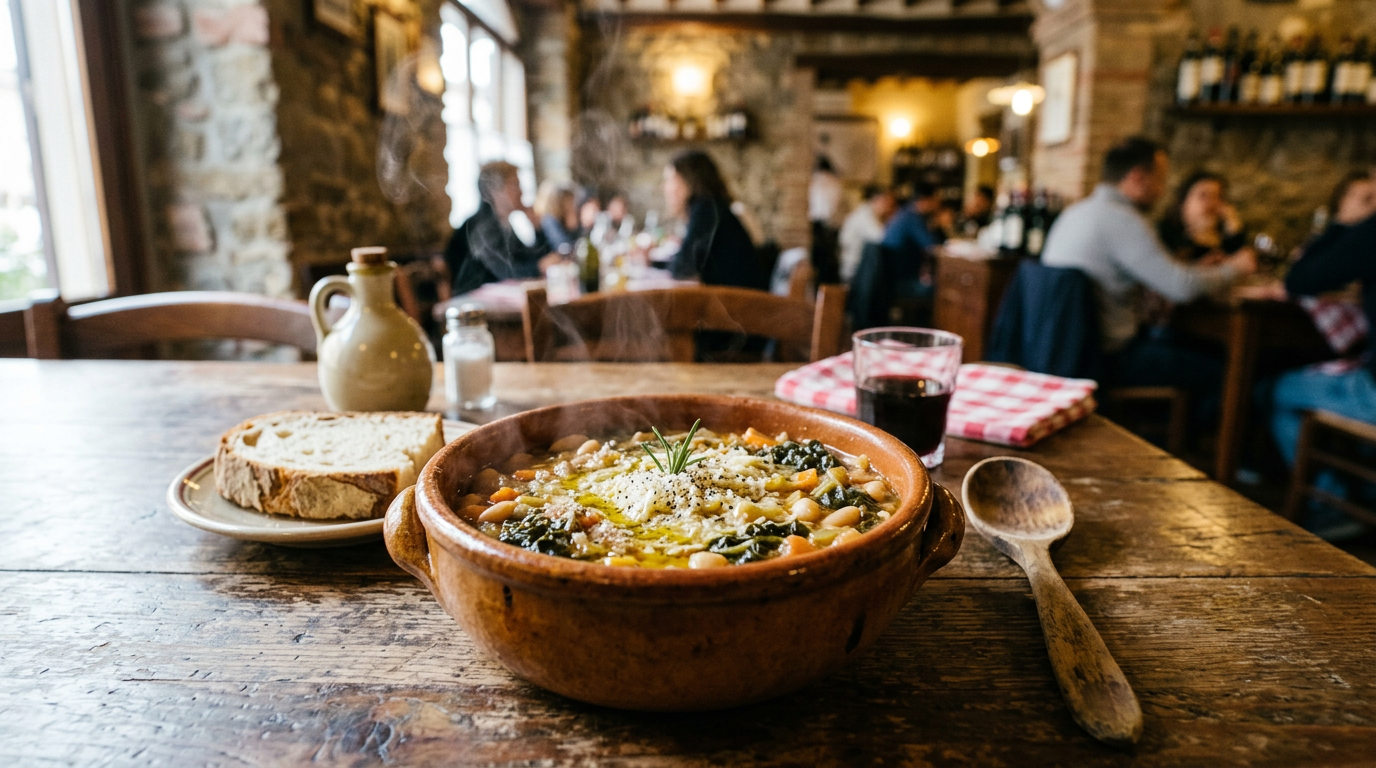
The genuine version is dark in colour, almost brown-green. The cavolo nero breaks down during long cooking and stains the broth. The bread absorbs the liquid and adds bulk. The consistency is closer to a thick porridge than a clear soup. It should arrive in a flat-bottomed earthenware bowl, not a deep soup bowl. It is served hot, with a drizzle of raw olive oil on top.
The tourist version tends to be lighter in colour, thinner, sometimes topped with a handful of fresh herbs for presentation, and served in whatever container the kitchen has available. It is usually made fresh the same day it is served rather than being reheated from the previous batch.
Neither version is dishonest in a moral sense, but if you want to taste what ribollita is supposed to be, you need to seek out the first type.
Clues that you are in the right place: the menu has ribollita only in autumn and winter, not in June. The soup is described as fatto in casa (house-made) with no other specifications. The restaurant is not directly on a major tourist route. The menu is short.
The trattorias where you eat the authentic dish
Finding a good ribollita in Florence requires going slightly off the main tourist routes. The following areas consistently have trattorias that produce honest versions.
The Sant’Ambrogio neighbourhood around Piazza Sant’Ambrogio and Via dei Macci has several small trattorias that operate primarily for locals. Many of these places run a daily changing menu that includes seasonal soups and stews. In October, November, and the winter months, ribollita appears regularly on the menu as a primo (first course).
The Oltrarno around Piazza del Carmine and Via dell’Orto has a similar density of unpretentious local trattorias. The neighbourhood is less touristy than the area immediately around Palazzo Pitti and Ponte Vecchio, and the restaurants price accordingly.
The San Lorenzo area away from the market stalls, particularly the streets between Via degli Alfani and Via San Zanobi, has a number of family-run places that have been serving the same traditional dishes for decades.
A practical approach: look for trattorias where the menu is handwritten or printed on a single sheet and changes daily or weekly. If the menu includes ribollita alongside pappardelle al cinghiale and bistecca alla fiorentina in the appropriate seasons, it is a working trattoria, not a tourist restaurant.
Expect to pay 8 to 12 euros for a bowl of ribollita as a first course at a trattoria. At a more upscale restaurant, it may cost 14 to 16 euros. If you see it priced at 18 euros or more and it is on a laminated multi-language menu, adjust your expectations accordingly.
The right season: autumn and winter
Ribollita is an autumn and winter dish. The ingredients define the season: cavolo nero is harvested from October onwards and is better after frost. Black cabbage grown in summer heat does not have the same bitterness and depth.
The best time to eat ribollita in Florence is from late October through February. November and December are particularly good months: the city is quieter than in summer, the restaurants that serve traditional cooking are fully operational, and the temperatures make a hot, dense soup genuinely welcome.
In summer, some restaurants continue to serve ribollita as a concession to tourists who expect to find Tuscan classics year-round. These versions are made with whatever greens are available in summer and are never as good. If you are visiting in August and see ribollita on the menu, it is worth asking when it was made and what cavolo nero was used.
Some Florentines make ribollita at home in large batches starting in October. They eat it over several days, reheating it each time. The version eaten on the third or fourth day, when the flavour has fully developed and the bread has completely dissolved, is considered better than the fresh-made version by most who have experienced both.
The original recipe in brief
Ribollita does not have a single canonical recipe. Every family in Tuscany has its own version, and serious cooks disagree on specifics. But the core elements are consistent.
Start with dried cannellini beans, soaked overnight and then cooked until tender. Prepare a soffritto of onion, celery, carrot, and garlic in olive oil. Add the beans, their cooking liquid, and a generous amount of cavolo nero torn into pieces. Add canned or fresh tomatoes. Simmer for at least one hour.
Add slices of stale Tuscan bread (pane sciocco, unsalted bread, is traditional) and continue cooking until the bread has absorbed most of the liquid and the soup has thickened. Season with salt and pepper.
The key step: let it cool, refrigerate overnight, and reheat the following day before serving. Finish with good raw extra-virgin olive oil poured directly over the top of the serving.
The olive oil matters. A flat, oxidised oil adds nothing. A young Tuscan extra-virgin oil, ideally from the current harvest (the new oil arrives in November and December), adds a grassy bitterness that balances the sweetness of the beans and the bitterness of the cabbage. Some trattorias keep a bottle of the current year’s oil on the table specifically for dishes like this.
Where to stay
The Key is at Via Cittadella 22, five minutes on foot from Santa Maria Novella station in Florence. The Sant’Ambrogio neighbourhood, where several of the best traditional trattorias operate, is about 25 minutes on foot through the historic centre.
In the colder months, coming back to the guesthouse neighbourhood after a ribollita dinner is a comfortable end to an evening.