Florence Porta Romana: What to See in This Quiet Neighbourhood
The Porta Romana neighbourhood
Porta Romana sits at the southern edge of the Oltrarno district, at the point where the medieval city walls ended and the road to Rome once began. Today it is a calm, residential neighbourhood with a character quite different from the tourist-heavy historic centre.
The area is centred on Piazza della Calza and the gate itself. Most visitors who come here are on their way to or from the Boboli Garden’s southern entrance, or are students from the nearby faculties of the University of Florence. Neither group stays long, which means the neighbourhood retains a working character that is increasingly rare in the centre of Florence.
The Porta Romana area is worth a half-day visit, especially if you want to experience a part of Florence that functions as a normal neighbourhood rather than an open-air museum.
The medieval gate: history and curiosities
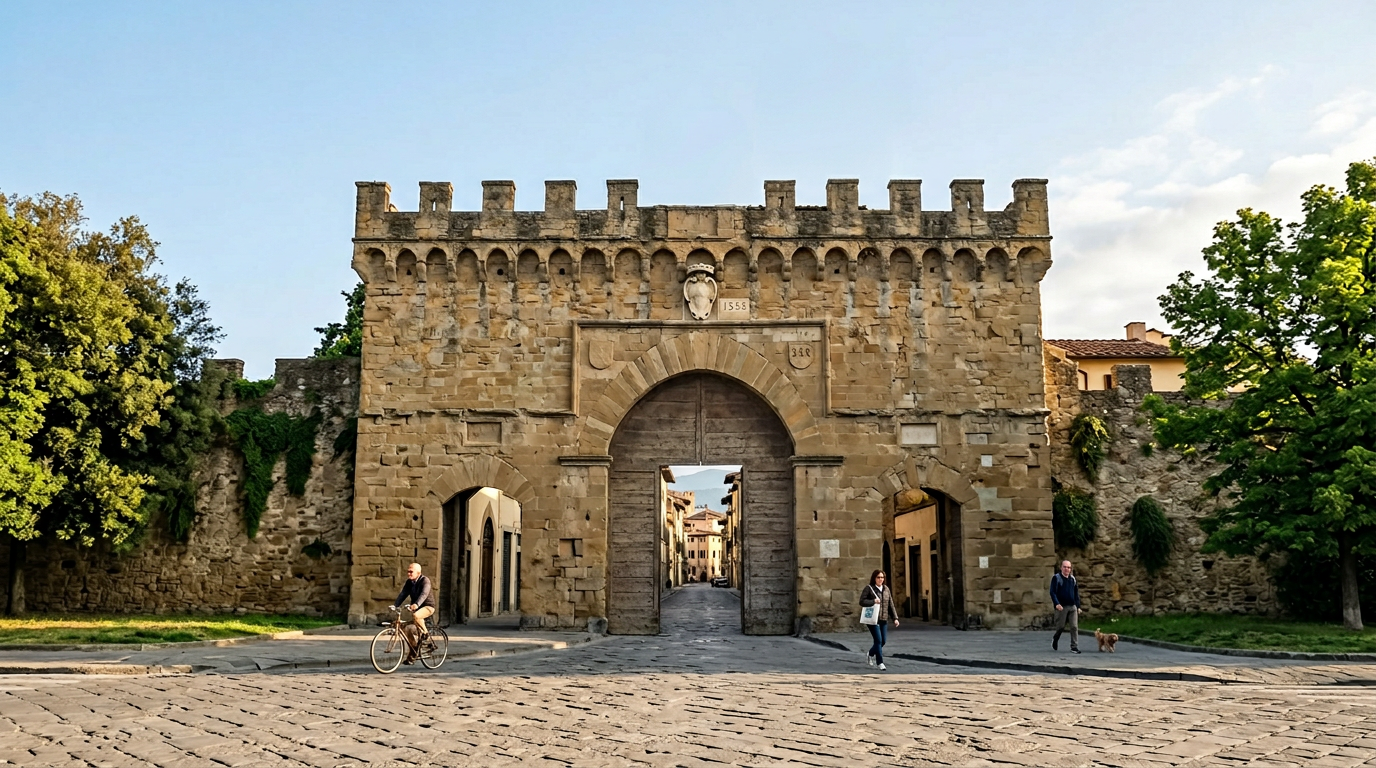
The Porta Romana is the only city gate in Florence that is still completely intact. Built between 1326 and 1328 as part of the expansion of the city walls under the Anjou rulers, the gate served as the main entrance to Florence from the road to Siena and Rome for several centuries.
The gate consists of two fortified towers flanking a central arch. Above the arch, on the inner face, there is a 14th-century fresco of the Madonna with Child that has survived, partially, despite centuries of exposure. The outer face of the arch still bears the original portcullis groove.
The gate is 13 metres high. When it was built, it was part of a continuous circuit of walls extending across the south of the city. Most of the wall circuit was demolished in the 19th century when Florence briefly served as the capital of Italy and the city was modernised. Porta Romana survived because the avenue leading to it, Viale del Poggio Imperiale, remained an important road.
You can pass through the gate freely; it sits on a functioning road. The best way to understand its scale is to stand on the south side and look north through the arch toward the city. The avenue of trees (Viale Niccolò Machiavelli) recedes toward the centre, and the gate frames the view.
The small church of Santa Maria della Calza, adjacent to the gate, contains a 15th-century fresco cycle by Franciabigio. It is not always open, but when it is, entry is free and it is nearly always empty.
The Boboli Garden from this entrance
The Boboli Garden is usually entered from the Palazzo Pitti side, which is the northern entrance and the most heavily trafficked. The southern entrance at Porta Romana is different: quieter, less crowded, and useful if you want to walk through the garden from south to north rather than turning around at the palace.
Entering from Porta Romana, you come in at the lower section of the garden, near the amphitheatre. The climb to the upper sections requires a 20 to 30 minute walk on gravel paths with moderate elevation gain. The route passes through cypress alleys, past several statuary groups, and eventually reaches the Kaffeehaus pavilion, which offers a view over the city from a terrace at garden level.
The Boboli Garden is open daily. Hours vary by season: 08:15 to 18:30 in autumn, later closing in summer. Entry costs 10 euros for adults, or is included in the combined Palazzo Pitti ticket at 22 euros. The Porta Romana entrance uses the same ticket.
One practical advantage of the Porta Romana entrance: it is noticeably less crowded than the Pitti entrance for most of the year. If you arrive at the Pitti entrance in summer after 10:00 and find a queue, walk 15 minutes south to this entrance and you will typically find no queue at all.
Local cafes and bars
The Porta Romana neighbourhood has several small bars and cafes that serve a local clientele. These are not tourist-facing establishments; they are places where university students, neighbourhood residents, and workers stop for coffee.
The area around Piazza della Calza and Via Romana has half a dozen small bars within a 5-minute walk. Prices here are close to standard Florentine rates: a standing espresso at the bar costs 1.20 to 1.50 euros. A cornetto costs around 1.20 euros. These prices are roughly 20 to 40 percent lower than the equivalent at a bar in front of the Uffizi.
Via Romana itself, which runs north from the gate toward Piazza Pitti, has a more mixed character. There are some tourist-facing restaurants, a few trattorias with daily lunch menus, and several alimentari and small food shops. For an inexpensive lunch near the Boboli Garden, this street is a reasonable option.
One specific note: the bars on Via Romana and Piazza della Calza tend to have outdoor seating available from about April through October. In the late afternoon, they attract a post-garden crowd of visitors and a post-university crowd of students. It is a relaxed setting for a coffee or a light aperitivo before heading back toward the centre.
How to get there from Oltrarno
Porta Romana is about 1.2 km south of Piazza Pitti, which is the heart of the Oltrarno neighbourhood. The walk takes about 15 minutes at a comfortable pace.
The most direct route from Piazza Pitti: walk south along Via Romana. The street runs straight to the gate, passing the entrance to the Boboli Garden on the right. The road is pedestrian-friendly in the morning but carries a moderate amount of traffic during the day.
An alternative route with more character: from Piazza Pitti, walk south along Via Toscanella, turn onto Via del Campuccio, and approach the gate from the east via Piazza della Calza. This route passes through quieter residential streets and gives you a better sense of the neighbourhood’s everyday texture.
From Santa Maria Novella station, bus 11 and bus 36/37 run south to the Porta Romana area. Journey time is about 15 to 20 minutes from the station. The stop is on Viale del Poggio Imperiale, just south of the gate.
For visitors staying in the historic centre north of the Arno, the walk from Santa Croce across the Ponte alle Grazie, then south through Oltrarno to the gate, takes about 35 to 40 minutes and passes some of the more interesting residential streets of the neighbourhood.
Where to stay
The Key is at Via Cittadella 22, five minutes on foot from Santa Maria Novella station. Reaching Porta Romana from the guesthouse by bus takes about 20 minutes via bus 11 or 36. Walking through the historic centre and Oltrarno takes about 35 to 40 minutes and gives you a complete cross-section of the city from the station to the medieval wall.