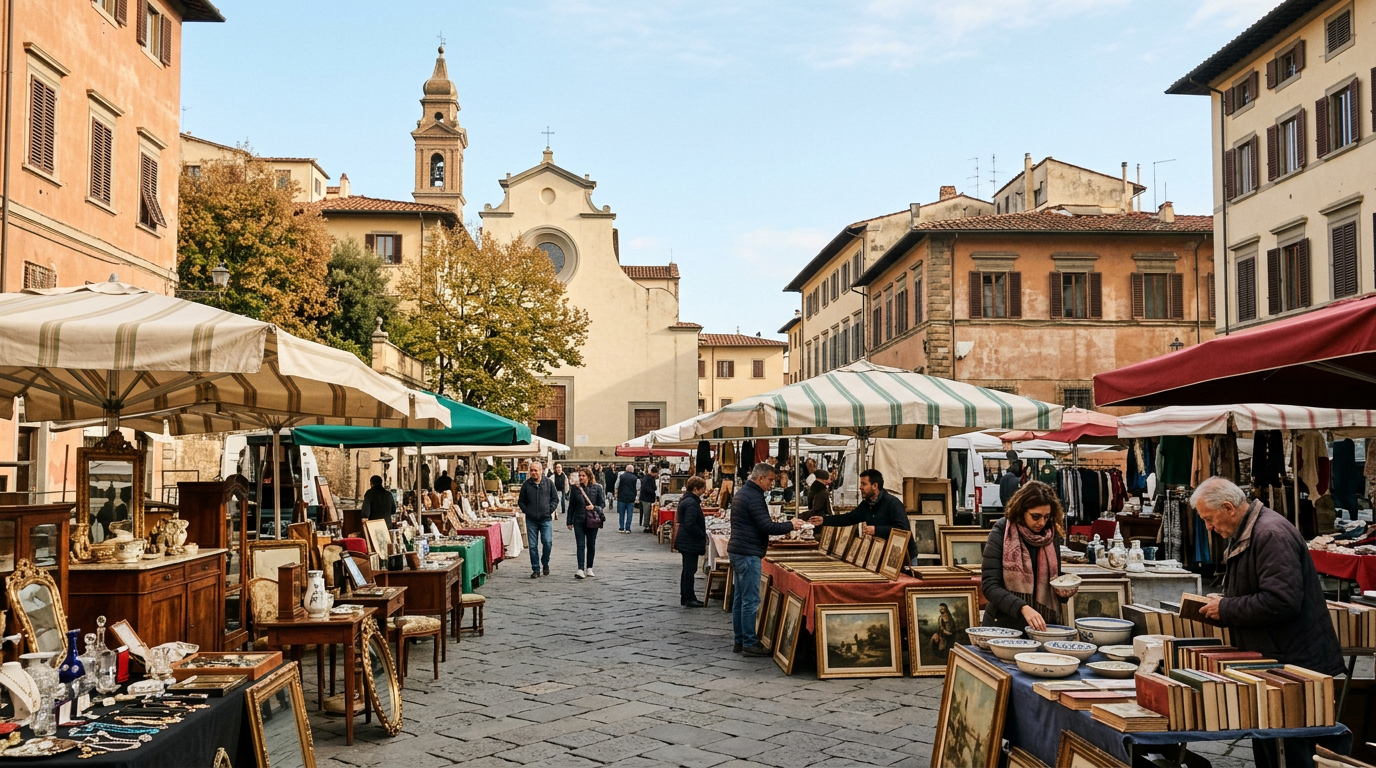
Florence Antique Market Sunday: Where to Find the Best Deals
Antique markets in Florence
Florence has a tradition of antique dealing that goes back centuries. The city’s role as a repository of Renaissance and baroque material culture means that objects of genuine historical interest surface in the market regularly, alongside the more typical range of 19th and 20th century furniture, prints, ceramics, glassware, and everyday objects.
The antique market scene in Florence is centred on two main locations. One operates year-round on a daily basis. The other runs on a monthly schedule that makes Sunday visits particularly relevant. There are also seasonal antique fairs, auction previews, and specialist dealers in the Oltrarno and the streets around Piazza Santa Croce.
This article covers the main Sunday options, what you are likely to find, and practical advice on prices and negotiation.
The Flea Market at Piazza dei Ciompi
The Piazza dei Ciompi is the primary location for everyday antique and second-hand dealing in Florence. The permanent market here operates daily (Monday to Saturday) with a set of established stalls on the south side of the piazza. These stalls carry a permanent stock of printed material, old photographs, postcards, ceramics, small furniture pieces, and miscellaneous objects.
On the last Sunday of each month, the market expands substantially. Additional dealers set up temporary stalls that fill the entire piazza and extend into the surrounding streets. This expanded market is the best opportunity in the city for browsing genuine antiques and second-hand goods in a single location.
The range of goods at the expanded Ciompi market covers: vintage clothing (1950s to 1980s), vinyl records at 3 to 10 euros per disc, old books and illustrated volumes, 19th and early 20th-century prints and lithographs, antique silverware, Florentine faience and majolica, old tools and hardware, military memorabilia, 20th-century furniture and lighting, and a general category of objects that defy classification.
The piazza is at Via Pietrapiana in the Sant’Ambrogio neighbourhood. From Santa Maria Novella station: take bus 14 toward Via Gioberti, or walk the full distance in about 25 minutes through the historic centre. Opening time on the expanded Sunday is approximately 09:00; most stalls are set up by 09:30.
The monthly market at Santo Spirito
The Piazza Santo Spirito antique and artisan market runs on the second Sunday of each month. The market occupies the piazza and is focused on antiques, vintage objects, and artisan crafts rather than general second-hand goods.
The character of the Santo Spirito market is slightly more curated than the Ciompi flea market. The dealers here tend to specialise in specific categories: antique furniture, vintage jewellery, ceramic and glass, printed maps and engravings, and artisan-made objects that are not strictly antique but are made using traditional methods.
Prices at the Santo Spirito market are generally slightly higher than at Ciompi, reflecting both the location and the curation. An antique print that might cost 8 euros at Ciompi could be 15 euros at Santo Spirito, but the Santo Spirito version may be in better condition and better presented.
The piazza is in the Oltrarno neighbourhood. From Santa Maria Novella station: walk south through the historic centre, cross the Ponte Vecchio, and continue through Oltrarno to Piazza Santo Spirito. The walk takes about 25 minutes. Alternatively, bus C3 runs from the centre to the Oltrarno.
Opening time is typically 09:00 to 19:00. The market is cancelled if there is significant rain; confirm on local listings or the Florence municipality website before making a special trip.
What you find and at what prices
Here is a practical breakdown of what to expect in terms of goods and pricing at Florence’s antique markets.
Prints and paper: black-and-white photographic prints from the early 20th century sell for 5 to 20 euros depending on subject and condition. Coloured lithographs from the 19th century: 15 to 60 euros. Antique maps of Florence or Tuscany: 20 to 120 euros depending on age and quality. Old postcards: 0.50 to 3 euros each.
Books: Italian-language books from before 1940 are common at 2 to 8 euros per volume. Illustrated volumes with engraving plates cost more, typically 15 to 50 euros. Books in English or other languages are less common but appear, especially at the Ciompi market.
Ceramics and glass: Florentine red clay ceramics (impruneta terracotta) and hand-painted majolica pieces range from 10 to 80 euros depending on age, condition, and decoration. Murano glass from the 20th century: 15 to 100 euros per piece. Ordinary 19th-century glassware: 3 to 15 euros.
Furniture: small pieces of 19th-century furniture (chairs, occasional tables, mirror frames) sell for 80 to 300 euros. Anything from the Renaissance or baroque period will be significantly more expensive and should be checked carefully for authenticity and restoration.
Vintage clothing: 1970s and 1980s clothing is common at 8 to 25 euros per piece. Better preserved 1950s and 1960s garments: 20 to 60 euros. Quality depends heavily on condition; vintage Italian clothing in excellent condition is worth the higher price.
Silverware and jewellery: antique silver at Italian markets is frequently hallmarked with the Italian silver marks (800 or 925 for sterling equivalents). Small pieces like spoons or sugar tongs: 10 to 30 euros. Brooches and earrings from the 1930s to 1960s: 15 to 60 euros. Always check hallmarks on silver.
Tips for bargaining
Bargaining at Italian antique markets is expected and practised, but there are norms that make it productive rather than confrontational.
Start with genuine interest. Dealers respond better to buyers who show actual interest in an object. Ask where it comes from, how old it is, what it was used for. This establishes a basis for conversation and signals that you are a serious buyer rather than someone testing prices for sport.
Make a reasonable offer. A standard opening offer is 20 to 30 percent below the asking price. Going below 50 percent of the asking price is generally read as insulting and usually ends the negotiation. If the asking price is 30 euros, an opening offer of 22 to 24 euros is reasonable. An offer of 10 euros is not.
Be prepared to pay. When a dealer accepts your offer or counter-offers at a price you accept, have cash ready. Most market stalls at Ciompi and Santo Spirito are cash-only. Bringing 80 to 100 euros in small denominations is a sensible preparation for any browsing session.
Buy in the morning. Dealers are generally more flexible on price in the first two hours of the market. In the early morning, before the market is fully established, some dealers will accept offers just to start their day with a transaction.
Know when to walk away. If a dealer will not move from their asking price on a piece you want, thank them, note the price, and continue browsing. If you return later in the day and the piece is still there, the dealer may be more flexible. If the piece is gone, you have useful information for future negotiations.
Where to stay
The Key is at Via Cittadella 22, five minutes on foot from Santa Maria Novella station in Florence. The Piazza dei Ciompi market is about 25 minutes on foot through the historic centre. Piazza Santo Spirito, for the second-Sunday monthly market, is about 25 minutes on foot through the centre and across the Arno.
Both markets are reachable without public transport from the guesthouse, which makes Sunday morning visits straightforward regardless of bus schedules.