Florence Medici History: Curiosities Beyond the Guidebooks
Who the Medici really were
The Medici are one of the most mythologised families in European history. They are associated with Renaissance art, banking power, papal influence, and the general idea of cultural patronage. But the standard presentation of the family often skips the contradictions.
The Medici were merchants who became bankers. They were bankers who became de facto rulers of a republic that officially had no rulers. They were patrons of the arts partly because they understood that beauty was a form of power: it communicated wealth, sophistication, and permanence.
The family rose from the wool trade in the late 13th century. By the early 15th century, the Medici bank was the largest in Europe, with branches in 16 cities including London, Bruges, Geneva, and Rome. The bank’s most important client was the papacy, and managing the Vatican’s finances gave the Medici leverage over popes, kings, and emperors.
They were not artists. They were not philosophers. They employed and supported artists and philosophers. The distinction matters. Understanding the Medici as strategic investors in cultural production, not just beneficent patrons, gives you a more honest picture of the Renaissance and how it was funded.
The Medici places not to miss
Florence has more Medici-related sites than most visitors realise. The major ones are well-known, but there are several that repay a closer look.
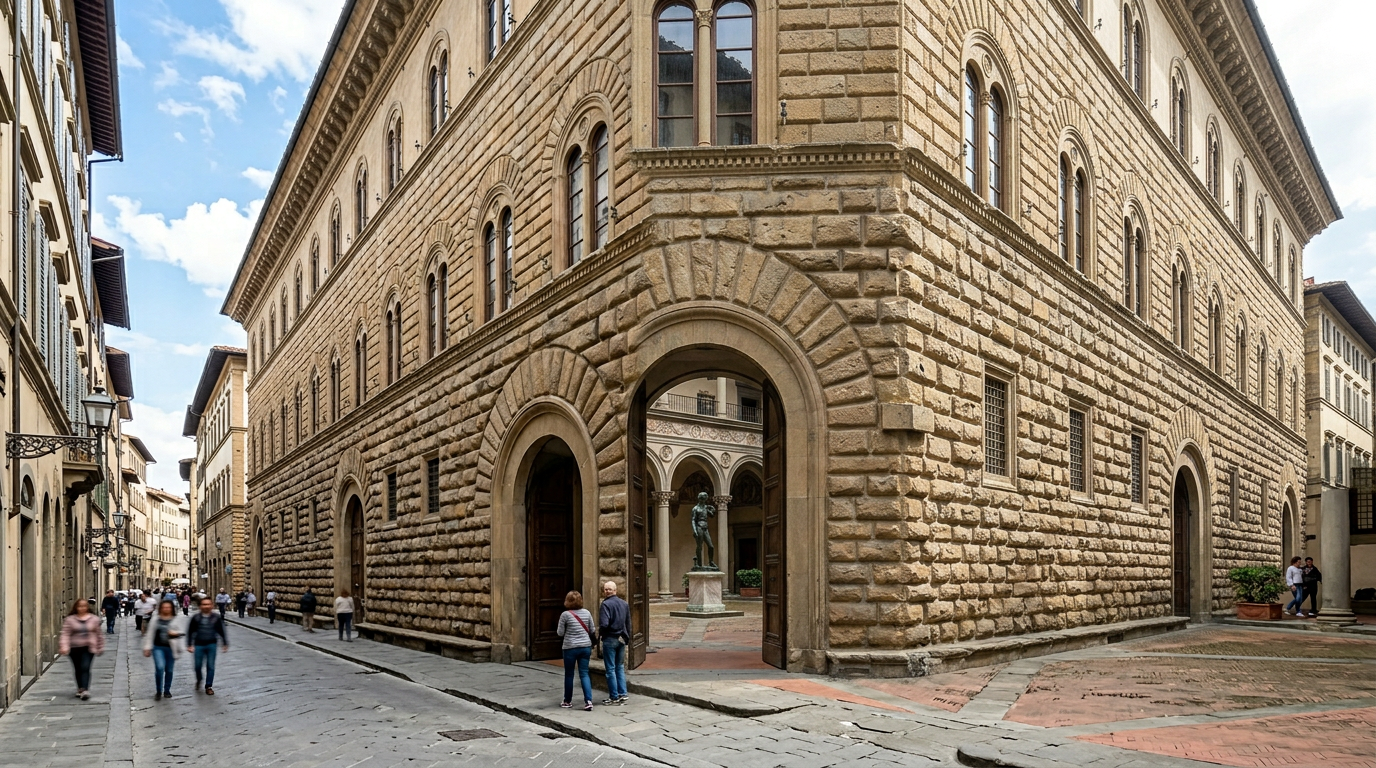
Palazzo Medici Riccardi at Via Cavour 3 is the best place to start. Built by Michelozzo for Cosimo the Elder from 1444, it was the family’s main residence in Florence for nearly 100 years. The Cappella dei Magi on the first floor contains a fresco cycle by Benozzo Gozzoli (1459 to 1461) depicting the Procession of the Magi. The faces in the procession are portraits of the Medici family and their associates. It is one of the finest examples of early Renaissance portraiture and is often overlooked because the chapel is small and requires a timed entry slot.
Entry to the palace is 7 euros. Open Monday to Wednesday and Friday to Sunday 09:00 to 19:00, closed Thursday.
The Uffizi Gallery was originally the administrative offices (uffici) of the Medici state, designed by Vasari in 1560 for Cosimo I. The building was converted into a public gallery in 1769 by the last Medici heir, Anna Maria Luisa. Without her bequest, stipulating that the collection could never leave Florence, the city would have lost its greatest art holdings.
San Lorenzo church and the Medici Chapels: the family’s parish church and mausoleum. The Sacrestia Nuova, designed by Michelangelo, contains the tombs of Lorenzo the Magnificent’s son and grandson. The figures of Day, Night, Dawn, and Dusk on these tombs are among the most intensely studied sculptures in the world. Entry to the chapels is 9 euros.
Cosimo the Elder and Lorenzo the Magnificent
These two men, separated by two generations, defined the Medici’s golden period.
Cosimo de’ Medici (1389 to 1464), known as Pater Patriae (Father of the Fatherland), was the architect of Medici dominance. He returned from exile in 1434 and spent the following 30 years consolidating the family’s position. He supported Donatello, funded Brunelleschi’s projects, and established the Platonic Academy in Florence, bringing Greek scholars who had fled Constantinople after 1453.
He operated carefully. He never held formal office consistently, but controlled the city through financial power, carefully maintained alliances, and a network of clients who owed him favours. He was also the first Medici to be buried in the crypt of San Lorenzo rather than the family plot in the Mugello hills, a deliberate statement about the family’s identity as Florentines.
Lorenzo de’ Medici (1449 to 1492), called Il Magnifico, is the Medici most people picture. He was a poet, a linguist, a collector, and a political operator of considerable skill. His court at Palazzo Medici employed Botticelli, Leonardo da Vinci (briefly), Poliziano, Pico della Mirandola, and other key figures of the late 15th-century Florentine intellectual scene.
But Lorenzo also presided over the beginning of the family’s financial decline. The Medici bank contracted significantly during his reign, partly through mismanagement and partly through political pressures. When he died in 1492, the business was already weakening.
The decline of a dynasty
After Lorenzo’s death, the Medici were expelled from Florence twice: in 1494 and again in 1527. Each time, they returned within a few years, backed by external military force.
The final Medici period began in 1530, when the family returned as hereditary dukes of Florence rather than as private citizens exercising influence behind the scenes. Cosimo I (1519 to 1574) transformed Florence from a republic into a proper principality. He expanded Tuscan territory, commissioned the Uffizi, extended the Palazzo Vecchio, and built the Corridoio Vasariano linking the palace to Palazzo Pitti.
But the dynasty was running out of heirs. The later Medici grand dukes produced fewer children and the family’s genetic line narrowed. The last male Medici ruler was Gian Gastone, who died in 1737 without legitimate heirs. His sister Anna Maria Luisa arranged the bequest of the entire Medici collection to the Tuscan state, on the condition that it remain in Florence permanently.
The Medici as a political dynasty effectively ended in 1737. What remained was the art.
Facts you will not find in guidebooks
A few details about the Medici that tend to be left out of standard tour narratives.
The Medici bank did not charge interest directly. Usury was forbidden by the Church. Instead, the bank used currency exchange transactions to earn what was effectively interest without calling it that. The papacy, their main client, knew this arrangement perfectly well and tacitly accepted it.
Lorenzo the Magnificent was not universally loved in Florence. In 1478, the Pazzi family, rivals of the Medici, attempted to assassinate both Lorenzo and his brother Giuliano during High Mass in the Duomo. Giuliano was stabbed 19 times and died. Lorenzo escaped. Lorenzo’s response was to execute the conspirators brutally and cement his control more firmly. He was merciful in some respects and ruthless in others.
Cosimo I, despite being an effective ruler, was also paranoid and capable of significant cruelty. He had his son Garcia executed after Garcia allegedly killed another of Cosimo’s sons in a dispute. Some historians doubt the story, but it reflects how the later Medici rulers managed family tensions.
The Medici villas in the countryside around Florence, at Poggio a Caiano, Artimino, and the Mugello, were not purely leisure residences. They served as agricultural estates, political retreats, and in some cases as quarantine facilities during plague outbreaks. Several are open to visitors today and see a fraction of the visitor numbers of the city centre sites.
Where to stay
The Key is at Via Cittadella 22, five minutes from Santa Maria Novella station. Palazzo Medici Riccardi is a 15-minute walk from the guesthouse. The Medici Chapels at San Lorenzo are about 12 minutes on foot through the centre.