Florence Legends and Stories: The City's Darker Side
The legends of Florence
Every old city accumulates stories. Some are documented in archives. Some are transmitted orally across generations and arrive in the present day with their origins obscure. Some are completely invented and have been repeated so many times that they have acquired the texture of fact.
Florence is particularly rich in this kind of layered narrative. The city’s long and turbulent history, involving warfare, political conspiracy, assassination, plague, flood, and periodic social upheaval, provides abundant raw material for stories that blur the line between record and legend.
This article covers both: stories that have a documented historical basis and stories that are genuinely legendary. It is worth knowing which is which, because that distinction tells you something about how Florence understands and projects its own identity.
The ghost of Palazzo Vecchio
The most commonly cited ghost in Florence is associated with Palazzo Vecchio. The story concerns a figure who is said to appear in the Salone dei Cinquecento, the enormous council hall commissioned by Savonarola and completed in 1495.
The spirit is described as that of a young man in Renaissance dress who appears near the walls and then disappears. Various explanations have been offered over the centuries. The most persistent attributes the presence to a political prisoner who died in the palace’s cells.
Palazzo Vecchio served as both seat of government and prison throughout the 14th and 15th centuries. Prisoners were held in the Alberghettino, a series of cells on the upper floors. Several notable figures were imprisoned and executed here, including Savonarola himself, who was burned in Piazza della Signoria in 1498 after being held in the palace.
The truth is that no systematic ghost sightings have been documented at the palace. But the building’s history of imprisonment, execution, and political violence over six centuries provides enough actual drama that the legend does not feel entirely invented.
Palazzo Vecchio is open Monday to Wednesday and Friday to Sunday 09:00 to 19:00, Thursday 09:00 to 14:00. Entry is 12.50 euros for adults.
The legend of the Vasari Corridor
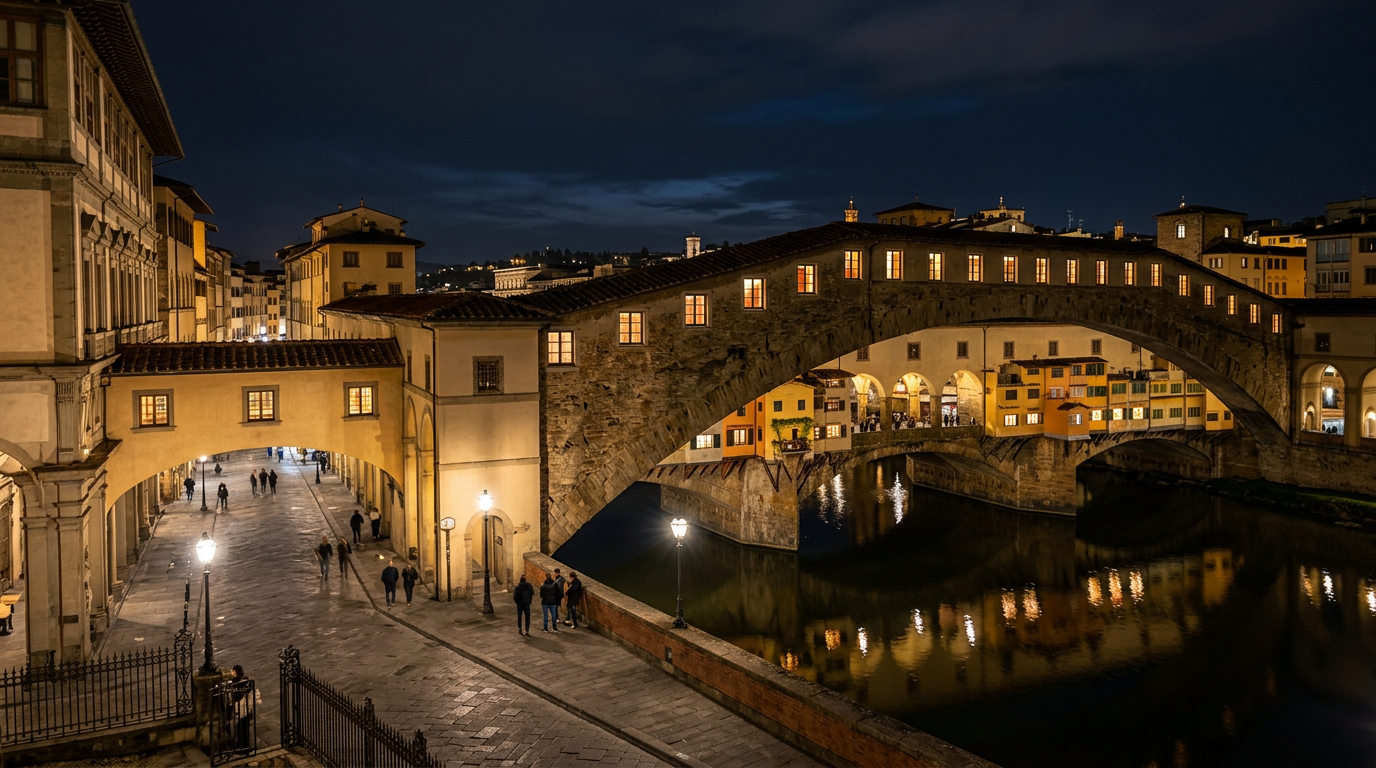
The Corridoio Vasariano is a 1-km elevated passageway built in 1565 connecting Palazzo Vecchio to Palazzo Pitti via the Ponte Vecchio. It was commissioned by Cosimo I de’ Medici so that the Grand Duke could move between his administrative offices and his private residence without descending to street level.
The practical reason is clear. What has accumulated around the corridor is a set of stories about what it was used for beyond its stated function.
One persistent story holds that the corridor was a means of escape in case of political crisis. It does pass through several buildings and could theoretically provide an exit route to the Oltrarno side of the river. Whether it was ever actually used as an escape route is not documented.
A more colourful story claims that the corridor was used for secret meetings, that it had listening posts from which the Medici could monitor conversations in the rooms below, and that its walls concealed hidden compartments. Some of this is plausible given the political paranoia of later Medici rulers. None of it is specifically documented.
What is documented: the corridor was used to move the Medici art collection between buildings. It was damaged in the 1944 bombing of the Ponte Santa Trinita and later in the 1993 Uffizi bombing. It now holds one of the world’s largest collections of artist self-portraits, with over 700 works spanning the 15th to 20th centuries.
The corridor reopened to limited public visits in 2021 after years of closure. Check the Uffizi website for current access conditions; entry is via a timed guided visit and costs approximately 30 to 35 euros including the Uffizi ticket.
The underground passages
Florence sits on geological layers that include medieval cellars, Roman-era drainage systems, and the remains of structures that predate the medieval city. Several areas of the historic centre have subterranean spaces beneath them that are partially accessible and partially sealed.
The area under the Piazza della Repubblica is particularly layered. The piazza was created in the late 19th century by demolishing the old Mercato Vecchio and the medieval ghetto. Before demolition, the area was photographed and partially documented. Excavations have revealed Roman-era structures beneath the medieval layers.
Santa Reparata, the early Christian cathedral that preceded the current Duomo, is visible beneath the present floor of the cathedral. Entry is included in the combined cathedral ticket, approximately 18 euros. You descend into a space that shows walls from the 4th to 12th centuries: different construction periods, different materials, laid one on top of the other.
The term “underground passages” as used in tourist legend often implies a network of connected tunnels beneath the city. The reality is more fragmented: individual cellars, cisterns, and foundation spaces from different periods, not generally accessible to the public and not connected into a continuous network.
That said, some guided tours offer access to specific underground spaces, particularly in the area around Santa Maria Novella and the Piazza della Repubblica. These are legitimate archaeological experiences and genuinely interesting if you have a particular interest in stratigraphy and urban history.
True stories that sound invented
Some of the most remarkable things about Florence’s history are not legends at all. They are documented events that are simply too extraordinary to seem real.
In 1494, after the Medici were expelled from Florence, a crowd entered Palazzo Medici and began carrying off its contents. The household furniture, tapestries, and portable art objects were removed and distributed or sold. This was an enormous collection assembled over 60 years. Most of it was dispersed in a matter of days. The pieces that survived, including the sculptures that Michelangelo had made while studying at the Medici household, did so largely by chance.
The Pazzi Conspiracy of 1478 was planned with extraordinary precision and almost succeeded. The conspirators arranged for the assassination to take place during High Mass in the Duomo on Easter Sunday. Two groups of assassins attacked Lorenzo and Giuliano simultaneously at the moment of the Elevation, when the congregation had their heads bowed. Giuliano was stabbed 19 times. Lorenzo, who was only cut on the shoulder, drew his sword and retreated with his companions into the sacristy, locking the heavy bronze doors. The conspirators had assumed both brothers would be killed and that the city would immediately rally behind the Pazzi. Instead, Florence rallied behind Lorenzo, and most of the conspirators were captured and executed within days.
The Florence flood of November 1966 reached a level of 6 metres above normal in the streets of the Oltrarno and damaged or destroyed approximately 14,000 works of art and 1.5 million books and manuscripts. The event mobilised a generation of art restorers, conservators, and volunteers from across the world. Many techniques of modern conservation were developed in response to the damage from this single flood. The water marks are still visible on several buildings near the Uffizi and Santa Croce at a height of roughly 2 metres above ground level.
Where to stay
The Key is located on Via Cittadella 22, about 5 minutes from Santa Maria Novella station in Florence. Palazzo Vecchio is about 20 minutes on foot through the historic centre. The flood water marks near Santa Croce are about 25 minutes on foot from the guesthouse.