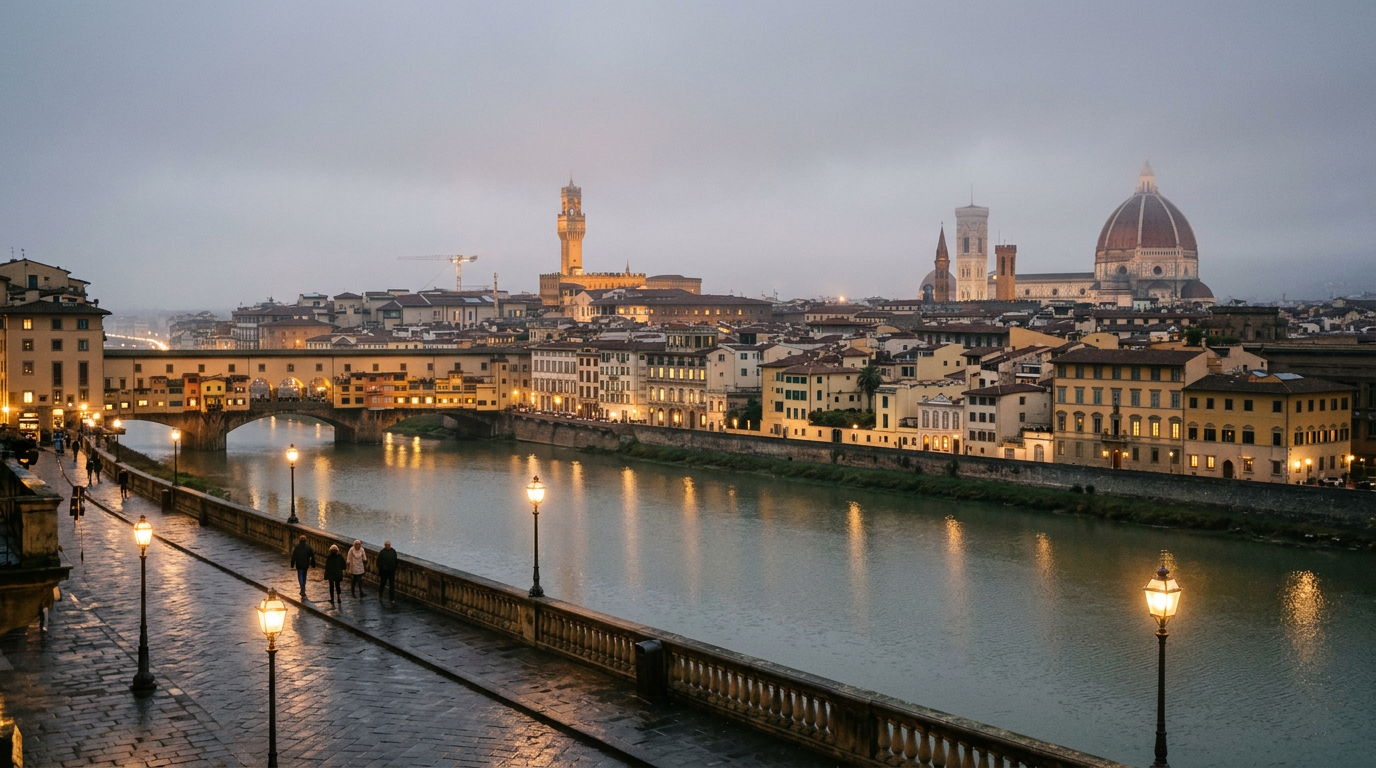
Florence in Winter: Why It Is Worth Visiting
Florence in winter is a different city from Florence in summer. The crowds are smaller, accommodation is cheaper, and the museums are more accessible. The trade-off is cold, grey days and occasional rain.
Whether that trade-off is worth it depends on what you are looking for. If museums and art matter more to you than outdoor piazza time, winter is arguably one of the best periods to visit.
Florence in winter: why it is worth it
The single biggest practical advantage of winter is museum access. In January and February, you can walk into the Uffizi without a booking and face a wait of 10-20 minutes at most. In July, the same walk without a booking means a 90-minute queue.
The Accademia, Bargello, Museo di San Marco, and Museo dell’Opera del Duomo are all significantly less crowded in winter. You can move through these spaces at your own pace, spend as long as you want in front of specific works, and have a completely different experience from the high-season visit.
Accommodation prices drop substantially from November through February, with the exception of the Christmas and New Year period (20 December-6 January). Outside those dates, prices can be 30-50% lower than peak summer rates.
The city is also quieter in a general sense. The streets are calmer, the restaurants are less rushed, and it is easier to find a table at a good trattoria without booking weeks ahead.
Museums without queues
November through February is consistently the low season for Florence museums. This is the best time to visit the major collections if your primary interest is art.
The Uffizi (Piazzale degli Uffizi 6, open Tuesday-Sunday 8:15-18:30, last entry 17:30) still requires booking at peak periods (Christmas, New Year) but is genuinely walk-in accessible during most winter weeks.
The Galleria dell’Accademia (Via Ricasoli 60, open Tuesday-Sunday 8:15-18:50) is similarly accessible. In January, it is possible to have the David hall nearly to yourself in the first 45 minutes after opening.
The Palazzo Pitti complex (Piazza de’ Pitti 1) has reduced winter hours for the Boboli Gardens (8:15-16:30, last entry 15:30) but the Galleria Palatina stays open and is worth the 16-euro entry.
The Museo di San Marco (Piazza San Marco 3, entry 4 euros) and the Cappelle Medicee (entry 9 euros) are both good winter choices. Small, focused, and almost always uncrowded.
November and December: what changes
November is the quietest full month in Florence. The summer events have ended, Christmas preparations have not yet started, and the weather is cool and sometimes rainy. Average temperatures in November: 6-15 degrees.
The upside is that you get the city at its most local. Florence in November is not staging itself for tourists. The Mercato Centrale, the Oltrarno streets, the bars around Piazza della Repubblica: these are all running at a local pace.
December changes the tone from mid-month. Florence puts up Christmas lights along Via dei Tornabuoni and Via della Vigna Nuova (usually from 8 December). The Piazza Santa Croce hosts the German Christmas market, Weihnachtsmarkt, which runs from late November to 24 December. It is one of the oldest in Italy and a legitimate event, not just a tourist attraction.
The weeks between Christmas and 6 January (Epiphany) see a return of crowds, particularly for the Uffizi and other major museums. Book ahead if your visit falls in this window.
The Florentine cold: how cold does it really get
Florence sits in the Arno valley, surrounded by hills. The topography traps cold air in winter and creates a humid chill that feels colder than the thermometer reading suggests.
The coldest months are January and February. Average temperatures: 2-10 degrees Celsius. Night frosts are possible, particularly in January.
Snow in Florence is rare but not unheard of. It falls on average once every two to three years in the centre, more frequently on the surrounding hills. When it does snow, the city is beautiful but transport is disrupted.
Wind is not usually a major factor in Florence, but the humidity makes a mid-range jacket feel insufficient. Layers work better than a single heavy coat. A waterproof outer layer is useful in November, December, and February when rain is most frequent.
What the cold does not affect: the museums, restaurants, and cafes. Florence operates normally throughout winter. There is no meaningful loss of indoor services.
What to do on rainy days
Rainy days in Florence are not a problem. They are simply days for museums and cafes.
The Uffizi can fill an entire rainy day if you want it to. The permanent collection alone covers more than 45 rooms across multiple floors. In winter, with fewer visitors, you can actually spend time with works rather than moving quickly to avoid bottlenecks.
The Museo dell’Opera del Duomo (Piazza del Duomo 9, open daily 9:00-19:00) is excellent in any weather. The display of Ghiberti’s original “Gates of Paradise” doors is inside a circular room designed specifically for them. The museum also holds Michelangelo’s Pieta Bandini and Donatello’s wooden Mary Magdalene. Entry is included in the 30-euro Duomo complex pass.
Florence has several good bookshops and the Biblioteca Nazionale Centrale (Piazza dei Cavalleggeri 1), which is the national library. Non-Italian readers may find limited browsing material, but the building itself is interesting.
The covered Mercato Centrale first floor (Via dell’Ariento, open daily until 24:00) is a genuine option for a rainy lunchtime. The food hall has about 20 stalls covering Florentine and Italian regional food. Prices are moderate and the space is comfortable.
Where to stay
In winter, a warm and central base matters more than in summer. The Key is at Via Cittadella 22, a 5-minute walk from Santa Maria Novella station, close to the Duomo and the main museums you will want to visit without losing time in cold and rain.