Florence Day Trip to Bologna by Train
Bologna is 35 minutes from Florence by high-speed train. That makes it one of the fastest and most accessible day trips from the city, and one of the most different: Bologna has a distinct character from Florence, with its medieval porticoes, market culture, and reputation as one of the best cities for food in Italy.
Whether it works as a day trip depends partly on how much you want to see. Bologna rewards a slow visit. But a well-planned day trip gives you a genuine experience of the city.
Bologna from Florence: 35 minutes by train
The Frecciarossa and Frecciabianca high-speed trains connect Florence Santa Maria Novella to Bologna Centrale in 35-37 minutes. This is one of the fastest inter-city connections in Italy.
Frequency: High-speed trains between Florence and Bologna run approximately every 30-60 minutes throughout the day, from around 6:00 to 22:00.
Prices: The price of a second-class high-speed ticket varies significantly depending on how far in advance you book.
Early booking (2-4 weeks ahead): approximately 9-15 euros each way. Last-minute (day of travel): approximately 20-35 euros each way.
Regional trains also connect Florence and Bologna via a slower route (1.5-2 hours) for approximately 9-12 euros without requiring booking, but the high-speed service is worth the price difference for a day trip.
Booking: Use the Trenitalia website, app, or the Italo platform (a competing operator that also runs trains on this route). Frecciarossa tickets require a seat reservation, which is included in the ticket price.
Bologna Centrale station is in the city centre. The historic centre of Bologna (Piazza Maggiore, the two towers, and the main markets) is a 15-minute walk from the station or a short bus ride.
What to see in Bologna in a day
Bologna is walkable. The historic centre covers about 2.5 km at its widest point. Most of the main sights are within a 1-km radius of Piazza Maggiore.
Piazza Maggiore and Piazza del Nettuno: The civic centre of Bologna. The Basilica di San Petronio (free entry, open 9:30-17:30) on the east side of the square is the fifth-largest church in the world by volume. The interior contains a sundial meridian line, a 16th-century sundial carved into the floor by Cassini. The Giovanni da Bologna bronze Neptune fountain in the adjacent piazza is one of the finest Renaissance bronzes in Italy.
The Two Towers (Le Due Torri): The Asinelli and Garisenda towers at the centre of medieval Bologna. The Asinelli Tower (entry 5 euros) can be climbed: 498 steps to the top, with panoramic views over the terracotta rooftops and the Apennines. The Garisenda tower leans more than Pisa’s but cannot be entered.
Piazza Santo Stefano: A triangular piazza with a complex of churches (the Basilica di Santo Stefano, composed of seven interconnected churches, entry free) and some of the best cafe seating in the city. Less visited than Piazza Maggiore and worth the 10-minute walk east.
The Mercato di Mezzo (Via Clavature, open daily 8:00-24:00): A covered food market in the centre of the old Jewish quarter, surrounded by speciality food shops. The centrepiece is the Mercato delle Erbe (Via Ugo Bassi 2, open Monday-Saturday 7:00-14:00, indoor and outdoor sections).
University quarter: Bologna’s university (founded in 1088, the oldest in the western world) is spread through the city but centred on the Via Zamboni area north of Piazza Maggiore. The Biblioteca dell’Archiginnasio (Piazza Galvani 1, open Monday-Friday 9:00-19:00, Saturday 9:00-14:00, free) is the former main building of the university and contains an anatomical theatre and spectacular painted ceiling.
The porticoes and Bolognese cuisine
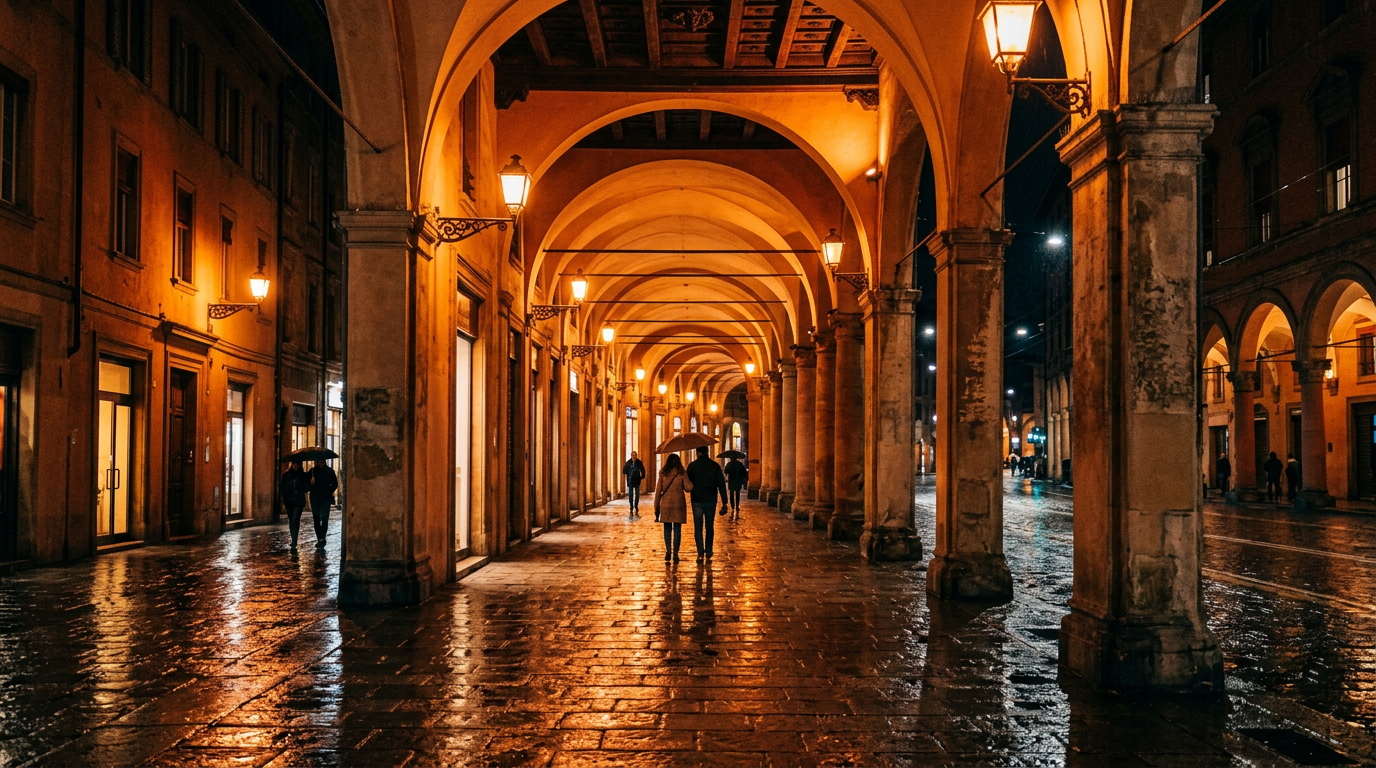
Bologna has approximately 40 km of porticoes (covered walkways) within the city. They are one of the most distinctive features of the urban landscape and have been designated a UNESCO World Heritage Site.
The porticoes mean you can walk across the entire historic centre without getting wet in the rain. They also mean most commercial life, including food shops, restaurants, and cafes, is accessible from a covered walkway.
The longest portico in the world runs from the city centre to the Sanctuary of the Madonna di San Luca on the hill above the city: 3.8 km, with 666 arches. The walk takes approximately 45 minutes each way and is worth it if you have the time.
Bolognese food is the reason many people visit Bologna. The city is the origin of tagliatelle al ragu (the authentic version of “Bolognese sauce”), tortellini (meat-filled pasta in broth), mortadella (the original, nothing like the supermarket version), and many other preparations.
For lunch, the area around Via Clavature, Vicolo Ranocchi, and Via Pescherie Vecchie has the best concentration of traditional food shops and small trattorias. A sit-down lunch with tagliatelle al ragu and a glass of local Pignoletto wine costs approximately 20-30 euros per person.
Mortadella from one of the salumerie (cured meat shops) near the Quadrilatero (the old market quarter) is an excellent, inexpensive lunch option, typically sold in sandwiches for 5-8 euros.
How to organise the day
07:30 Depart Florence Santa Maria Novella on high-speed train.
08:10 Arrive Bologna Centrale. Walk or take bus to Piazza Maggiore (15 minutes walk).
08:30-10:30 Piazza Maggiore, Basilica di San Petronio, Piazza del Nettuno.
10:30-11:30 Mercato di Mezzo and the Quadrilatero food market area.
11:30-12:30 Climb the Asinelli Tower (or walk to the Archiginnasio library).
13:00 Lunch in the Quadrilatero area.
14:30 Piazza Santo Stefano.
15:30 Walk along the porticoes of Via dell’Indipendenza or browse Via Zamboni (university area).
17:00 Return to Bologna Centrale.
17:30 or later High-speed train back to Florence.
This is a full day, not a rushed one.
Is it worth it as a day trip
Yes. Bologna is genuinely different from Florence and genuinely worth a visit.
The caveat is that the day trip requires booking your train tickets in advance to keep costs manageable. If you book the week before and pay 30 euros each way, the transport alone becomes expensive. Book at least 10-14 days ahead.
Bologna also rewards more than one day if you want to explore the surrounding region (the Apennines, Modena, Ferrara). But as a one-day introduction to one of Italy’s most distinctive cities, a day trip from Florence works well.
Where to stay
Florence is the logical base for a Bologna day trip given the train connection. The Key is at Via Cittadella 22, a 5-minute walk from Santa Maria Novella station, making the early-morning departure completely straightforward.