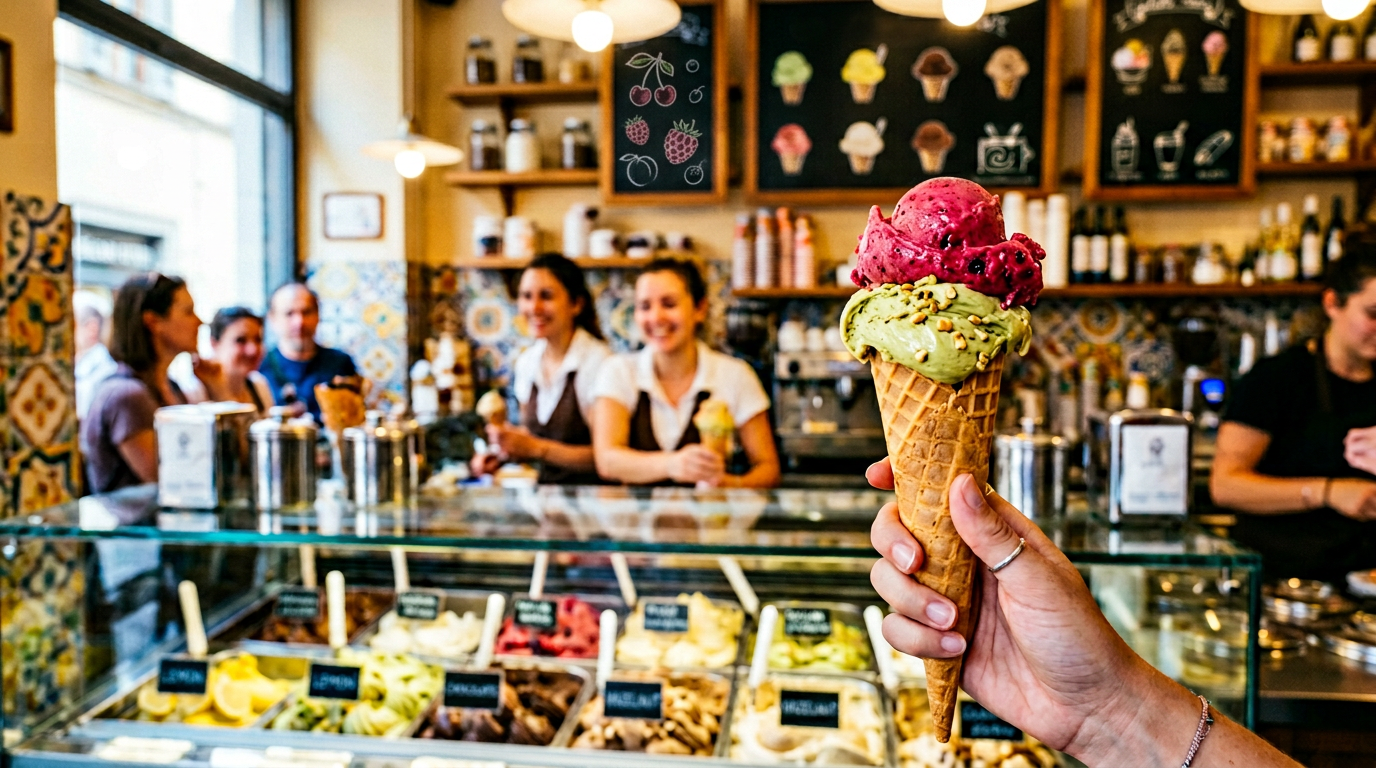
Best Artisan Gelato in Florence: How to Choose Well
How to recognise real artisan gelato
Most gelato sold in Florence is not artisan gelato. That is a blunt statement, but it is accurate. The city has hundreds of gelaterie, and a large number of them serve a product that comes from industrial bases, artificial colouring, and flavour concentrates mixed with water.
The problem is that industrial gelato often looks more impressive than artisan gelato. It is piled high in dramatic mounds, painted in vivid colours, decorated with wafers and fruit. It looks like gelato from a children’s book.
Real artisan gelato does not look like that. Here is what to observe.
The containers should be covered with metal lids or kept at a level surface, not piled high above the rim. Pistacchio should be grey-green, not bright green. Banana should be pale cream, not yellow. Hazelnut should be light brown, not orange-brown. Strawberry should be dusty pink, not red.
The texture of artisan gelato is denser and softer than industrial gelato. It melts faster because it contains less air. A small serving of 2 to 3 scoops at a quality gelateria typically costs 2.50 to 4 euros.
If the portion costs 6 euros and is piled into a cone the size of your forearm, it is almost certainly industrial. Artisan gelaterie charge fair prices because they use quality ingredients and have no reason to oversell volume.
The historic gelaterie of Florence
Florence has a small number of gelaterie with genuine long histories. These are worth knowing about, not just as tourist spots, but because their consistency over decades reflects something real about quality.
Gelateria dei Neri at Via dei Neri 9-11r has been operating since the 1980s and has a loyal local following. The flavours rotate with the seasons and the ricotta and fig combination in late summer is well regarded. It is close to Santa Croce and usually accessible without a long wait.
Gelateria Vivoli at Via dell’Isola delle Stinche 7 is one of the oldest gelaterie in the city, with records of the family business going back to 1929. It serves gelato in cups only, no cones, which is its long-standing policy. Prices are slightly higher than average, around 3.50 to 5 euros, but the quality is consistent.
Sbrino in the Sant’Ambrogio area and a few other newer locations follows traditional methods with a focus on fruit sorbets in summer. The watermelon sorbet is a reliable summer choice.
These gelaterie are not always easy to find if you are navigating by the most prominent signs on the street. Several of them are on side streets, not on the main tourist routes, and that is part of why they have maintained their standards.
New artisan gelaterie worth discovering
In the last 10 to 15 years, a wave of younger gelatieri has opened shops that treat gelato with the same seriousness that a good restaurant brings to cooking. These spots are worth the slight detour.
Gelateria Carapina at Piazza Oberdan 2 and a second location on Via Lambertesca uses milk from a single farm in the Sienese countryside and sources fruit regionally. Their pistachio is made from Bronte pistachios, which are grown near Etna in Sicily and are considered the best variety available. A cup or cone costs 2.50 to 4 euros.
Gelateria della Passera at Piazza della Passera 15 in Oltrarno is a small shop that changes its menu almost weekly. The owners focus on unusual combinations: lavender with honey, pear with cardamom, ricotta with orange zest. It is particularly good in autumn when the fruit flavours shift.
Gelateria Edoardo at Piazza del Duomo 45 deserves mention despite its prominent location. It is one of the few gelaterie directly on a major tourist piazza that maintains artisan standards. Prices are slightly higher here given the location, around 3 to 5 euros, but the quality justifies it.
Local flavours not to miss
Florence has a handful of gelato flavours that are either particular to the city or to Tuscany. These are the ones to try if you want to eat something genuinely regional.
Fiordilatte is the simplest flavour: fresh cow’s milk gelato with no added flavouring. It is the baseline test for a gelateria’s quality. If the fiordilatte tastes clean, slightly sweet, and genuinely milky, the other flavours are likely good too.
Cantucci gelato uses crumbled Tuscan almond biscuits as the mix-in. It is a local combination and you will not find it in the same form elsewhere. The best versions use proper cantuccini from Prato, which are harder and more almond-forward than generic biscotti.
Ricciarello flavour, based on the soft Sienese almond biscuit, appears in a few gelaterie around late autumn and winter. It is rarer and worth looking for.
Chestnut gelato appears in autumn, typically from October onwards. Chestnut flour and roasted chestnuts are a Tuscan staple, and the gelato version captures the earthy sweetness of the ingredient.
Vin Santo gelato, based on the Tuscan dessert wine, is made by a small number of gelaterie. It is not always sweet in the obvious sense; the wine brings some acidity and a faint nuttiness from the aging process.
Where to avoid tourist traps
The simplest rule is geographic: avoid gelaterie on the streets immediately adjacent to the Duomo, Piazza della Signoria, Ponte Vecchio, and the Uffizi. Almost without exception, the gelaterie in these exact locations serve industrial product at tourist prices.
The second rule is visual: if the gelato is piled above the rim of the container, walk on. Real artisan gelato is served flat or just slightly above the metal container edge.
A third rule: if the sign says “Artigianale” or “Artigiano” in very large letters on a bright banner, be skeptical. Quality gelato shops rarely need to shout about their methods. The product communicates itself.
Areas where you are much more likely to find genuine artisan gelato: Oltrarno, Sant’Ambrogio, Via dei Neri, the area around Piazza San Marco, and the quieter streets of the San Lorenzo neighbourhood away from the market stalls.
One practical note: artisan gelaterie often have shorter opening hours. Most open around 11:00 or 12:00 and close by 22:00 or 23:00 in summer. A few close on Mondays. Industrial tourist-facing shops stay open much longer because the product does not require the same daily preparation.
Where to stay
The Key sits at Via Cittadella 22, five minutes from Santa Maria Novella station in Florence. Several of the gelaterie mentioned in this article, including those in the Sant’Ambrogio area and Oltrarno, are reachable on foot in 20 to 30 minutes through the historic centre.
The neighbourhood around the guesthouse also has a few good neighbourhood gelaterie that serve a local clientele without the tourist centre premium.