Best Places to Photograph Florence: A Practical Guide
The best places to photograph Florence
Florence offers an extraordinary density of photographic subjects within a very small area. The skyline, the river, the medieval streets, the Renaissance facades, and the hills above the city all provide strong material for photographs at almost any time of day.
The challenge is not finding subjects. It is finding the moments and positions that are genuinely yours rather than exact copies of images you have already seen.
This guide covers the most rewarding locations and, crucially, the practical information that makes a photograph possible: when to arrive, what direction the light comes from, and which lesser-known alternatives exist for when the famous viewpoints are crowded.
Piazzale Michelangelo: when to go
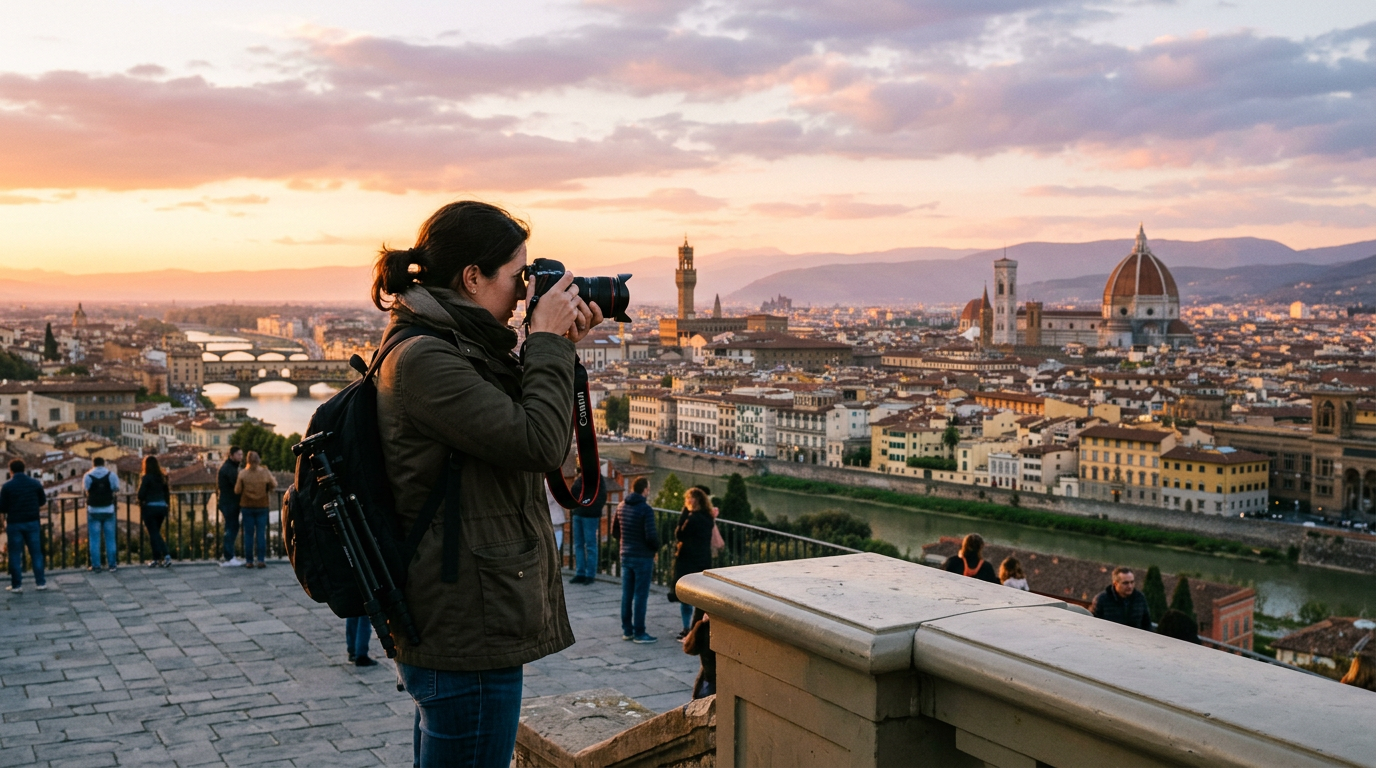
Piazzale Michelangelo is the most photographed viewpoint in Florence. The broad terrace at the top of the hill south of the Arno gives you a panoramic view over the entire historic city, with the cathedral dome, the tower of Palazzo Vecchio, and the Arno river all visible in a single frame.
The problem is that this viewpoint is always busy. At any time of day between 10:00 and 20:00 in the tourist season, you will be surrounded by other people trying to take the same photograph. The view is still worth it, but the experience depends on timing.
For photography specifically: the best light hits the city from the east and slightly south. In the morning (07:00 to 09:00), the light falls on the western faces of the cathedral and towers, which are not directly visible from Piazzale Michelangelo. In the late afternoon (17:00 to 19:00) the setting sun comes from the west and illuminates the historic centre from the direction you are looking, which is ideal.
The sunset and blue hour (the period 20 to 40 minutes after sunset) provide the most dramatic conditions. Arrive by 18:30 in summer to secure a position at the railing. The light changes fast and the window for the best sky colour lasts only 10 to 15 minutes.
To reach the piazzale: bus 13 runs from Lungarno Pecori Giraldi and takes about 10 minutes. The walk up from the Porta San Niccolo takes 15 to 20 minutes.
Views from above that few people know
Piazzale Michelangelo is the default viewpoint but it is not the only elevated position over Florence.
The terrace of the Bardini Garden at Costa San Giorgio offers a view that is slightly higher and more to the east than Piazzale Michelangelo. The perspective shifts enough to change the composition meaningfully: you see more of the Oltrarno neighbourhood directly below and a different relationship between the Ponte Vecchio and the hills. Entry to the Bardini Garden costs 10 euros (combined ticket with Boboli Garden available). It is open 08:15 to sunset, closed Mondays.
The tower of Palazzo Vecchio gives you a view from the centre of the city rather than from the periphery. Looking down at Piazza della Signoria from 94 metres up, with the terracotta rooftops of the historic centre spreading in every direction, is a completely different photographic experience from any of the hill viewpoints. Entry to the tower costs 12.50 euros and requires a timed booking in high season.
The Forte di Belvedere, a 16th-century fortification on the hill between the Boboli Garden and Piazzale Michelangelo, is open when it hosts exhibitions. The bastion at the top of the fort is one of the least crowded elevated viewpoints in the city. Entry price varies depending on the current exhibition; check current listings.
The terraces of the Uffizi on the second floor are accessible to museum visitors and offer a straight-on view of Palazzo Vecchio’s tower against the Florentine skyline. Free with museum entry.
The most photogenic streets
The streets of Florence’s historic centre are, at the right time of day, genuinely extraordinary to photograph. The key variable is light: the narrow medieval streets are deeply shaded for much of the day and then briefly illuminated when the sun reaches the right angle.
Via dei Tornabuoni is Florence’s most elegant street, lined with Renaissance palaces and high-end boutiques. It photographs well in the early morning when the shops are closed and the light falls on the stone facades at a low angle. After 10:00, the street fills with pedestrians and delivery traffic.
Borgo degli Albizi is a long straight street running east from Via del Proconsolo. The medieval tower houses and the uniform height of the buildings create a strong corridor effect. It photographs best in late afternoon when the sun comes from the west and travels the full length of the street.
Via dei Servi connects Piazza del Duomo to Piazza Santissima Annunziata. At its northern end, looking back toward the Duomo, you have a framed view of Brunelleschi’s dome at the end of a long straight street. This is one of the classic compositional shots in Florence photography, and it works best in the early morning before the street is full of people.
Piazza della Passera in Oltrarno is a small, quiet square that offers a contrast to the main tourist routes. The scale is domestic, the buildings are working Florentine residential architecture, and in the early morning it is almost completely empty.
Tips for the best light
Understanding the light in Florence depends on knowing the city’s orientation. The city runs roughly east to west along the Arno. The historic centre is on the north bank; Oltrarno on the south.
This means that in the morning, the south-facing facades on the north bank of the Arno receive direct light. The Lungarno buildings, the backs of the palaces along the riverfront, and the north side of the cathedral are all well lit from 07:00 to 10:00 in summer.
In the afternoon, the north-facing facades of the Oltrarno buildings and the south side of the cathedral receive direct light. The Ponte Vecchio lights up beautifully from the west in the late afternoon, roughly 17:00 to 19:00 in summer.
For interior photography in churches and museums: most interiors have very low, directional light from high windows. A camera that handles low light well (or a phone set to a higher ISO) is necessary for sharp results. Flash photography is prohibited in most Florentine museums and churches.
The golden hour in Florence in summer (July, August) runs approximately from 19:30 to 20:30. In September and October it shifts earlier to around 18:00 to 19:00 as the days shorten. These are the best times for outdoor photography in almost every location described here.
Where to stay
The Key is at Via Cittadella 22, five minutes on foot from Santa Maria Novella station. Via dei Tornabuoni is about 10 minutes on foot from the guesthouse. The Lungarno, ideal for morning and afternoon photography, is about 15 minutes on foot south through the centre.
For the hill viewpoints: tram T2 from the station to the city centre, then bus 13 to Piazzale Michelangelo, takes about 25 minutes total.