Dante in Florence: The Places Linked to His Life
Dante in Florence: where it all began
Dante Alighieri was born in Florence in 1265. He spent the first 35 years of his life in the city, was educated here, fell in love here, entered politics here, and was ultimately exiled from here in 1302. He never returned.
The Florence that shaped Dante no longer exists in a literal sense. Medieval buildings were demolished, streets were widened, and the neighbourhood where he grew up was largely rebuilt in the 19th century. But the geography survives. The hills, the river, the Baptistery, the church of Santa Croce, the general layout of the streets around what is now Via Dante Alighieri, all of this was recognisable to him.
Walking through this part of the historic centre with Dante in mind is a different experience from simply looking at buildings. You are moving through the landscape of the Commedia, at least in its origins.
Casa di Dante: is it worth visiting
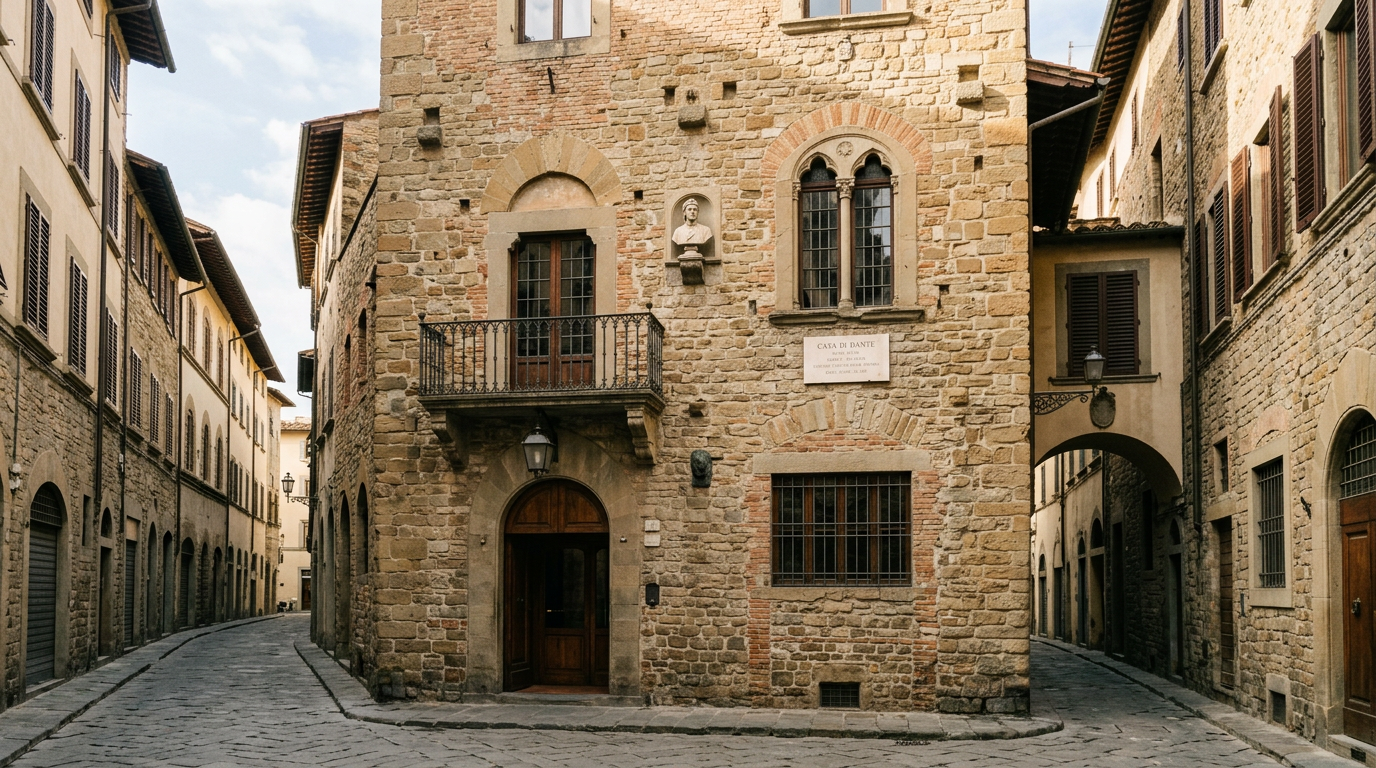
The Casa di Dante at Via Santa Margherita 1 is not Dante’s actual house. That needs to be said clearly. The building was constructed in the early 20th century on a site thought to be near the area where Dante’s family lived. It was built specifically to serve as a museum.
With that caveat, the museum is better than its premise might suggest. The permanent collection covers Dante’s Florence: the political conflicts between the Guelph and Ghibelline factions, the structure of medieval Florentine society, the geography of the city in the 13th century, and a substantial section devoted to the Commedia itself.
The museum is spread over several floors and takes about 45 to 60 minutes to visit properly. Entry costs around 4 euros for adults. It is open Tuesday to Sunday, 10:00 to 18:00. It closes on Mondays.
If you have read even part of the Commedia before your visit, the museum becomes considerably more interesting. If you have not, it provides a useful framework for understanding why the Commedia was so revolutionary in its time.
One detail worth noting: the small church of Santa Margherita dei Cerchi is immediately next to the museum. It is free to enter and takes 10 minutes. It is traditionally associated with Beatrice Portinari, the woman Dante loved and immortalised in his writing. The church is medieval in origin, and inside there is a small basket where visitors leave messages addressed to Beatrice. This has been happening spontaneously for decades.
The Baptistery: the place of his childhood
The Baptistery of San Giovanni on Piazza del Duomo was the religious centre of medieval Florence. Every Florentine child was baptised here. Dante was baptised here, and he refers to it in the Commedia as his “beautiful San Giovanni” (Inferno, Canto XIX).
The building is older than most people expect. The current structure dates mainly from the 11th and 12th centuries, though there are elements that may go back to late antiquity. The exterior is clad in alternating bands of white Carrara marble and dark green marble from Prato, a pattern that defines the visual identity of Romanesque Florence.
The interior is dominated by the mosaic ceiling, completed in the 13th century. It covers the entire octagonal dome and depicts biblical scenes, the life of John the Baptist, the life of Christ, and at the centre, an enormous figure of Christ in Judgement. Dante would have grown up knowing this ceiling intimately.
Entry costs 5 euros and is often included in combined museum tickets for the cathedral complex. The Baptistery is open Monday to Saturday 08:15 to 19:15, and Sunday 12:00 to 19:15. It tends to be less crowded in the morning before 10:00.
The famous bronze doors by Lorenzo Ghiberti face the cathedral and were completed between 1401 and 1452, well after Dante’s death. But the earlier south doors by Andrea Pisano, completed in 1336, date from within living memory of the poet.
Santa Croce: the tomb and cenotaph
Dante died in Ravenna in 1321, at the age of 56, while serving as a diplomatic envoy for the lord of Ravenna. He is buried there. Ravenna has always refused Florence’s requests to return the remains, and at this point there is no realistic prospect of the situation changing.
Florence built a cenotaph instead. The monument inside the Basilica of Santa Croce, designed by Stefano Ricci and completed in 1829, is an elaborate marble tomb with allegorical figures. It sits in the main nave, along the right wall, among the actual tombs of Michelangelo, Galileo, Machiavelli, and Ghiberti.
The cenotaph is worth seeing, but it is important to understand what you are looking at. It is a monument to absence: to the fact that Florence exiled its greatest writer and never reconciled with him in his lifetime.
Santa Croce is open Monday to Saturday 09:30 to 17:30, Sunday 12:30 to 17:30. Entry costs 8 euros for adults. The Pazzi Chapel in the cloister, designed by Brunelleschi, is included in the ticket.
A Dante trail through the historic centre
You can walk through the core of medieval Florence, the area where Dante lived, in about 90 minutes. The route covers about 2.5 km.
Start at the Baptistery on Piazza del Duomo. Spend 20 to 30 minutes inside, then stand outside and look at the relationship between the Baptistery and the cathedral. Dante’s Florence did not yet have the cathedral as we see it today; construction began in 1296, when Dante was 31. The new building was rising around him.
From the Baptistery, walk south down Via dello Studio and turn left onto Via del Proconsolo. This street was part of the medieval civic core. The Bargello, now Florence’s sculpture museum, was built in 1255 as the city’s first public building, serving as a seat of government and later as a prison. Entry is 10 euros.
Continue south to Via Dante Alighieri, which runs alongside the approximate area of his family neighbourhood. The Casa di Dante museum is here. Walk through the narrow streets to Santa Margherita dei Cerchi.
From here, continue south toward Piazza Santa Croce. The basilica and the cenotaph are the final stop on the trail.
This route passes through one of the most intact sections of the medieval street plan. The buildings are largely from the 13th to 15th centuries, and the scale of the streets gives you a reasonable sense of the density and character of the city Dante knew.
Where to stay
The Key is situated at Via Cittadella 22, five minutes on foot from Santa Maria Novella station. The medieval quarter around Via Dante Alighieri is about 20 minutes on foot through the centre from the guesthouse. Santa Croce is roughly 25 minutes on foot, or a short bus ride on line C2.