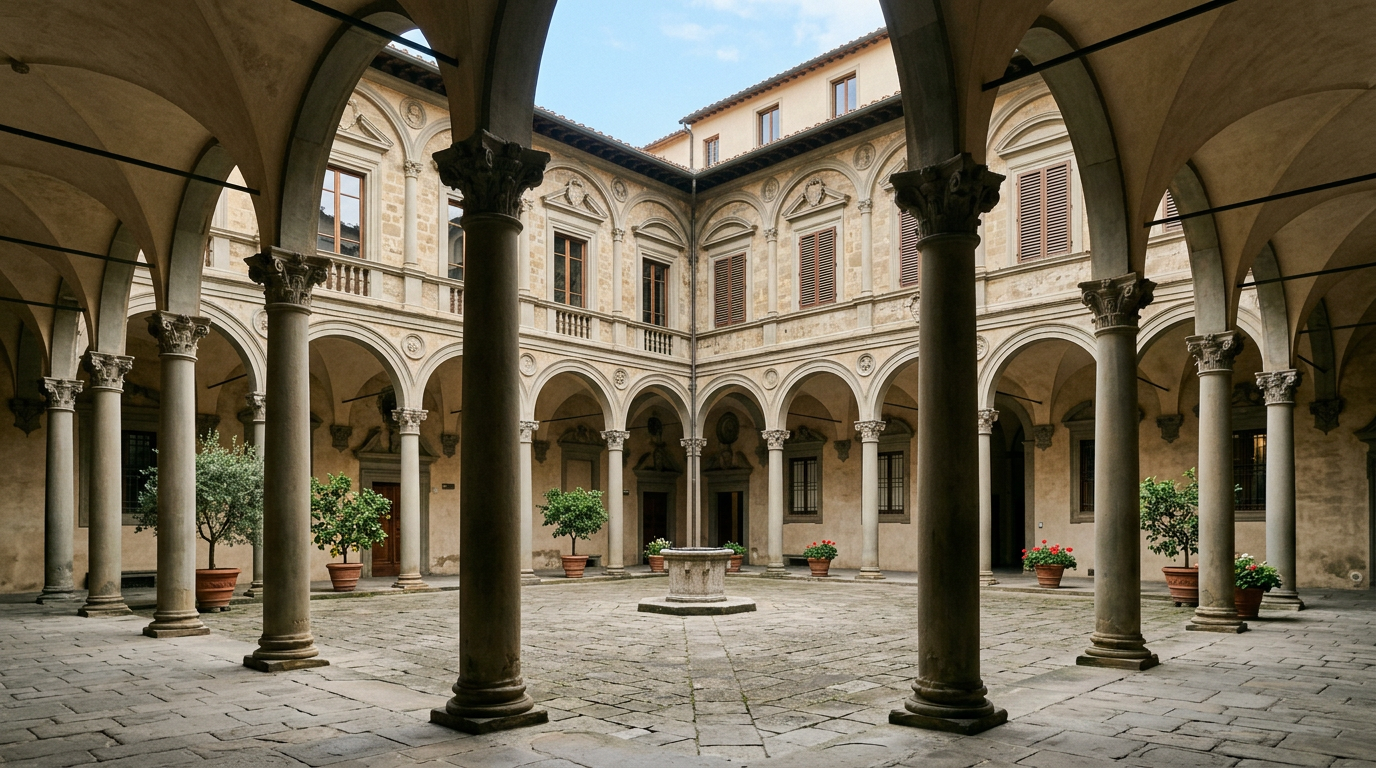
Florence Secret Palace Courtyards: How to Find Them
The hidden courtyards of Florence
Florence’s palaces face the street with closed facades. Heavy stone walls, small windows, and solid wooden doors give nothing away. The wealth and beauty that the family wanted to demonstrate was contained within, not displayed outward to the street.
Behind those facades lie courtyards. Some are intimate, some are monumental, some have gardens, some have wells, some have ancient sculpture. Many are accessible to anyone who simply walks through an open door.
This is one of the quiet pleasures of walking in Florence: the discovery that a door you almost walked past leads to a space completely unlike the street outside. These are not tourist attractions in the formal sense. They do not appear on most itineraries. Some are completely free to enter.
How to enter the historic palaces
Many of the grand palaces on Via dei Servi, Via dei Tornabuoni, Via Maggio, and Via dei Bardi have ground floors that are occupied by offices, notaries, law firms, or cultural institutions. Where there is a functioning ground floor, the street-level door is usually open during business hours: typically 09:00 to 13:00 and 15:00 to 19:00 on weekdays.
Walking through a half-open door into a courtyard is not trespassing in most cases. It is consistent with the Italian cultural norm that public spaces within buildings are accessible as long as you behave appropriately. This means moving quietly, not opening further doors without an invitation, not photographing people without permission, and leaving if anyone indicates that the space is not publicly accessible at that moment.
The most productive time to explore courtyards is mid-morning on weekdays, when ground-floor offices are open and the street doors are ajar. Saturday mornings work for some palaces. Sunday and after-hours visits are rarely possible unless the building is explicitly open as a museum.
The most beautiful courtyards in the centre
The courtyard of Palazzo Strozzi at Piazza degli Strozzi is the largest Renaissance palace courtyard in Florence. The building was begun in 1489 by Filippo Strozzi the Elder, a banker who intended to surpass the Medici with his commission. The courtyard is open because Palazzo Strozzi now operates as a major exhibition space. You can enter the ground floor and the courtyard freely even if you do not attend the current exhibition. The proportions of the courtyard, three floors of loggias surrounding a central space, are among the finest examples of late 15th-century palace architecture.
The courtyard of Palazzo della Gherardesca on Borgo Pinti is less accessible but visible from the street through the gate. It contains a formal garden with ancient trees and a Baroque fountain. The building is now a hotel, and guests can access the garden. From the street, the gate allows at least a partial view.
The Palazzo di Bianca Cappello at Via Maggio 26 has a courtyard behind its famous 16th-century facade decorated with sgraffito work. The building has housed various offices over the years; check whether the door is open when you pass.
The courtyard of the Bargello at Via del Proconsolo 4 is accessible with museum entry (10 euros). The courtyard is the former execution ground of the city’s prison, and the walls still bear painted coats of arms of former administrators. Donatello’s bronzes are in the first-floor loggia, which opens directly onto the courtyard.
The Chiostro dei Morti (Cloister of the Dead) at the Basilica della Santissima Annunziata off Piazza Santissima Annunziata is free to access and often overlooked. Enter through the loggia of the church, turn left, and find the small cloister that served as the burial ground for notable Florentines from the 15th century onward. The Mannerist frescoes in the cloister lunettes are by Andrea del Sarto and others.
Palazzo Medici Riccardi: the most famous courtyard
The courtyard of Palazzo Medici Riccardi at Via Cavour 3 is the most architecturally significant in the city. Designed by Michelozzo for Cosimo de’ Medici from 1444, it established the template for the Renaissance palace courtyard: a square space surrounded by arcades at ground level, with the upper floors set back above the arcade cornice.
The proportions are studied: the height of the arcade columns, the diameter of the arches, and the height of the upper floors are all in ratios that produce a sense of order without rigidity. The capitals of the columns are classically derived but not copies; they are new inventions working within a classical vocabulary.
In the courtyard you will see roundels in the spandrels of the arches, decorative tondi with cameo-like figures attributed to Bertoldo di Giovanni. These reference classical Roman medallions and signal the humanist program behind the building: this was a house designed to communicate the owner’s identification with ancient Rome.
Entry to the palace is 7 euros. The courtyard alone can sometimes be seen from the entrance without paying, but the main interest, the Cappella dei Magi with Benozzo Gozzoli’s frescoes, requires the ticket. The palace is open Monday to Wednesday and Friday to Sunday, 09:00 to 19:00.
When the courtyards are open to the public
Access to most Florentine courtyards follows a few general patterns.
Museum buildings (Bargello, Palazzo Vecchio, Palazzo Medici Riccardi): accessible with the relevant admission ticket during official opening hours.
Active office buildings (many palaces on Via dei Servi, Via dei Tornabuoni, Borgo degli Albizi): accessible when the ground floor is occupied and the street door is open. Weekday business hours, typically 09:00 to 13:00 and 15:00 to 19:00.
FAI open days: the Fondo per l’Ambiente Italiano organises open-house weekends twice a year, in spring (usually March) and autumn (usually October). On these days, private palaces and normally inaccessible courtyards are opened to the public. Check fondoambiente.it for the current schedule.
Cultural institutions: several palaces house academies, foundations, or cultural institutes that organise visits and events. The British Institute of Florence at Piazza Strozzi 2 has a reading room and library accessible to registered users; the building dates from the 15th century. The Fondazione Zeffirelli at Piazza San Firenze 5 is in a 17th-century palace with a significant courtyard.
Hotels in historic palaces: several luxury hotels occupy historic palaces. If you are not a guest, you cannot access private areas, but lobbies and sometimes small courtyards adjacent to public entrances are occasionally visible. This varies considerably by property.
Where to stay
The Key is at Via Cittadella 22, five minutes on foot from Santa Maria Novella station in Florence. Palazzo Strozzi is about 12 minutes on foot from the guesthouse, east on Via dei Cerretani and south on Via dei Tornabuoni. Palazzo Medici Riccardi is about 15 minutes on foot through the centre.