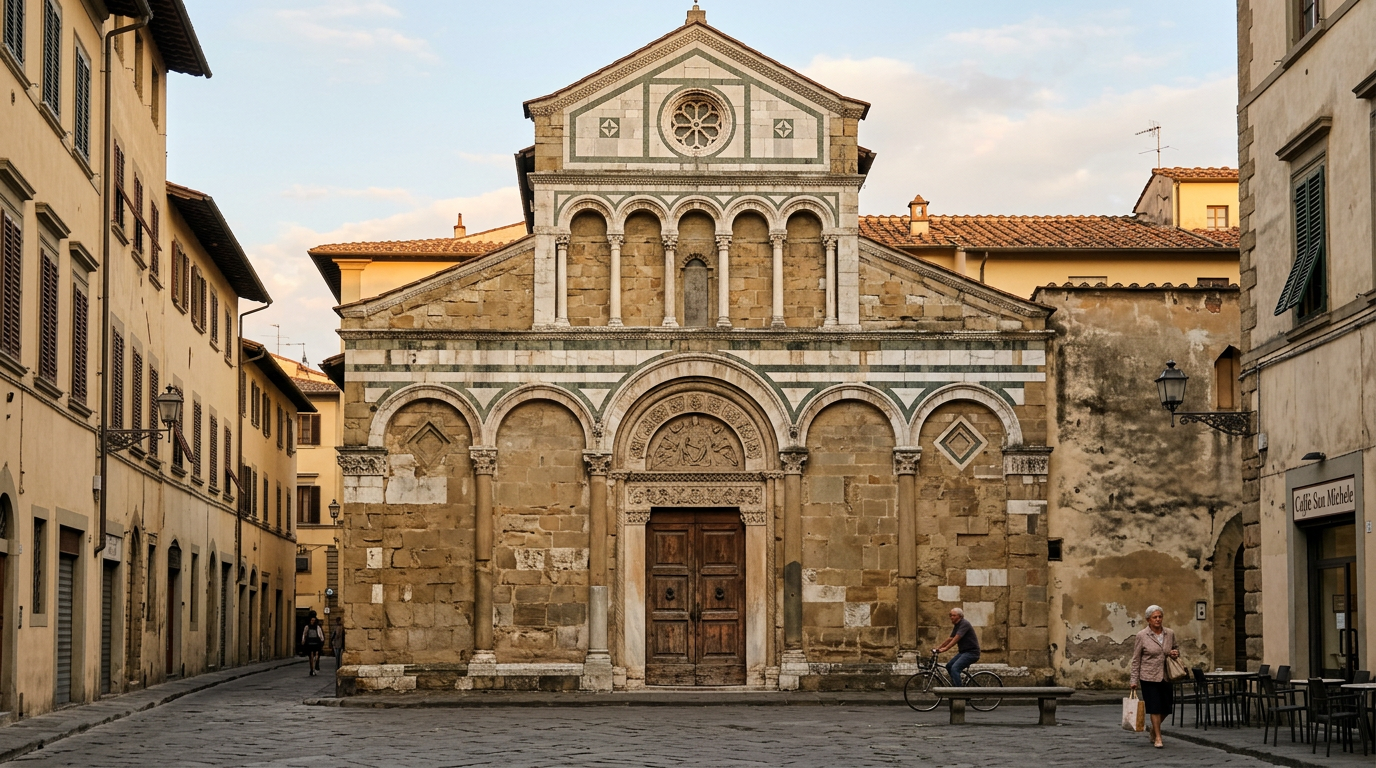
Florence Lesser-Known Churches: A Guide to the Overlooked
Florence churches tourists skip
Florence has dozens of churches. The standard tourist itinerary focuses on three or four: the Duomo, Santa Croce, Santa Maria Novella, and occasionally San Lorenzo. These are excellent choices, but they represent a small fraction of what the city contains.
The lesser-visited churches of Florence are, in some cases, more interesting than the famous ones. They are less crowded, better lit for looking, and often contain single works of art that repay serious attention. Several are free to enter. Most have fewer than 20 visitors at any given time.
This guide covers four specific churches, with practical information on hours, entry costs, and what to look for.
Santa Felicita: the Capponi Chapel
Santa Felicita on Piazza Santa Felicita is the first church you reach after crossing Ponte Vecchio and entering Oltrarno. It is one of the oldest churches in Florence, with origins in the 4th century, though the current building dates mainly from the 18th century.
The reason to visit is specific and singular: the Capponi Chapel, second on the right as you enter, contains two works by Jacopo Pontormo painted between 1525 and 1528. The Deposition from the Cross is the main altarpiece. The Annunciation is on the right wall.
The Deposition is one of the most technically and emotionally radical paintings of the 16th century. Pontormo abandoned the conventional spatial logic of Renaissance painting. The figures occupy an airless, undefined space. The colours, which art historians describe as acidic, include a luminous pink, a pale lilac, and a sharp green that have no parallel in contemporary Florentine painting. The emotional register is intense and disorienting in ways that resist easy description.
If you have been in the Uffizi and found Mannerism interesting, this is where that style reaches a kind of concentrated peak. If you have not heard of Pontormo, this room is a convincing argument to find out more.
Santa Felicita is open Monday to Saturday 09:30 to 17:30. Entry is free but there is a small charge of around 2 euros to enter the Capponi Chapel specifically. The chapel is lit by windows and does not have additional artificial lighting, so morning visits in good light are preferable.
Orsanmichele: the market turned church
Orsanmichele on Via dei Calzaiuoli is one of the most unusual buildings in Florence. It began as a grain market in the 14th century and was converted into a church in 1380 without altering the exterior structure significantly. The result is a building that looks like a palace and functions as a church.
The exterior is studded with statues in tabernacle niches, commissioned by the major guilds of medieval Florence. These include works by Donatello, Ghiberti, Verrocchio, and Nanni di Banco. The originals of most statues have been moved to the interior museum (enter from Via dell’Arte della Lana; open Monday only, 10:00 to 17:00, free) and replaced with high-quality copies outside.
Inside, the main visual focus is the enormous Gothic tabernacle by Andrea Orcagna, completed in 1359. It frames a painting of the Madonna of Orsanmichele by Bernardo Daddi, and its surface is covered with reliefs, coloured glass, marble inlay, and gold work that reflects nearly every tradition of 14th-century decorative art simultaneously.
The church itself is open Tuesday to Sunday 10:00 to 17:00. Entry to the main space is free. It is on one of the busiest streets in Florence but receives a fraction of the visitors of the nearby Duomo complex.
One reason Orsanmichele is overlooked: it does not look like a church. Most visitors walk past the exterior without registering that they can go inside. The entrance is on the north side of the building, via a door that is easy to miss.
San Miniato al Monte: the most beautiful
San Miniato al Monte on the hill above the Arno is, by many accounts, the most beautiful church in Florence. It predates the Duomo by several centuries and is one of the finest examples of Romanesque architecture in Italy.
The church was built beginning in 1018 on a site where a small oratory had already stood. The white and green marble facade, the same colour scheme used in the Baptistery and Santa Croce, was applied in stages from the 11th to the 13th centuries. The upper section, including the mosaic of Christ between the Virgin and Saint Miniato, dates from the 13th century.
Inside, the nave preserves its medieval structure with minimal later intervention. The floor is inlaid with marble panels in geometric and zoomorphic designs, completed in 1207. The crypt, which you descend to from the nave, contains the remains of Saint Miniato and is still used for daily services by the Olivetan monks who have occupied the monastery since 1373.
The Cappella del Cardinale del Portogallo (Chapel of the Cardinal of Portugal), on the left side of the nave, is a complete Renaissance ensemble designed in 1466 to 1473. It brings together architecture by Antonio Manetti, sculpture by Antonio Rossellino, glazed terracotta by Luca della Robbia, and painting by Alesso Baldovinetti. It is one of the most accomplished collaborative architectural spaces of the early Renaissance.
Entry is free. The church is open daily 09:30 to 13:00 and 15:00 to 19:00 (summer hours; slightly shorter in winter). Gregorian chant vespers take place at 17:30 on weekdays and 17:00 on Sundays.
How to plan a tour of the minor churches
Visiting Florence’s minor churches requires a different pace from the major museum visits. Most minor churches are open for limited hours and close for several hours in the middle of the day. Planning your route in advance avoids arriving at a locked door.
A practical one-day circuit of minor churches:
Morning (09:00 to 12:30): Start at Santa Felicita in Oltrarno (opens 09:30), then cross back to the north bank and visit Orsanmichele (opens 10:00). End the morning at the Brancacci Chapel in Santa Maria del Carmine (opens 10:00, requires booking, entry 10 euros).
Afternoon (15:00 to 18:30): After the midday break, visit San Miniato al Monte. Bus 13 from near the Uffizi takes about 15 minutes. Return in time for vespers at 17:30 if you want to hear Gregorian chant in the church. Descend on foot back to the Arno, a walk of about 20 minutes.
This circuit covers about 6 km on foot and four significant churches, all of which require fewer than 30 minutes each. Total entry costs are minimal: Santa Felicita 2 euros, Orsanmichele free, Brancacci Chapel 10 euros, San Miniato free.
Where to stay
The Key is at Via Cittadella 22, five minutes on foot from Santa Maria Novella station in Florence. Santa Felicita is about 20 minutes on foot from the guesthouse. Orsanmichele is about 15 minutes on foot through the centre on Via dei Calzaiuoli.