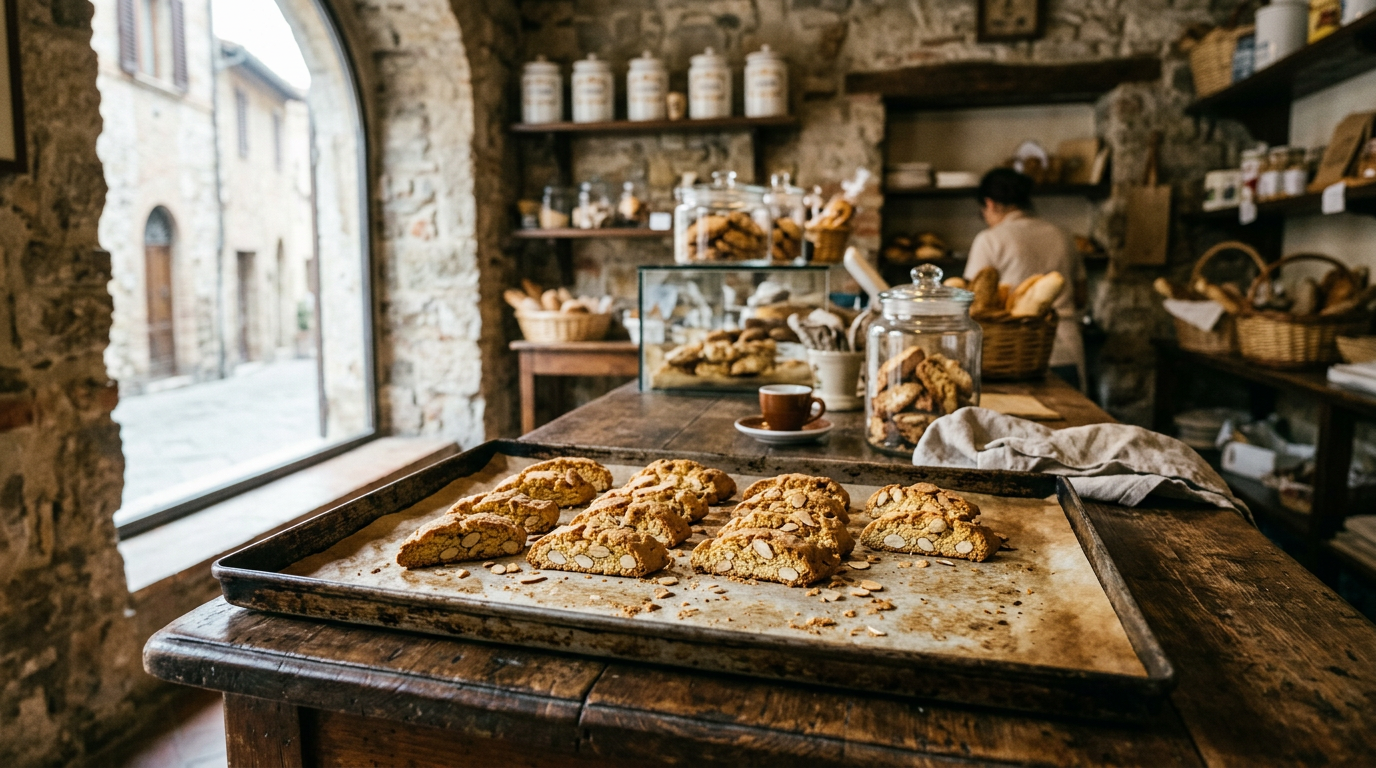
Florence Cantuccini: Where to Buy the Best and What to Know
Florentine cantuccini: the history
Cantuccini are twice-baked almond biscuits from Tuscany. They are small, hard, dry, and shaped like elongated fingers. The dough is baked first in a log, then sliced and returned to the oven to dry completely. The result is a biscuit that keeps for weeks without going stale, that dissolves in liquid, and that has a concentrated almond flavour from whole toasted almonds embedded throughout.
The technique of twice-baking goes back to Roman antiquity. The Latin word biscoctus, from which the English “biscuit” and the Italian “biscotto” derive, means cooked twice. Roman soldiers and sailors carried twice-baked bread because it survived long journeys without spoiling.
The Tuscan version with almonds developed during the medieval and Renaissance periods. The earliest documented recipe that closely resembles modern cantuccini comes from a Prato baker named Antonio Mattei, who started producing them in 1858. His shop on Via Ricasoli in Prato, approximately 17 km north of Florence by train, is still operating today and is widely considered the reference point for the original version.
The difference between cantuccini and cantucci
The names are used interchangeably in most contexts, including by Tuscan producers, but there is a distinction worth knowing.
Cantucci (singular: cantuccio) is the older term and refers to the thick, hard, twice-baked biscuit made with almonds in the Prato style. The word cantuccio refers to a corner or a cut piece, reflecting the diagonal cut made when slicing the baked log.
Cantuccini is the diminutive form and, in practice, often refers to slightly smaller, lighter versions of the same biscuit. Some producers use the word cantuccini for their standard product and cantucci for a larger, more rustic version. Others use the words without distinction.
In Florence specifically, you will encounter both terms. The key quality indicator is not the name but the ingredients and the baking method. A cantuccio made with whole blanched almonds, butter or lard, eggs, flour, sugar, and a small amount of anise or vanilla, baked twice until thoroughly dry, is the authentic version.
Be wary of products labelled cantuccini that contain other nuts, dried fruit, chocolate chips, or flavourings such as pistachio or lemon. These are variations, not the original, and are often produced for the tourist market.
The historic pastry shops
Biscottificio Antonio Mattei in Prato (Via Ricasoli 20) is the ultimate reference. The shop is not in Florence but is 17 km away by train (approximately 25 minutes from Florence Santa Maria Novella station, Prato Centrale stop). The journey is worth it if you take the biscuits seriously. Mattei’s cantuccini have a characteristic austere dryness and almond intensity that has remained consistent since the 19th century.
In Florence itself, several bakeries and pastry shops produce or stock cantuccini of genuinely good quality.
Il Forno di Stefano Galli at Via delle Caldaie 34r in Oltrarno is a working bakery that produces cantuccini using traditional methods. The shop does not advertise heavily and is primarily used by neighbourhood residents. A bag of approximately 250 grams costs around 4 to 6 euros.
Pasticceria Buonamici at Borgo degli Albizi 11r sells cantuccini made in-house alongside a range of traditional Florentine pastries. The shop is small and the production is visible through the door to the back kitchen.
Mercato Centrale on Via dell’Ariento has several stalls on the ground floor selling Tuscan food products including cantuccini. Quality varies between stalls; look for bags where the biscuits are visibly dry and golden rather than pale and soft.
For something to take home in good packaging: Migone Confetture e Biscotti at Via dei Calzaiuoli 85r has a selection of packaged Tuscan biscuits and confections in presentation boxes. The prices are higher than a bakery but the packaging is appropriate for a gift.
Vin santo: how to pair it
Cantuccini are traditionally served with vin santo, a Tuscan dessert wine. The pairing is not just conventional; it is functional. The hard, dry biscuit is meant to be dipped in the wine until it softens slightly and absorbs some of the liquid. Eating a cantuccino dry is acceptable but misses the point of the combination.
Vin santo (literally “holy wine”) is made from partially dried Trebbiano and Malvasia grapes. The grapes are harvested and then dried on racks in well-ventilated rooms for several months. The drying concentrates the sugars. The resulting must is fermented in small barrels (caratelli) and aged for a minimum of 3 years; serious producers age it for 5 to 8 years or more.
The flavour of vin santo ranges from moderately sweet to intensely sweet depending on the producer and the vintage. Better versions have a walnut, dried fig, and honey character with some oxidative notes from the barrel aging. The sweetness is balanced by acidity and a slight nuttiness that comes from the long barrel contact.
In a restaurant, vin santo is served at the end of the meal alongside cantuccini. Expect to pay 5 to 10 euros for a small glass (50 to 75 ml). For a bottle to take home, quality vin santo from a reputable Tuscan producer costs 20 to 50 euros for a 375 ml bottle at an enoteca in Florence.
Producers worth seeking out at an enoteca: Avignonesi, Isole e Olena, Capezzana, and Fontodi all produce vin santo alongside their table wines. Their products are available at several wine shops near the Mercato Centrale and in Oltrarno.
How much to spend to take them home
Cantuccini travel well. They are dry, dense, and packaged easily. They make a practical and genuinely Florentine item to bring back.
Here is a practical guide to pricing and format.
Bulk from a bakery: 500 grams costs 7 to 12 euros depending on the shop. This is the most economical option if you are buying for personal consumption or want a large quantity. The biscuits will keep for 2 to 3 weeks in a sealed container.
Packaged in paper bags from artisan producers: small bags of 150 to 200 grams from shops like Mattei (in Prato) or the Mercato Centrale cost 4 to 7 euros. These are appropriate as small gifts.
Gift boxes and presentation packaging: shops like Migone or the specialty food shops near Piazza della Repubblica offer decorated tins or boxes containing 250 to 500 grams of cantuccini for 12 to 22 euros. The presentation is designed for gift-giving.
Combined vin santo and cantuccini sets: some enoteca shops and gift food shops assemble boxes containing a half-bottle of vin santo and a bag of cantuccini. Prices range from 25 to 40 euros depending on the wine quality.
A note on supermarket cantuccini: Tuscan supermarkets (Coop, Esselunga, PAM) stock several brands of cantuccini at prices of 2 to 4 euros per bag. Quality varies but several supermarket versions are made by producers who also supply upmarket retailers. If you want cantuccini for personal use without the gift-appropriate packaging, the supermarket is a reasonable option.
Where to stay
The Key is at Via Cittadella 22, five minutes on foot from Santa Maria Novella station in Florence. The train to Prato, for the Mattei shop, departs from Santa Maria Novella and the journey takes about 25 minutes. The Mercato Centrale and several Florentine pastry shops are within a 15-minute walk of the guesthouse.