Florence Leather Artisans: Workshops, Tradition and What to Buy
Florentine leather: a real tradition
Florence has been a centre of leather craftsmanship since the medieval period. The tanning and working of hides was one of the city’s most important industries from the 13th century onwards, and the Arno river provided the water supply essential for the tanning process.
The Florentine leather trade declined significantly in the 20th century as industrial production made handmade goods less economically competitive. What remains is a much smaller number of working craftspeople, concentrated in a few specific areas of the city, who continue to make leather goods by hand using traditional methods.
The tourist market in Florence is saturated with goods labelled “made in Florence” or “Florentine leather” that are neither. Much of what is sold in the stalls near the Duomo, on Ponte Vecchio, and in the San Lorenzo market is machine-made, often in factories in China or Eastern Europe, and has no connection to Florentine craft tradition.
Understanding the difference matters if you want to spend money on something real.
The Scuola del Cuoio at Santa Croce
The Scuola del Cuoio (Leather School) at Via San Giuseppe 5r, inside the Basilica of Santa Croce complex, is one of the few places in Florence where you can watch leather being made and buy the finished goods in the same building.
The school was founded in 1950 by Florentine monks and two master leather artisans, with the goal of teaching leatherworking to young people orphaned by the Second World War. It has operated continuously since then. Today it functions as both a working atelier and a shop, with apprentices and experienced craftspeople working at benches visible from the shop floor.
The products made here are fully handmade in the building: wallets, bags, belts, gloves, desk accessories, and notebooks covered in florentine leather. Prices are significantly higher than the market stalls but correspond to what handmade goods cost to produce. A hand-stitched leather wallet costs 60 to 130 euros depending on size and complexity. A shoulder bag costs 200 to 500 euros.
The school is accessible from Via San Giuseppe through an entrance separate from the basilica ticket office. Entry to the shop and workshop viewing area is free. Open Monday to Saturday 10:00 to 18:00. In summer (June to August), hours extend to 18:30.
One useful detail: the staff at the Scuola del Cuoio are generally willing to explain the production process and answer questions about materials and techniques. This is not a high-pressure sales environment.
Active artisan workshops
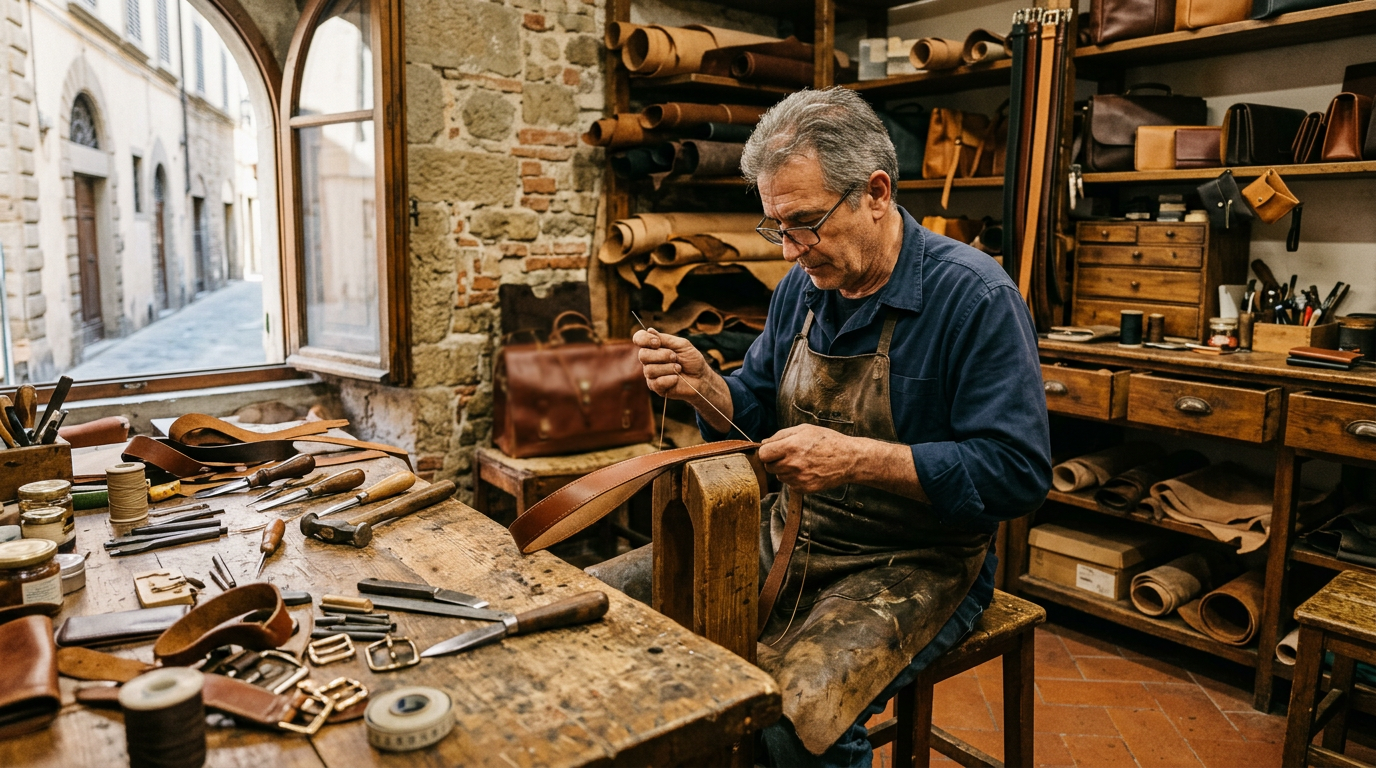
Beyond the Scuola del Cuoio, a small number of independent leather workshops operate in Florence. These are typically in the Oltrarno neighbourhood, particularly in the streets around Via Maggio, Via dei Bardi, and the Piazza della Passera area.
The Oltrarno has historically been Florence’s artisan district. Bookbinders, gilders, furniture restorers, and leather workers have operated here for centuries. While the concentration has diminished, it has not disappeared entirely.
When looking for a working leather workshop, the signs are straightforward. The smell of leather and tanning solutions is distinctive and noticeable from the street. An open door during working hours is typical; many Florentine workshops operate with the door open for ventilation and light.
What to look for in a workshop: tools visible and in use, off-cuts and materials on the workbench, a range of works in different stages of completion. If everything is in glass cases and the craftsperson is behind a counter, you are in a shop. If there is a bench with tools and the person working there is making something in front of you, you are in a workshop.
Buying directly from a workshop, rather than through a shop, gives you the opportunity to commission specific items or discuss customisations. A craftsperson who makes wallets may be able to add a monogram, alter a colour, or produce a larger or smaller version of a standard design. This is worth asking.
How to recognise handmade leather
Several practical tests help distinguish genuinely handmade leather goods from machine-made alternatives.
Stitching: handmade saddle stitching uses two needles and a waxed thread passed through each hole from opposite sides. The result is a slightly irregular appearance with each stitch at a slight angle. Machine stitching is perfectly uniform, with each stitch identical. Under close inspection, hand stitching has a quality that machine stitching does not replicate exactly.
Edges: on a handmade piece, the edges of the leather are burnished or painted individually by hand. You can see the slight variation in pressure and coverage. Machine-finished edges are perfectly uniform.
Thickness and weight: handmade goods often use thicker leather than machine-made alternatives because thicker leather works better with hand tools. A wallet or belt that feels substantial and slightly stiff when new, and that will mold to your shape over time, is typically made from full-grain leather. Lighter, immediately soft goods are often split leather or bonded leather with a plastic coating.
Price: genuine handmade leather goods made in Florence from quality hides cost significantly more than market-stall goods. A handmade wallet below 50 euros is unlikely to be what it claims. A handmade bag below 150 euros is suspicious. These are not absolute thresholds, but they are reasonable starting points.
What to buy and at what prices
If you are buying leather goods in Florence, here is a practical guide to what to expect in terms of prices and value.
Wallets: from a genuine artisan, 60 to 130 euros for a bi-fold or card wallet in full-grain leather. A passport holder or travel wallet costs more, typically 80 to 180 euros.
Belts: 50 to 120 euros from a working artisan. Wider belts in thicker leather cost more.
Bags and shoulder bags: 200 to 600 euros for a handmade everyday bag. Larger or more complex pieces cost proportionally more. This is a significant purchase; confirm that it is genuinely made in the workshop before committing.
Gloves: Florence has a specific tradition of leather glove-making. A pair of handmade leather gloves costs 60 to 150 euros depending on the leather and any lining.
Notebooks and stationery: marbled paper notebooks with leather covers are available from 15 to 50 euros depending on size and quality. This is one of the more accessible artisan categories and a practical gift option.
The San Lorenzo leather market and the stalls near the Duomo typically sell wallets for 15 to 30 euros. These are machine-made, often from bonded leather or split leather with a surface coating, and are not representative of Florentine leather craft. They are durable in the short term but will not develop the patina that characterises quality leather over years of use.
Where to stay
The Key is at Via Cittadella 22, five minutes on foot from Santa Maria Novella station in Florence. The Scuola del Cuoio at Santa Croce is about 25 minutes on foot through the centre. The Oltrarno workshops are accessible across the Arno, about 20 to 25 minutes on foot from the guesthouse.