Florence Walking Itinerary: On Foot Through the City
Florence is one of the best European cities to explore on foot. The historic centre is compact, largely pedestrianised, and flat except for the hills south of the Arno.
You do not need a car. You do not need a bus for most sights. What you do need is a pair of shoes that can handle 10 km of cobblestones without destroying your feet by midday.
This guide gives you two distinct walking routes: one through the historic centre north of the Arno, one through the Oltrarno to the south. You can do them on separate days or, if you are energetic, combine them into one long day.
Florence is best explored on foot
The ZTL (zona a traffico limitato) restricts cars from the historic centre. Buses run on a limited number of routes through the area. Bikes are possible but the cobblestones and tourist foot traffic make them impractical in the densest zones.
Walking also means you notice things. Florence’s architecture rewards attention. Look up from the street level. Look at the carved details over doorways, the colour of the render on old palaces, the narrow alleys that run between larger streets.
The other advantage of walking is that you avoid the most common tourist mistake: spending 30 minutes on a bus to cover a distance you could walk in 12 minutes.
The historic centre walking route
This route starts at Santa Maria Novella station and ends at Piazza della Signoria. Total distance: approximately 1.8 km. Time on foot with stops: around 2.5 hours.
From the station, walk east along Via dei Banchi. In 4 minutes you reach Piazza Santa Maria Novella. The church of Santa Maria Novella (open Monday-Thursday 9:00-19:00, Friday 11:00-19:00, Saturday and Sunday 9:00-17:30, entry 7.50 euros) has a Renaissance facade by Leon Battista Alberti and important frescoes inside by Ghirlandaio.
Continue east to Piazza del Duomo. The walk from Piazza Santa Maria Novella takes about 8 minutes. Spend at least 30 minutes here, more if you have tickets for the dome or Baptistery.
Walk south on Via dei Calzaiuoli. This is Florence’s main pedestrian street, about 600 metres long. It connects the Duomo area to Piazza della Signoria. On the right, you pass Orsanmichele (stop in if it is open; entry is free).
Arrive at Piazza della Signoria. This is the city’s civic centre. The Loggia dei Lanzi at the east end has Renaissance sculptures under an open arcade. Entry is free. Stand in front of the Palazzo Vecchio (open 9:00-23:00 in summer, 9:00-19:00 in winter) and look at the copy of Michelangelo’s David (the original is at the Accademia).
From Piazza della Signoria, walk 5 minutes west to Ponte Vecchio.
The Oltrarno walking route
This route begins at Ponte Vecchio and ends at San Miniato al Monte. Total distance: approximately 3.5 km with about 70 metres of elevation gain. Time: approximately 2 hours with stops.
Cross Ponte Vecchio and walk south on Via Guicciardini. Turn right onto Piazza Santa Felicita (1 minute). The church here is small and usually quiet. It contains Pontormo’s Deposition, one of the most striking Mannerist paintings in the city. Entry is free.
Continue to Palazzo Pitti. The piazza in front is large and gives a good sense of scale of the building. If you are visiting the Galleria Palatina, entry is 16 euros. The Boboli Gardens entrance is around the left side of the palace.
Walk east towards Piazza Santo Spirito (about 7 minutes from Palazzo Pitti). The square is the social centre of the Oltrarno. There is a small daily market in the morning and many bars and restaurants around the perimeter.
From Piazza Santo Spirito, head south and east toward Piazzale Michelangelo. The route takes you up Via di Belvedere past the old city walls and the Forte di Belvedere. This section is about 1.5 km and takes 25 minutes uphill.
From Piazzale Michelangelo, the walk to San Miniato al Monte takes a further 10 minutes. Follow the signs uphill from the piazzale. The church opens at 9:30, the Romanesque facade dates from the eleventh century, and the views from the terrace are excellent.
Real distances between main sights
These are walking distances from Santa Maria Novella station:
- Station to Piazza del Duomo: 900 metres, about 12 minutes
- Station to Ponte Vecchio: 1.5 km, about 18 minutes
- Station to Uffizi: 1.6 km, about 20 minutes
- Station to Piazzale Michelangelo: 3.5 km, about 45 minutes
- Duomo to Accademia: 650 metres, about 8 minutes
- Uffizi to Ponte Vecchio: 250 metres, about 3 minutes
- Palazzo Pitti to San Miniato al Monte: 1.5 km, about 25 minutes uphill
These are direct walking distances on the most logical routes. Actual time varies depending on crowds and how often you stop.
What to bring with you
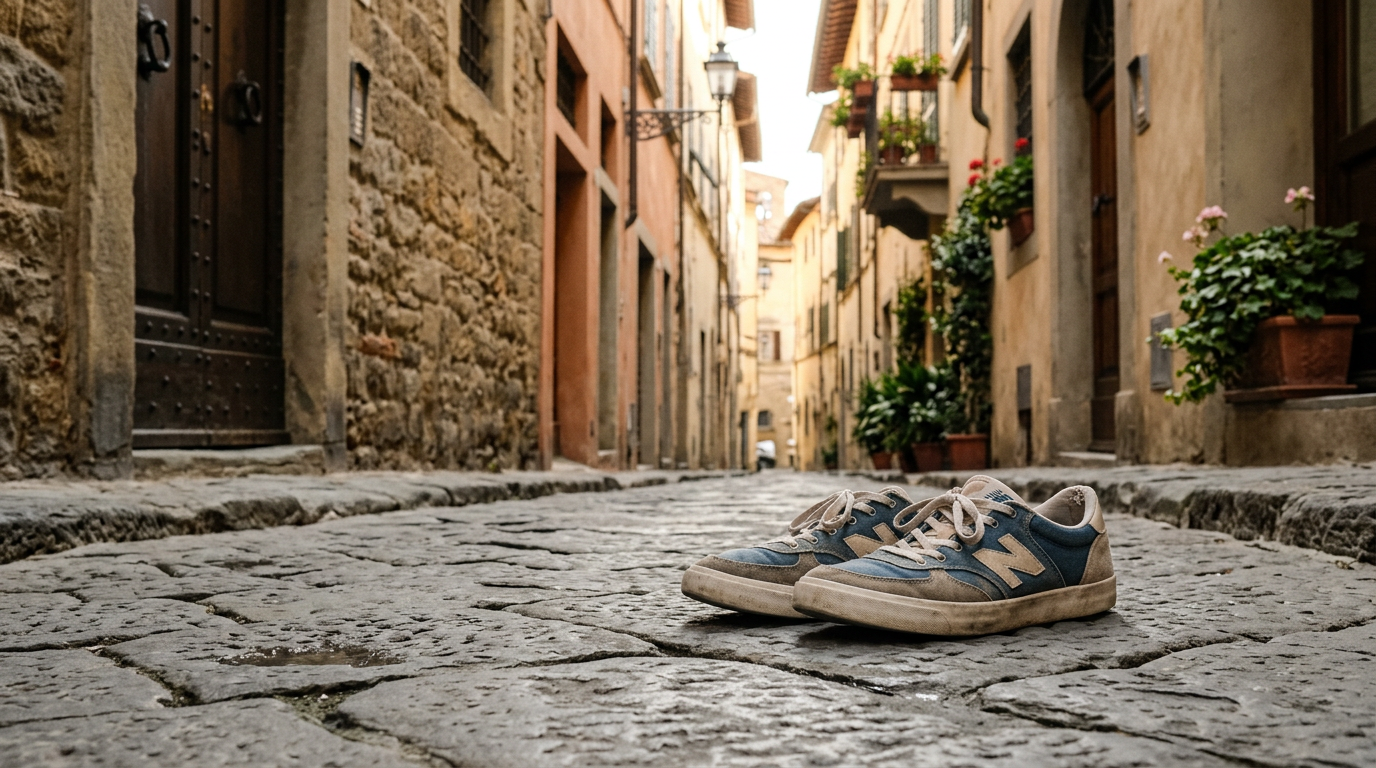
Comfortable shoes are the single most important item. The streets in Florence are largely paved with pietra serena or irregular cobblestones, both of which are hard on feet. Running shoes or light walking shoes work well. Formal shoes do not.
Carry a small bottle of water. Drinking fountains (nasoni) are scattered throughout the city, marked on most city maps. The water is drinkable and free.
A paper or offline map is worth having. Mobile signal can be weak in some narrow streets and in the basement of museums. Download the area in Google Maps or Maps.me before you start.
Dress in layers, especially in spring and autumn. Florence at 9:00 in April can be 12 degrees. By midday it might be 22 degrees. Both are possible on the same day.
A small daypack is enough. You will not need luggage storage for a walking day unless you are arriving or departing. Most central hotels and guesthouses offer luggage storage.
Where to stay
The Key is at Via Cittadella 22, which puts you 5 minutes from Santa Maria Novella station on foot and within the start of both walking routes described here. You can walk out the door and begin your Florence day without any transit.