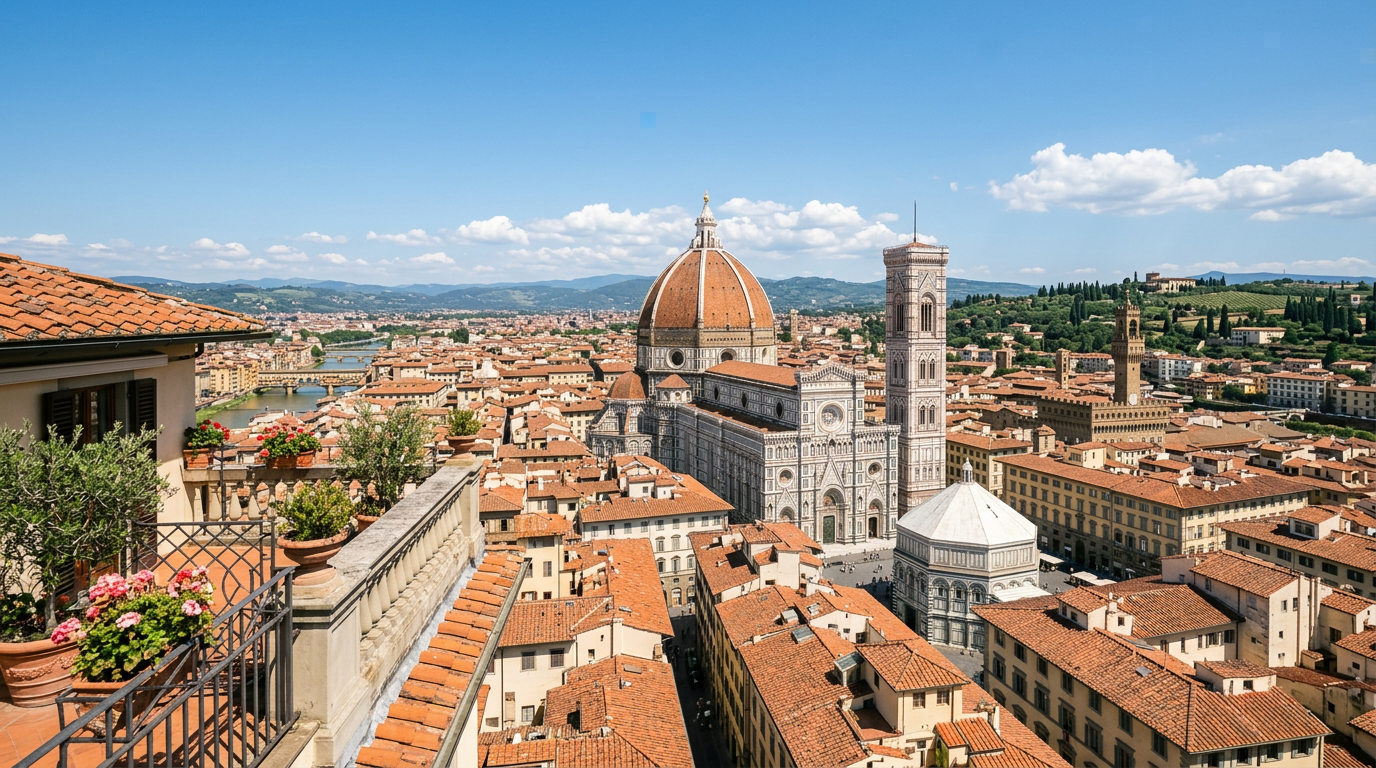
Florence in 3 Days: What to See
Three days in Florence is a comfortable amount of time. You can see the main monuments, visit at least two major museums, and still have time to wander without rushing.
The key is to plan the museum visits before you arrive. Both the Uffizi and the Accademia require advance booking, particularly between April and October when queues without a ticket can reach 90 minutes or more.
This plan is designed for someone based in the city centre and walking everywhere. All distances are given in minutes on foot from a central starting point.
How to split 3 days in Florence
Day 1 covers the Duomo area and Piazza della Signoria. Day 2 is dedicated to the two major museums. Day 3 takes you into the Oltrarno and up to the hills south of the Arno.
This split avoids the most common mistake: trying to visit the Uffizi on the same day you spend three hours at the Duomo complex. Both require serious time and attention.
Museums are best in the early afternoon, when morning crowds have thinned slightly. Book your Uffizi and Accademia slots for 13:00 or 14:00 on Day 2.
Start each day as early as you can manage. The main squares are genuinely quieter before 9:30.
Day 1: Duomo and the centre
Begin at Piazza del Duomo. The Baptistery of San Giovanni opens at 9:00 (entry 15 euros). The facade of the Duomo is viewable at any time for free.
If you want to climb Brunelleschi’s dome, you need a separate timed ticket, which costs 30 euros as part of the Duomo complex pass. Book it online. The climb involves 463 steps and no lift. The view from the top is 360 degrees over the entire city.
By 11:00, walk south via Via dei Calzaiuoli to Piazza della Signoria. The Loggia dei Lanzi at the east end of the square contains Renaissance sculptures, including Cellini’s Perseus with the Head of Medusa. Entry is free.
Lunch near Via dei Neri or the Mercato Centrale. Both areas have options from around 10 euros per person.
In the afternoon, visit the Bargello (Via del Proconsolo 4), which is Florence’s sculpture museum. It contains Donatello’s David, the first freestanding nude since antiquity. Entry costs 10 euros and it is usually less crowded than the Uffizi.
Spend the early evening walking along the Arno embankment. Cross Ponte Vecchio and return on Ponte Santa Trinita. The light on the water at sunset is worth the detour.
Day 2: Museums and galleries
This is your museum day. It will be intense.
The Accademia is at Via Ricasoli 60, about 10 minutes on foot from the Duomo. It opens at 8:15 from Tuesday to Sunday. Entry costs 12 euros without reservation, though you should book ahead. The David is in the central hall, the Tribuna.
Plan 45 minutes to 1 hour inside the Accademia. The collection beyond the David is smaller than most visitors expect.
After a light lunch near Piazza San Marco, head to the Uffizi. Piazzale degli Uffizi is about 15 minutes on foot from the Accademia via the centre.
The Uffizi opens at 9:00 but it is better to arrive at your booked slot time, not before. Standard entry costs 20 euros (25 euros during peak periods). Pre-booking fee is 4 euros.
Devote at least 2.5 hours to the Uffizi. The Botticelli rooms (10-14) are the centrepiece. Room 15 contains Leonardo da Vinci’s Annunciation and Adoration of the Magi. Room 83 holds Michelangelo’s Doni Tondo.
In the evening, return to Piazzale Michelangelo for the sunset (20-minute walk south from Ponte Vecchio, or bus line 13). Most visitors leave after the sunset. If you stay until dark, the city lights are equally impressive.
Day 3: Oltrarno and the hills
Cross the Arno on Ponte Vecchio before 9:00. The Oltrarno feels like a different city. There are fewer tourists, smaller streets, and local bakeries that have been there for generations.
Walk to Piazza Santo Spirito. The basilica of Santo Spirito (Piazza Santo Spirito 30) opens at 10:00 and entry is free. It was designed by Brunelleschi and is considered one of the most harmonious interiors in Italian Renaissance architecture.
From there, continue west to Palazzo Pitti. The main gallery, the Galleria Palatina, contains works by Raphael, Titian, and Rubens. Entry costs 16 euros. The attached Boboli Gardens (entry 10 euros) are the best green space in Florence proper.
After lunch in the Oltrarno area (try the streets around Piazza della Passera for good trattorie), take the walk up to the church of San Miniato al Monte. The walk from Piazzale Michelangelo takes about 10 minutes up a gentle slope. The church opens at 9:30 and is free. The views from the terrace outside are among the best in the city.
Spend your last evening back in the centre. Piazza della Repubblica has several historic cafes if you want to sit down with coffee or a Negroni.
Logistical tips
Florence’s centre is compact. The distance from Santa Maria Novella station to the Uffizi is about 1.5 km, or roughly 18 minutes on foot. You do not need a bus for most of these routes.
The ZTL covers the entire historic centre. If you are arriving by car, do not drive inside the ZTL. Fines are automatic and high (starting at 80 euros). Use peripheral parking areas and walk or take the tram.
Tram line T1 connects the airport and the western suburbs to the city centre, with the main stop at Alameda. From there it is a 10-minute walk to the Duomo.
ATAF buses cover the rest of the city. A single ticket costs 1.70 euros if bought in advance (at tabacchi or the app) or 2.50 euros on board. A day pass costs 5 euros.
Restaurant reservations are strongly recommended for Saturday and Sunday evenings and during public holidays. Florentine trattorias are small and fill quickly.
Where to stay
If you are spending 3 days in Florence, a central base saves significant time every day. The Key is at Via Cittadella 22, a 5-minute walk from Santa Maria Novella station, with all the sights in Day 1, Day 2 and Day 3 within easy reach on foot.