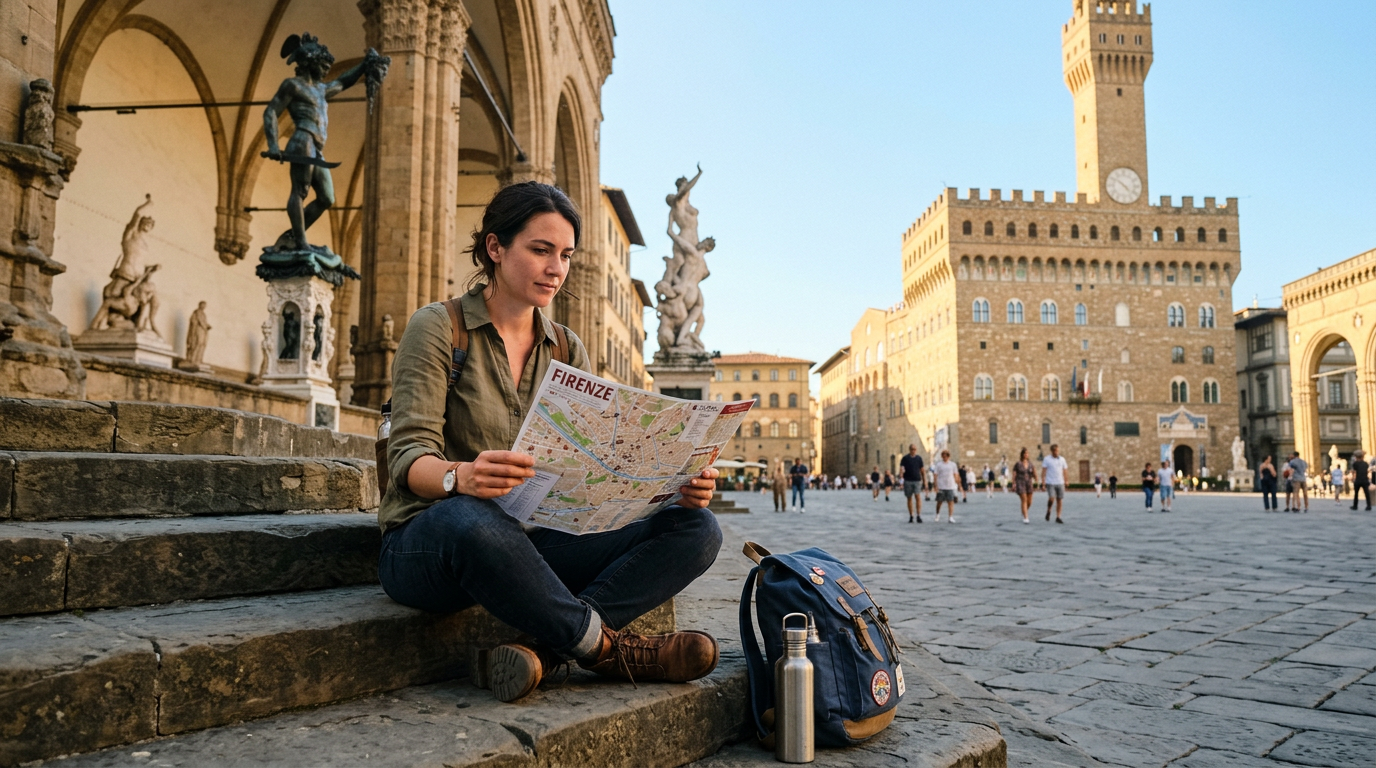
Florence 2-Day Itinerary: The Practical Plan
Two days in Florence is a workable window, as long as you are realistic about what fits. You will not see everything. No one does, not even with a week.
The goal here is a focused plan that covers the essentials without turning the visit into an endurance race. You will walk a lot, roughly 10-14 km per day. Good shoes are non-negotiable.
Book the Uffizi and Accademia before you travel. Both require timed-entry tickets. Walk-up entry is technically possible but not reliable, and the queues without a ticket can be 60-90 minutes long in high season.
Why 2 days are enough if used well
Florence’s main sights are clustered within a 2-km radius. From Santa Maria Novella station to the Uffizi is about 1.5 km. From the Duomo to Piazzale Michelangelo is about 2.8 km.
This density works in your favour. You do not lose time in transit between sites. You move through the city on foot, which also means you see things you would miss on a bus.
The trade-off is that you need to be selective. Two days means choosing between the Uffizi and the Accademia, unless you book early enough to fit both. It means skipping the Palazzo Pitti. It means accepting that some of Florence will remain for next time.
That is not a failure. It is just the reality of two days in one of the most art-dense cities in Europe.
Day 1: the must-sees
Start at Piazza del Duomo by 8:30. The Baptistery opens at 9:00 (15 euros). The dome climb is worth it if you booked in advance; if not, viewing the exterior is still a meaningful hour.
By 10:30, walk to Piazza della Signoria via Via dei Calzaiuoli. Spend 20-30 minutes here. The Loggia dei Lanzi is free to enter and contains some of the finest public sculpture in Italy.
Have lunch near Via dei Neri or around the Mercato Centrale (open until 24:00 on the ground floor; the first-floor food hall closes at 15:00). Budget 10-15 euros per person.
Afternoon is for the Uffizi. Book your slot for 13:30 or 14:00. The visit will take 2 to 2.5 hours if you focus on the highlights. Do not try to see every room. Concentrate on the Botticelli rooms, the Leonardo room, and the Michelangelo room.
Cross Ponte Vecchio late in the afternoon, around 17:00. The light on the Arno is good at this time and the goldsmiths’ shops are less crowded than at midday.
Spend the early evening in the Oltrarno. Piazza Santo Spirito has several aperitivo bars. A drink plus small plates typically costs 8-12 euros. Dinner in this neighbourhood is generally better value than the tourist-heavy streets north of the Arno.
Day 2: off the beaten path
Day 2 is for what most visitors skip.
Start at the church of Orsanmichele (Via dell’Arte della Lana 1), which opens at 10:00. Entry is free. It was a grain market before it became a church, and its exterior niches contain statues by Donatello, Ghiberti, and Verrocchio.
Walk to the Bargello (Via del Proconsolo 4). It opens at 8:15, Tuesday to Sunday. Entry costs 10 euros. This is Florence’s sculpture museum and it is consistently less crowded than the Uffizi. Donatello’s first David, in bronze, is here, as well as works by Michelangelo and Verrocchio.
After the Bargello, head to the Accademia if you have a ticket. Via Ricasoli 60, about 12 minutes on foot. The David by Michelangelo is 5.17 metres tall and even if you have seen images of it hundreds of times, standing in front of it is different.
Lunch in the San Marco area, north of the Duomo. The neighbourhood around Piazza San Marco has fewer tourist traps than the centre.
In the afternoon, cross the Arno again and walk up to San Miniato al Monte. From Ponte Vecchio the walk takes about 30 minutes, or you can take bus line 13 to Piazzale Michelangelo and walk up from there (10 more minutes). The church opens at 9:30, entry is free, and the Romanesque interior is genuinely beautiful.
The view from the terrace in front of San Miniato al Monte is one of the best in the city and less crowded than Piazzale Michelangelo just below.
What to skip without regrets
You do not need to go inside the Duomo. The interior is free, but it is relatively bare compared to the exterior. The time is better spent at the Bargello or Orsanmichele.
Skip the tourist restaurants on Via dei Neri and Via della Vigna Nuova if you are looking for value. These streets have some of the highest prices relative to quality in the city centre.
The queues for the Ponte Vecchio souvenir shops are not worth joining. The same items are available throughout the city.
If it rains, skip Piazzale Michelangelo. The view disappears in low cloud and the walk up is unpleasant in wet weather. Substitute with the Museo dell’Opera del Duomo instead (Piazza del Duomo 9, entry 15 euros), which houses the original doors of the Baptistery and many works from the Duomo complex in a covered, well-curated space.
Where to eat
For breakfast, Florentines go to a bar and stand at the counter. A cornetto (croissant) and cappuccino costs around 2.50 euros at the counter. Sitting at a table can triple the price in tourist areas.
For lunch, the Mercato Centrale (Via dell’Ariento, first floor) is a reliable and fairly priced option. It closes at 15:00. The street market on the ground floor sells leather goods and clothes and is open until approximately 19:00.
For a sit-down dinner, the Oltrarno is the best balance of quality and price. Streets around Piazza della Passera, Via di Santo Spirito, and Borgo San Jacopo have trattorie serving traditional Florentine food. Expect to pay 25-40 euros per person with wine.
Where to stay
Being central is what makes a 2-day itinerary actually work. The Key is at Via Cittadella 22, a 5-minute walk from Santa Maria Novella station, so you lose no time getting in or out of the city.