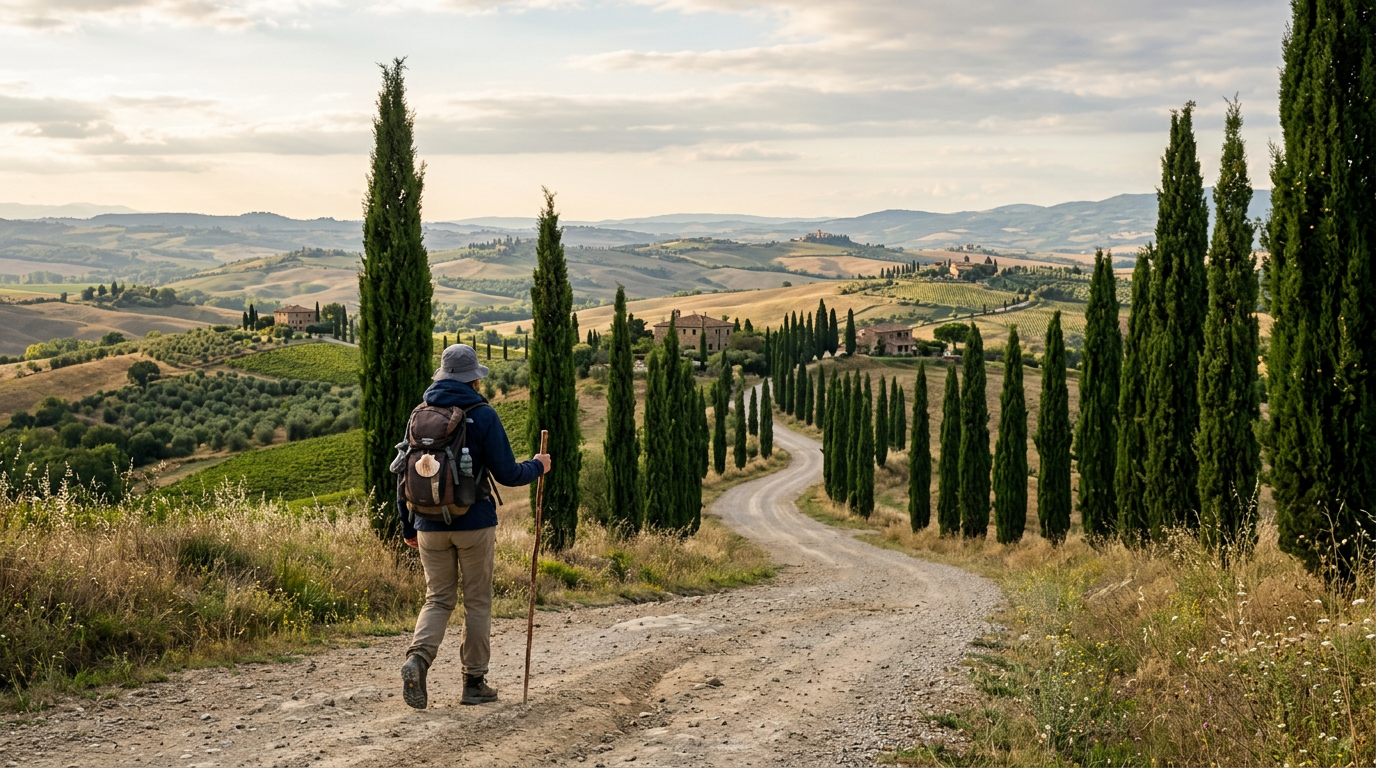
Via Francigena Tuscany: stages and routes
The Via Francigena is one of the great pilgrimage routes of medieval Europe. It runs from Canterbury in England to Rome, covering roughly 1,800 km through France, Switzerland, and Italy. The Tuscan section, from the Lunigiana in the north to the Lazio border in the south, is widely considered the most beautiful part of the entire route.
You do not need to walk the whole route to enjoy it. Many people walk one or two stages, using the Via Francigena as a framework for exploring the Tuscan countryside at a slow pace.
The Via Francigena in Tuscany
The Via Francigena entered Tuscany from the Cisa Pass in the Apennines and followed an ancient road south through Luni (now Luni Terre), the Lunigiana, and Lucca. From Lucca the route continued south to Altopascio, then through the Arno valley towards Florence.
The historical route did not pass through Florence itself. The main path crossed to the west of the city and followed the Val d’Elsa south towards Siena.
The Tuscan section of the Via Francigena covers approximately 380 km and is divided into about 15 stages. The terrain varies from flat river valleys to steep hill climbs. Some sections are on paved roads, but much of the route follows gravel tracks, farm lanes, and paths through vineyards and olive groves.
The Via Francigena in Tuscany is waymarked with standard pilgrim symbols. A white flag with a black cross on a red background appears on signs and markers throughout the route. Navigation is generally straightforward, but a printed guide or a GPS route file is useful.
The stages from Florence to Siena
The Florence-to-Siena section of the Via Francigena is one of the most popular stretches of the entire route. It covers roughly 120 km and takes four to five days to walk at a comfortable pace.
Stage 1: Florence to San Casciano Val di Pesa. About 25 km, elevation gain around 500 metres. The route leaves Florence through the southern suburbs and climbs into the Chianti hills.
Stage 2: San Casciano Val di Pesa to Tavarnelle Val di Pesa or Barberino Val d’Elsa. About 20 to 22 km. This stage passes through some of the most beautiful Chianti Classico vineyard countryside. The paths are mostly on white roads and tracks.
Stage 3: Barberino Val d’Elsa or Tavarnelle to Colle Val d’Elsa. About 20 km. The route descends into the Val d’Elsa and follows the river valley south.
Stage 4: Colle Val d’Elsa to Monteriggioni. About 18 km. This stage includes the approach to Monteriggioni, one of the most intact medieval walled villages in Tuscany. The village walls and towers are visible from several kilometres away as you approach.
Stage 5: Monteriggioni to Siena. About 20 km. The final approach to Siena follows a mix of roads and paths. The entry into the city through Porta Camollia is a memorable moment.
Each stage takes five to seven hours depending on your fitness level and how many stops you make. The recommended daily pack weight is under 8 kg including water.
The stretch through Val d’Elsa
The stretch of the Via Francigena through the Val d’Elsa is particularly rewarding. The route follows the Elsa river valley between Castelfiorentino to the north and Colle Val d’Elsa to the south, passing through or near several interesting villages.
Near Barberino Val d’Elsa the route passes through open countryside with views over vineyards and wheat fields. The pace here is genuinely slow. You are unlikely to encounter many other pilgrims outside the high season months of June to September.
The village of San Donato in Poggio is a short detour from the main route. It is a well-preserved medieval hamlet with walls, a central piazza, and a small church. Worth an extra 30 minutes.
The Pieve di San Pietro in Bossolo, near Tavarnelle, is a Romanesque church from the 11th century. It sits in open fields and is one of the most quietly impressive buildings along this stretch of the route.
Walking this section in April or May, you will find wildflowers on the banks of the track, wheat fields beginning to turn green, and vineyards just starting to leaf out. The light in these months is soft and the temperatures are ideal for walking, typically 15 to 22 degrees Celsius.
How to walk the Via Francigena
You can walk the Via Francigena independently with a guidebook and a credential (pilgrim passport). The credential is a small booklet that you get stamped at churches, hostels, and official waypoints along the route. In Rome, the Vatican issues a certificate called the Testimonium to those who have walked at least the last 100 km.
The most reliable English-language guidebook for the Italian section is published by Cicerone. It covers the route in detail with maps, elevation profiles, and accommodation listings.
The Associazione Europea delle Vie Francigene (AEVF) maintains an official website with route files for download, a list of accommodation, and up-to-date information on sections under maintenance. The website is available in English.
You do not need any special equipment beyond good walking boots, a lightweight pack, and weather-appropriate clothing. The route passes through villages with shops at regular intervals, so you do not need to carry large amounts of food or water.
Where to sleep and eat along the way
The Via Francigena in Tuscany is well served by pilgrim hostels, called ostelli del pellegrino, which offer basic accommodation at low prices. A bunk bed in a shared dormitory typically costs 15 to 25 euros including a simple breakfast.
Parish hostels, run by local churches, charge a voluntary donation (donazione consapevole). The donation is genuinely voluntary, but a contribution of 15 to 20 euros per person is appropriate.
Private accommodation along the route includes agriturismi, small hotels, and bed and breakfasts. These cost 50 to 90 euros per night for a double room and offer a more comfortable experience after a long day’s walk.
Most villages along the Florence-Siena stretch have at least one place to eat. Simple trattorie serve fixed-price lunch menus for 12 to 18 euros including water and house wine. In smaller villages you may need to book ahead, especially in July and August.
Siena has a Via Francigena pilgrim hostel near the historic centre. It is popular and books up quickly in summer. Reserve at least two weeks ahead for stays in July and August.
Where to stay
Sogno d’Oro is located near Barberino Val d’Elsa, directly on or close to the Via Francigena route in the Val d’Elsa. If you are walking this stretch of the Francigena, the guesthouse offers comfortable accommodation in the Tuscan countryside, surrounded by the same landscape the pilgrims have been crossing for over a thousand years.
You can use it as a base for a day walk on the Francigena and return in the evening, or as a stopping point on a longer journey through the route.