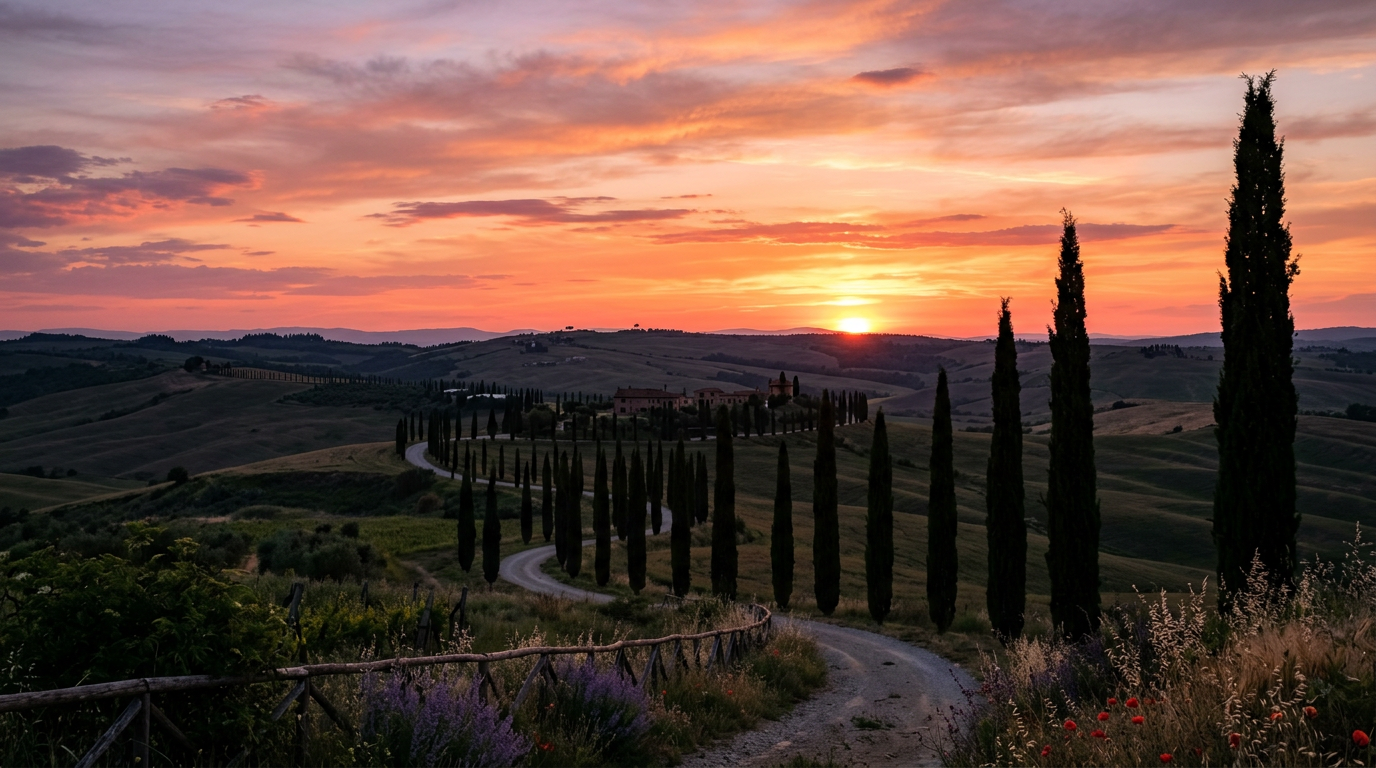
Tuscany sunset: the best spots near Barberino Val d'Elsa
Tuscany at sunset is one of those experiences that becomes a reference point for everything else. The quality of the light here in late afternoon, filtered through warm air and reflecting off limestone hills and terracotta rooftops, creates a visual atmosphere that feels almost theatrical.
Near Barberino Val d’Elsa you have access to hilltop viewpoints, scenic roads, and quietly positioned villages that offer exactly the right elevation and orientation for watching the sun drop behind the Apennines in the west.
The best sunset spots in Tuscany
Tuscany is large enough that sunset quality and character varies significantly by zone. The Chianti hills and the Val d’Elsa offer a specific combination: foreground vineyard patterns, middle-distance hill profiles, and a western sky clear enough to catch the full colour shift from gold to deep orange to violet.
The Val d’Orcia, further south, has a different character at sunset. The clay hills of the Crete Senesi catch the light from below, turning terracotta and ochre. Both are exceptional but require different drives from Barberino.
For convenience and consistency, the Val d’Elsa and Chianti hills immediately around Barberino are the most practical sunset zone. You can drive to a viewpoint in 10 minutes, watch the sunset, and return for dinner without losing half the evening.
Val d’Elsa hills at sunset
The hilltop villages in the Val d’Elsa are naturally positioned for sunset viewing. Their historic function as defensive outposts means they sit at the highest points on the ridge lines, with unobstructed views in multiple directions.
San Donato in Poggio, about 8 km southeast of Barberino, has a small terrace at the edge of its medieval walls. In the afternoon the view faces directly west over the Val d’Elsa toward the Apennine profile. Arrive 30 minutes before sunset and find a position on the wall.
Certaldo Alto, about 12 km north of Barberino, offers a long view from the brick citadel across the Elsa valley. The western exposure is ideal. The village has a bar and a few restaurants where you can linger after the light drops.
The Pieve di Sant’Appiano, a Romanesque church about 3 km from Barberino along a country road, stands alone in farmland with a clear horizon to the west. It is not a formal viewpoint but the landscape around it is exceptionally open. Driving here on a clear evening produces one of the quieter and more personal sunset experiences in the area.
Scenic roads near Barberino
Several roads in the Val d’Elsa and Chianti area are as beautiful at sunset as any fixed viewpoint. The movement through changing light, with vineyards alternating with woodland and farm buildings, creates an experience that a single photograph cannot capture.
The road from Barberino Val d’Elsa to San Donato in Poggio via Sambuca is lined with cypress trees and vineyard rows. In late afternoon the low light catches the cypress shadows at sharp angles. Drive slowly.
The Chiantigiana, the SS222 from Florence through Greve to Siena, is probably the most celebrated scenic drive in Chianti. The stretch north of Greve toward Panzano in Chianti has classic Chianti landscape on both sides. In late afternoon heading south, you drive directly toward the setting sun through open vineyard country.
The secondary road from Barberino south toward Marcialla passes through mixed farmland with good western exposure. It is not signposted as a scenic route but the light on clear evenings is as good as anywhere in the area.
How to photograph the sunset
The golden hour light in Tuscany lasts about 30 to 45 minutes before the sun actually reaches the horizon. Use this time for wide landscape shots. The light is warm and directional, ideal for rendering the three-dimensionality of the hill profiles.
Shoot 10 to 15 minutes after the sun has set, during what photographers call blue hour. The sky deepens and the landscape silhouettes become more graphic. This is often a better time to photograph the cypress tree lines and village profiles than the golden hour itself.
A tripod is useful but not essential in the golden hour when light levels are still moderate. It becomes essential at blue hour and after dark.
Avoid using the flash or the phone’s night mode for landscape shots. These tools average out the tonal range and eliminate the chromatic quality of the natural light that makes Tuscan sunsets distinctive.
The less-known viewpoints
The most photographed viewpoints in Tuscany, particularly in the Val d’Orcia and along the famous cypress-lined roads near Monticchiello or Pienza, are crowded by midday and packed by sunset. Cars park along the verge for hundreds of metres and tripods outnumber trees.
The Val d’Elsa has equivalent views with none of this congestion. A few suggestions worth investigating.
The ridge road between Barberino and Poggibonsi on the eastern edge of the valley runs at about 350 metres and provides a long view north over the Elsa valley. It is a working road with no particular designation as a viewpoint.
The hill above San Gimignano to the northwest, accessible on foot trails, offers a panorama over the vineyard landscape that extends west toward the coast. San Gimignano itself is too crowded for sunset peace, but the surrounding countryside is not.
The plateau above Tavarnelle Val di Pesa, about 8 km from Barberino, has farm tracks that run along the ridge with 180-degree western views. The elevation is modest but sufficient.
Where to stay
Sogno d’Oro in Barberino Val d’Elsa puts you within a short drive of some of the finest sunset viewpoints in the Val d’Elsa and Chianti. The surrounding landscape is the subject of the view.
A stay here in spring, autumn, or early winter, when the light is at its most dramatic and the crowds are minimal, gives you Tuscany at its least theatrical and most honest.