Tavarnelle Val di Pesa: what to see and do
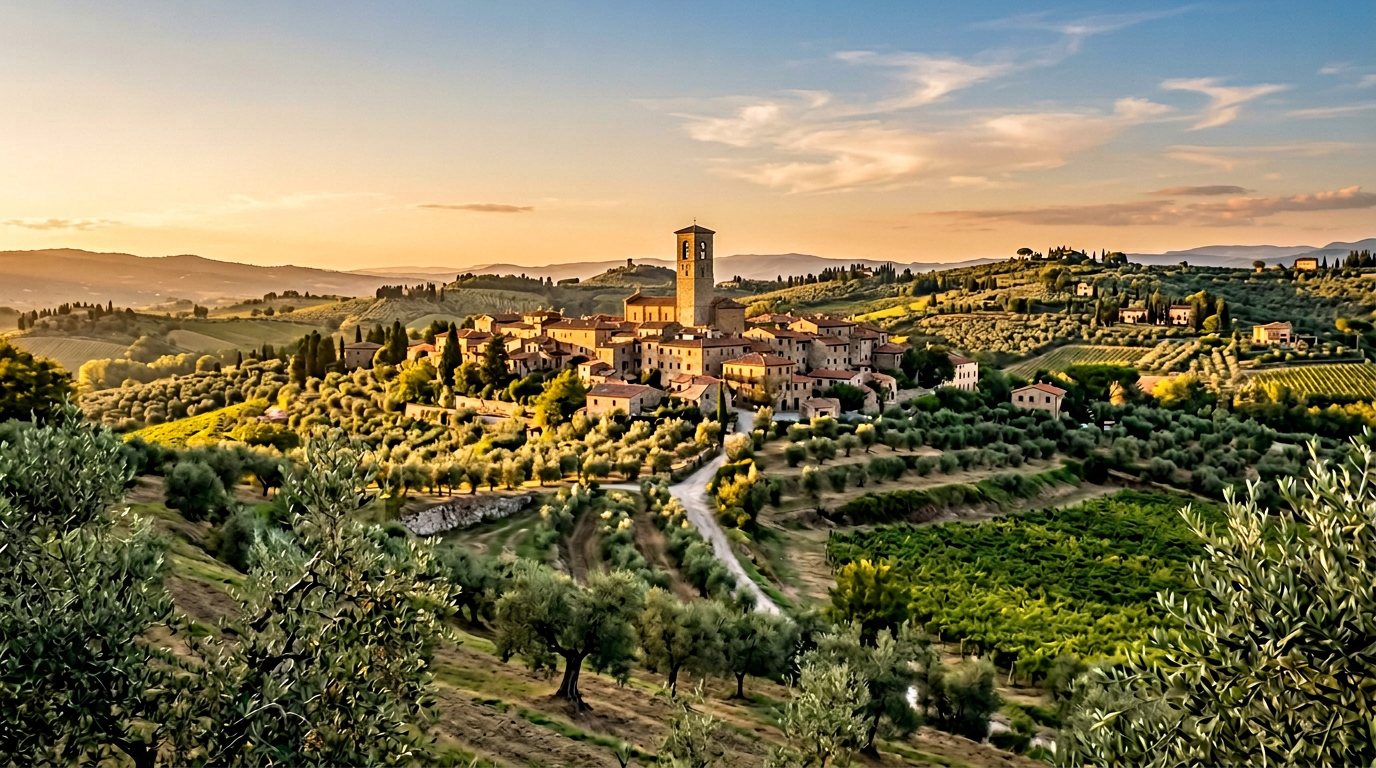
Tavarnelle Val di Pesa is one of the closest destinations from Barberino Val d’Elsa. Just 10 km away and about 12 minutes by car, it sits at the heart of the Chianti Classico wine zone in a landscape of vineyards, cypress trees, and stone farmhouses.
Since 2019, Tavarnelle Val di Pesa has merged with the neighbouring municipality of Barberino Val d’Elsa to form the new municipality of Barberino Tavarnelle. But the two communities retain their distinct characters and are still referred to separately by locals.
Tavarnelle Val di Pesa: what to do
The appeal of Tavarnelle is not concentrated in a single monument or museum. It is a working agricultural town surrounded by some of the most beautiful wine country in Tuscany. What draws people here is the landscape, the wine, and the slower pace of daily life.
The historic centre of Tavarnelle is modest but pleasant. The main street, Via Roma, has a few cafes and shops. The Church of Santa Lucia, at one end of the street, has a simple Romanesque facade and a quiet interior.
The town functions as a practical base for exploring the southern Chianti. You will find a decent supermarket, a pharmacy, several restaurants, and a local market on Friday mornings. The market sells produce, local cheese, cold cuts, and seasonal vegetables.
The surrounding countryside is well suited to slow travel. Walking and cycling routes connect Tavarnelle to nearby villages, vineyards, and abbeys. The landscape is gentle enough for most fitness levels.
The history of the village
Tavarnelle takes its name from the medieval taverns that once lined the road connecting Florence to Siena. The Via Cassia and its successor roads have passed through this valley for centuries, making the settlement a natural stopping point for travellers.
The area was contested between Florence and Siena during the medieval period, as much of the Val di Pesa and Val d’Elsa territory was. Florence eventually gained control in the 15th century, and the area remained under Florentine and later Medici influence.
The agricultural landscape visible today largely dates from the 18th and 19th centuries, when large landowners consolidated estates and planted the orderly rows of vines and olives that define the Chianti scenery.
The merger of Tavarnelle and Barberino Val d’Elsa into Barberino Tavarnelle in 2019 was one of several municipal mergers in Tuscany aimed at reducing administrative costs and improving services. The new municipality has a combined population of about 9,000.
Chianti Classico wineries
The area around Tavarnelle Val di Pesa is one of the most densely planted parts of the Chianti Classico DOCG zone. Wineries here produce wines under the Gallo Nero (Black Rooster) label, the symbol of the Chianti Classico Consortium.
Chianti Classico must be made from at least 80 percent Sangiovese grapes. It comes in three levels: the standard Chianti Classico, the Chianti Classico Riserva (aged at least 24 months), and the Gran Selezione (aged at least 30 months, from selected vineyards).
Antinori nel Chianti Classico, located a few kilometres from Tavarnelle, is one of the most architecturally striking wineries in Tuscany. The building is partly underground, integrated into the hillside. Tours and tastings are available by appointment. Tastings start at around 35 euros per person.
Isole e Olena is a smaller estate known for producing some of the finest Chianti Classico in the zone. Their wines consistently receive high critical scores. Visits by appointment. Tastings cost around 20 to 30 euros.
Castello della Paneretta is a historic estate in a converted medieval fortress. The winery produces both Chianti Classico and wines from native varieties like Canaiolo. Tastings are available by appointment and cost around 20 euros.
For a simpler experience, the local Enoteca del Chianti Classico in San Donato in Poggio, about 6 km from Tavarnelle, offers a wide selection of wines from local producers. You can taste and buy without booking.
The Badia a Passignano abbey
Badia a Passignano is one of the most important Benedictine abbeys in Tuscany. It sits about 5 km north of Tavarnelle in a small valley surrounded by vines and cypress trees. The surrounding landscape is among the most photographed in Chianti.
The abbey was founded in the 11th century and operated continuously by the Vallombrosan order. The complex includes the main church, the monastic buildings, and a set of Renaissance frescoes by Domenico and Davide Ghirlandaio. Tours of the abbey interior are available on specific days, usually Saturday and Sunday afternoons. Check with the abbey directly for current opening times.
The restaurant adjacent to the abbey, Osteria di Passignano, is one of the finest in the Chianti area. It combines serious Tuscan cooking with an exceptional wine list focused on Antinori wines. A full meal here costs around 70 to 90 euros per person. Booking is essential.
The road to Passignano from Tavarnelle is narrow and winds through some of the most beautiful vineyard scenery in Chianti. Even if you do not visit the abbey, the drive is worthwhile.
How to get there from Barberino Val d’Elsa
Tavarnelle Val di Pesa is about 10 km from Barberino Val d’Elsa. By car the drive takes around 12 minutes on the SP20 road heading north towards the Val di Pesa.
There is no regular public transport connection between Barberino and Tavarnelle. A car is the most practical option.
From Tavarnelle, Florence is about 27 km to the north, roughly 30 to 35 minutes by car. This makes Tavarnelle a convenient midpoint for a day that combines the Chianti countryside with a visit to Florence.
The local road network around Tavarnelle connects easily to San Donato in Poggio to the south, Badia a Passignano to the north, and Panzano in Chianti to the east. These connections make it easy to plan a half-day loop through several highlights of the southern Chianti.
Where to stay
Sogno d’Oro is just a few minutes from Tavarnelle Val di Pesa, set in the Val d’Elsa landscape near Barberino Val d’Elsa. The guesthouse sits at the edge of the Chianti Classico wine zone, with vineyards visible from the property and local producers within a short drive.
If you want to explore the wines of this area without covering large distances each day, this is an ideal base. The Chianti Classico countryside surrounds you on all sides.