Siena in one day: what to see
Siena is one of the great medieval cities of Europe. Unlike Florence, which rebuilt and expanded through the Renaissance and beyond, Siena has remained largely unchanged since the 14th century. Walking through its centre feels like stepping back into a world where stone, brick, and Gothic arch are the dominant visual language.
You can see the essential Siena in a single day. But it takes a certain approach. Start early, move at a deliberate pace, and save time for sitting still in Piazza del Campo.
Siena in one day: what to see
The historic centre of Siena is compact and almost entirely pedestrianized. It is divided into 17 contrade, or districts, each with its own symbol, colours, and communal identity. This system of neighbourhood loyalty has structured Sienese life since the medieval period.
The city stands on three hills, which means walking involves regular climbs and descents. Comfortable shoes are essential. The main sights - Piazza del Campo, the Cathedral, and the surrounding streets - are all within easy walking distance of each other.
A practical one-day itinerary starts at Piazza del Campo in the morning, moves to the Cathedral complex around midday, and spends the afternoon exploring the surrounding streets and neighbourhoods. Dinner in one of the trattorie near the Campo rounds off the day.
Siena is about 40 km from Barberino Val d’Elsa. You can drive there in around 35 minutes, which makes it a comfortable day trip.
Piazza del Campo and the Palio
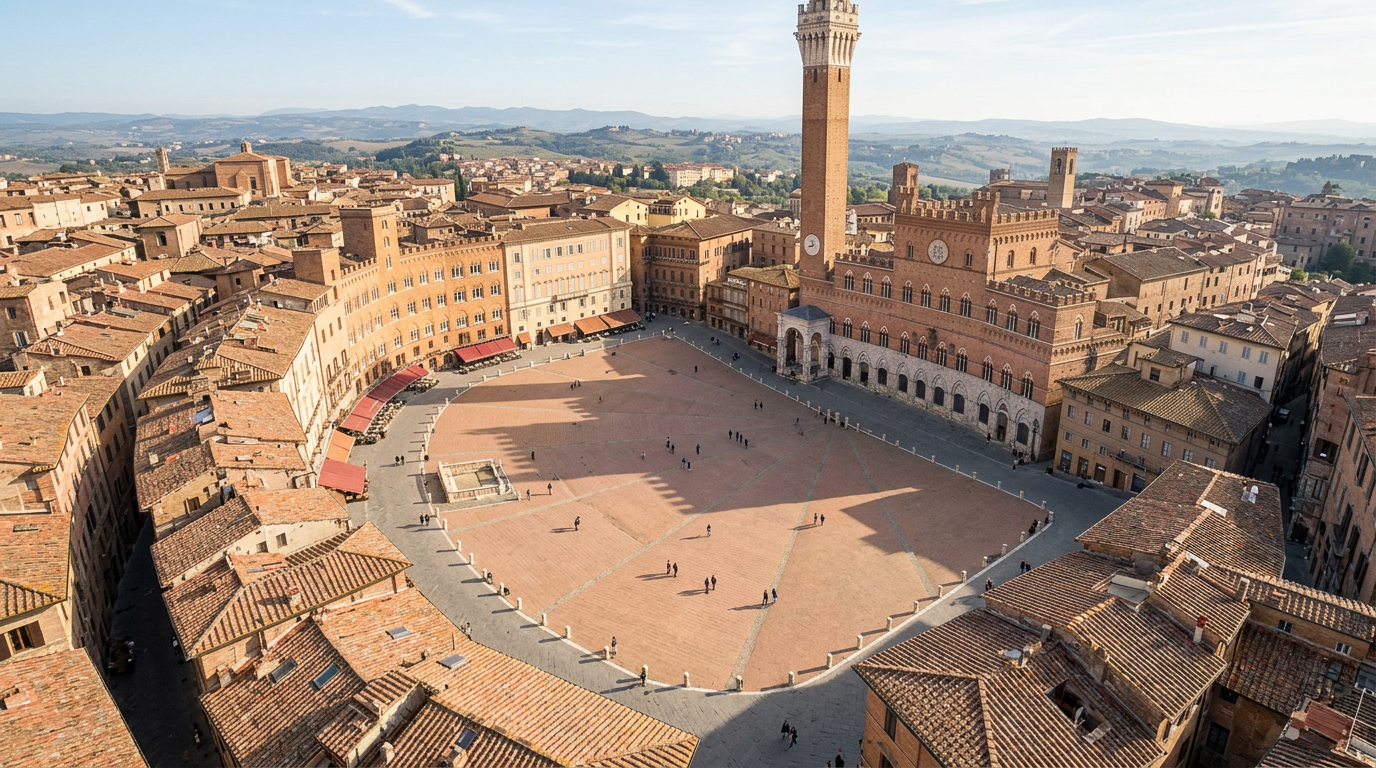
Piazza del Campo is the central square of Siena and one of the finest medieval public spaces in the world. Its shell-shaped pavement, divided into nine segments by white marble lines, slopes gently down towards the Palazzo Pubblico on the flat end.
The Torre del Mangia, the tall slender tower attached to the Palazzo Pubblico, rises 88 metres above the square. You can climb it for panoramic views over the city and the surrounding hills. Tickets cost around 10 euros. The climb involves 400 steps and no lift.
The Palazzo Pubblico itself houses the Museo Civico, which contains some of the most important secular medieval paintings in Italy. The Sala del Mappamondo has Simone Martini’s Maesta, painted in 1315. The Sala della Pace has Ambrogio Lorenzetti’s Allegory of Good and Bad Government, one of the greatest works of 14th-century European art. Museum tickets cost around 10 euros.
The Palio di Siena is the famous horse race held twice a year in the Campo, on 2 July and 16 August. Ten of the seventeen contrade participate in each race, selected partly by lot and partly by rotation. The race itself lasts about 90 seconds, but the day is filled with processions, ceremonies, and intense neighbourhood rivalry.
If you visit during the Palio, plan well in advance. Hotels book out months ahead and the city is extremely crowded. If you want to stand in the Campo during the race, arrive at least three to four hours early and be prepared to stand without leaving.
The Cathedral: what not to miss
Siena’s Cathedral, the Duomo, is one of the most richly decorated churches in Italy. The exterior alternates white and dark green marble in striped horizontal bands. The facade is an accumulation of Gothic sculpture, mosaic, and architectural detail built up over two centuries.
Inside, the floor is the Cathedral’s most remarkable feature. It consists of 56 marble panel scenes, each made from inlaid marble in different colours. The subjects include biblical stories, allegories, and the Sibyls. Most panels are covered for protection and revealed only for a limited period each year, usually between August and October.
The Piccolomini Library attached to the north wall contains a cycle of frescoes by Pinturicchio depicting the life of Pope Pius II. The colours are among the brightest of any 15th-century fresco cycle in Italy. Do not skip this even if you are running short of time.
The Cathedral complex also includes the Baptistery, the Crypt with its recently rediscovered 13th-century frescoes, and the Museo dell’Opera del Duomo. A combined ticket covers most of these and costs around 15 euros. Individual tickets are slightly cheaper but less flexible.
Opening hours for the Cathedral are approximately 10:00 to 17:30 from Monday to Saturday and 13:30 to 17:30 on Sundays. Hours change seasonally, so check before you go.
The medieval Gothic centre
Beyond the Campo and the Cathedral, Siena rewards aimless walking. The streets between the main sights are full of medieval palazzi, small churches, and the flags and symbols of the various contrade.
Via di Citta runs along the ridge connecting the Campo to the Cathedral complex. It is lined with medieval and Renaissance palazzi, including Palazzo Chigi-Saracini, which houses a music academy and often has concerts open to the public.
The neighbourhood of Terzo di Camollia to the north of the Campo is less touristy and gives a better sense of daily Sienese life. The Basilica di San Francesco and the Basilica di Sant’Agostino are both worth a brief visit.
For lunch, try Osteria Il Vinaio on Via dei Termini. It is small, unpretentious, and good value. Expect around 20 to 25 euros for a full meal. For a more formal lunch, Osteria le Logge on Via del Porrione is one of the best traditional restaurants in the city, at around 40 to 50 euros per person.
Siena’s local pastry is ricciarelli, almond-based soft biscuits with icing sugar. Panforte, a dense spiced cake with dried fruit and nuts, is another specialty. Both are available in most pastry shops and cafes in the centre.
How to get there from Barberino Val d’Elsa
Siena is about 40 km from Barberino Val d’Elsa. The drive takes around 35 minutes by car via the SR2 southbound. This is a straightforward and mostly fast road through the Chianti countryside.
By train, Siena is accessible from Poggibonsi-San Gimignano station. From Barberino Val d’Elsa you would need to drive or take a bus to Poggibonsi first. The train from Poggibonsi to Siena takes about 30 minutes. A train ticket costs around 4 to 5 euros.
There are also direct bus services from Florence to Siena operated by FlixBus and Sena. These stop in various towns along the way and can be a convenient option if you are arriving from Florence.
By car, parking inside Siena’s ZTL zone (restricted traffic zone) is not permitted without a special permit. Park in one of the car parks outside the walls. Il Campo park and Santa Caterina park are the closest to the centre. A day’s parking costs around 2 to 3 euros per hour in most surface parks.
Where to stay
Sogno d’Oro is set in the Val d’Elsa landscape near Barberino Val d’Elsa. From here, Siena is less than 40 minutes by car, making it an easy day trip without an early start or a long drive.
The quiet countryside setting means you return to fresh air and open views after a day in one of Tuscany’s most visited cities. That contrast - medieval urban density and calm rural landscape - is part of what makes slow travel in this region so satisfying.