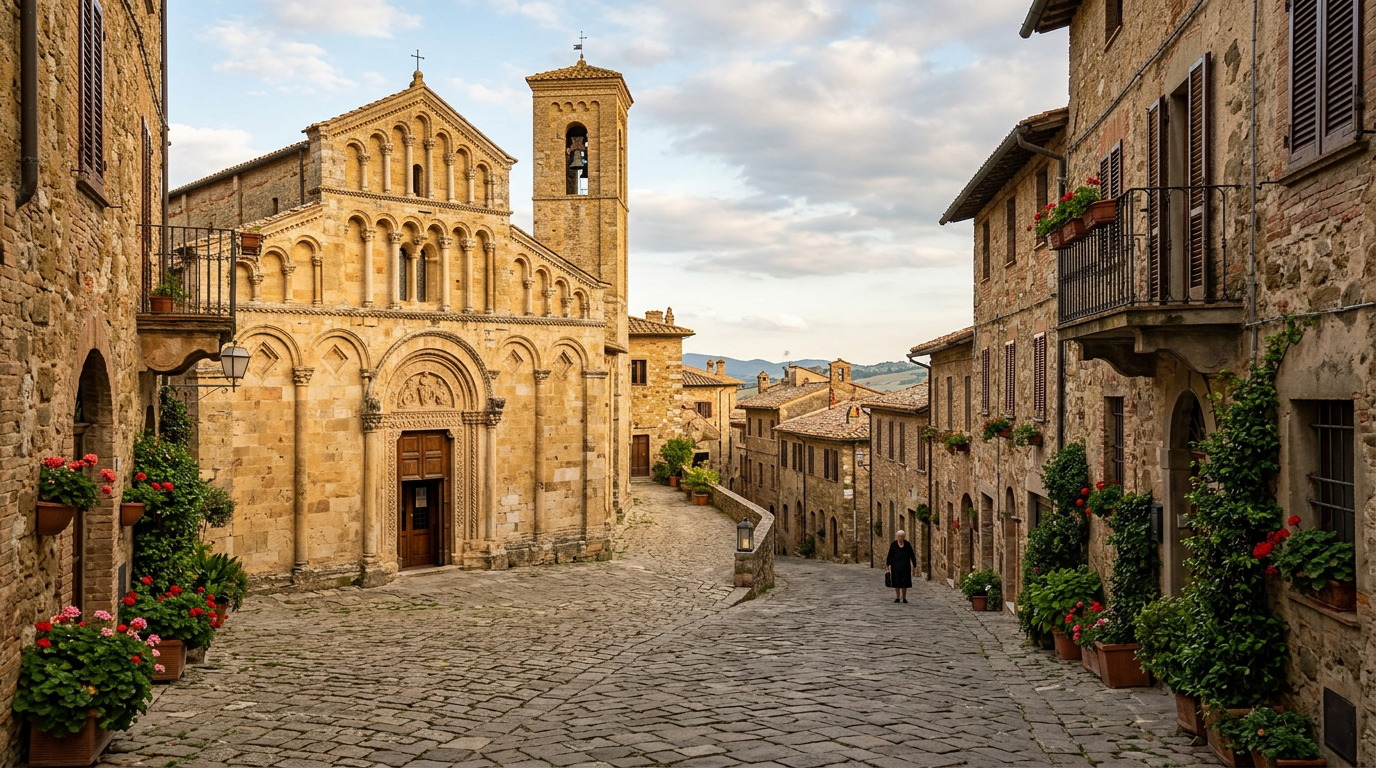
San Quirico d'Orcia: what to see and how to get there
San Quirico d’Orcia is a small medieval town in the Val d’Orcia, sitting on a modest hill between Siena and Radicofani. It is not as famous as Pienza or Montalcino but it has a quality of architectural and natural beauty that rewards a morning or afternoon spent without a fixed agenda.
From Barberino Val d’Elsa the distance is about 75 km and the drive takes roughly 65 minutes on the SR2 Cassia south through Siena and then toward the Val d’Orcia.
San Quirico d’Orcia what to see
San Quirico d’Orcia was an important stop on the Via Francigena, the medieval pilgrimage route from Canterbury to Rome. The town’s main monuments reflect this period of traveller traffic and ecclesiastical investment.
The historic centre is compact. You can see the main sites in two to three hours on foot. The streets are quiet and the town feels genuinely inhabited rather than preserved for tourism. People live and work here. Shops and bars serve locals as much as visitors.
Begin at the main gate on the northern side of the town. The corso (main street) leads directly south toward the Collegiate Church. Side streets to the east and west reveal medieval buildings, small piazzas, and views over the surrounding Val d’Orcia landscape.
The Collegiate Church and Horti Leonini
The Collegiate Church of SS. Quirico e Giulitta stands at the intersection of the Via Francigena and the town’s main road. It is one of the finest Romanesque churches in Tuscany.
The most remarkable feature is the three portals. Each was carved in a different period, from the early 12th century to the 14th, and each uses a different vocabulary of stone decoration. The main portal has twisted columns resting on lions and female figures. The detailing is intricate and unusually well preserved.
Inside the church the space is austere and calm. A polyptych by Sano di Pietro is the main artwork. The stone floor, carved wooden choir, and the quality of silence in the interior are themselves worth the visit.
The Horti Leonini is a formal Italian garden on the southern edge of the historic centre. It was laid out in 1580 and designed around geometric hedges of holm oak and box, with a central statue of Cosimo III de’ Medici. Entry is free.
The garden provides shade, seating, and a composed view over the countryside. In summer it is a relief from the heat. In autumn, with the surrounding landscape turning ochre and gold, it is quietly beautiful.
Bagno Vignoni: the historic baths
Bagno Vignoni is 5 km south of San Quirico d’Orcia on the road toward Abbadia San Salvatore. The drive takes 8 minutes.
The thermal spring here has been in use since Etruscan times. The Romans built baths. In the Middle Ages the hot water became a stopping point for pilgrims on the Via Francigena. Lorenzo de’ Medici and Pope Pius II both came to take the waters.
The central piazza is entirely occupied by the vasca grande, the large thermal basin built during the Renaissance. The water is no longer used for bathing in the main pool since a preservation order in the 1990s. But it remains filled with steaming thermal water and the effect of walking into a village square and finding a large smoking pool instead of paving stones is arresting.
Below the village the thermal water continues into the gorge of the Orcia river. A short path leads down from the village to the old Mulino (mill) and the natural hot springs at the base of the cliff. The walk is 20 to 30 minutes and is accessible to anyone who can manage uneven stone steps.
Several hotels in Bagno Vignoni offer thermal pool access to day visitors. Terme Posta Marcucci and Adler Thermae both have outdoor pools fed by the thermal spring at around 38 to 40 degrees.
Palazzo Chigi Zondadari
The Palazzo Chigi Zondadari stands in the central Piazza della Libertà of San Quirico, facing the Collegiate Church. It was built in the 18th century and served as a summer residence of the noble Chigi family.
The exterior facade is the most visible feature. The palace is not always open to visitors but the ground floor and loggia can be seen from the piazza. Temporary exhibitions are occasionally held inside.
The building anchors the piazza visually and provides the architectural counterpart to the religious authority represented by the Collegiate Church opposite. The piazza itself, with the palace on one side and the church on the other, is one of the more harmonious small-town spaces in the Val d’Orcia.
How to get there from Barberino Val d’Elsa
Take the SR2 Cassia south from Barberino. Follow the road through the Siena ring road (raccordo), then continue south on the SR2 toward Buonconvento. After Buonconvento, follow signs for San Quirico d’Orcia on the SR2.
The total distance is about 75 km and the drive takes approximately 65 minutes. Traffic is light for most of the route except around Siena at peak hours.
Parking in San Quirico d’Orcia is available outside the historic walls. The car parks on the northern side are the most convenient and free of charge.
From San Quirico you can combine the visit with Bagno Vignoni (5 km), Montalcino (26 km west), and Pienza (25 km east) on the same day without excessive driving.
Where to stay
Sogno d’Oro in Barberino Val d’Elsa is 65 minutes from San Quirico d’Orcia, making it a practical base for a Val d’Orcia day trip.
The guesthouse offers a peaceful return after a day in the medieval town and the thermal village, with the Val d’Elsa countryside as the landscape of your morning and evening.