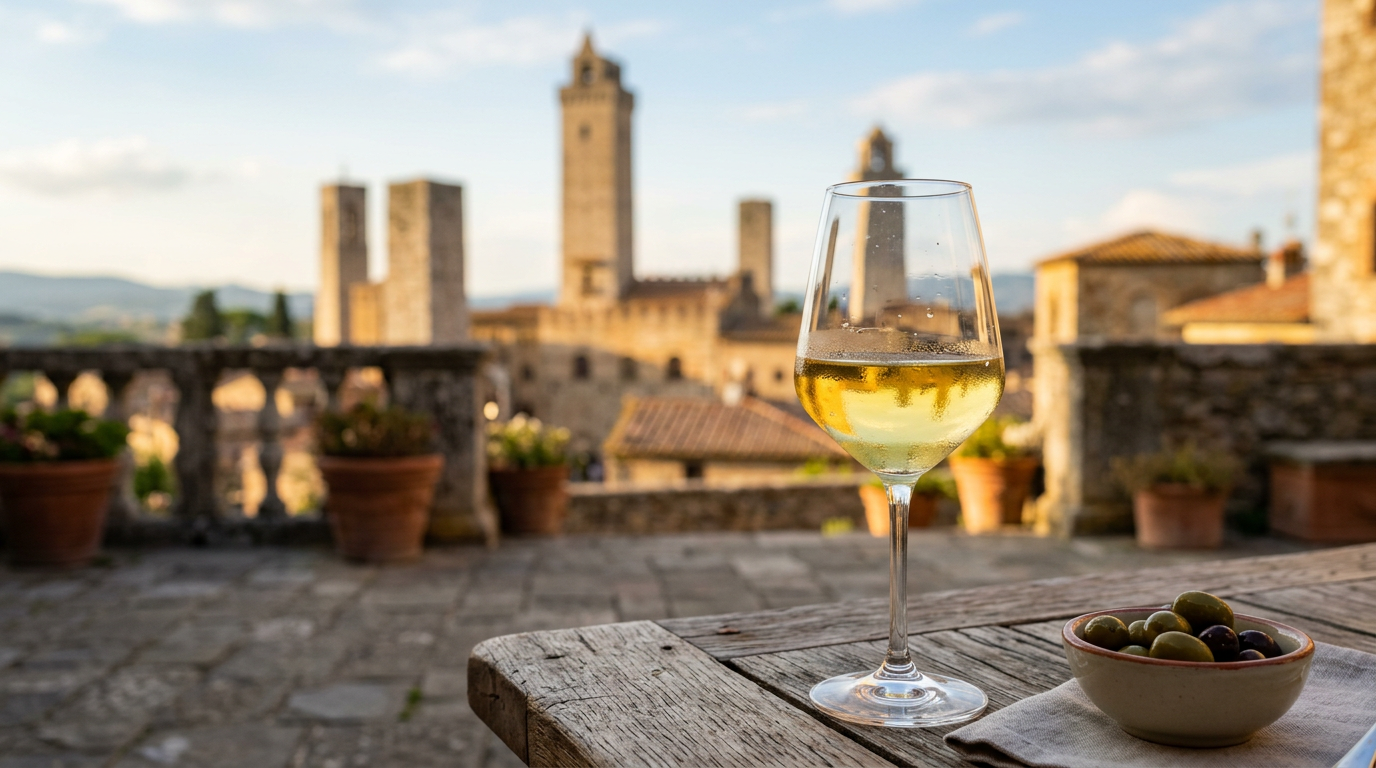
Vernaccia di San Gimignano: the white wine
Vernaccia di San Gimignano is the most important white wine in Tuscany. While the region is famous for its red wines - Brunello, Chianti Classico, Montepulciano - Vernaccia stands apart as a white wine of real character: dry, mineral, and with a distinctive bitter finish that pairs well with a wide range of foods.
San Gimignano is about 28 km from Barberino Val d’Elsa and about 30 minutes by car. The town itself is one of the most visited in Tuscany, famous for its 14 surviving medieval towers. But beyond the tourist crowds, the wine culture here is serious and the quality of good Vernaccia is remarkable.
Vernaccia di San Gimignano
Vernaccia di San Gimignano was the first Italian wine to receive DOC status, in 1966. It was elevated to DOCG in 1993. These designations recognize both the historical importance and the quality potential of the wine.
The Vernaccia grape is unique to San Gimignano. It is not closely related to the Vernaccias grown in other parts of Italy (Vernaccia di Oristano in Sardinia, for example, is a completely different variety). The San Gimignano Vernaccia has its own distinct genetic identity.
The wine is made in two main styles. The standard Vernaccia is crisp, fresh, and aromatic. It shows flavours of apple, pear, almond, and white flowers. The finish has a characteristic bitter note, slightly mineral, that is different from most other Italian whites.
The Riserva version requires additional aging, at least 11 months including at least four in wood. Riserva Vernaccia tends to have more weight, a golden colour, and flavours that develop towards honey, stone fruit, and oxidative notes. It pairs well with richer foods.
The most famous Tuscan white wine
Vernaccia di San Gimignano was mentioned by Dante in the Divine Comedy and praised by later writers as one of the finest wines of medieval Italy. In the 13th and 14th centuries, San Gimignano was a prosperous merchant town on the Via Francigena, and Vernaccia was one of its main exports.
The wine fell out of fashion during the 20th century, partly because of poorly made industrial versions that damaged its reputation. From the 1980s onwards, a generation of producers rebuilt the quality of Vernaccia di San Gimignano and restored its standing.
Today the DOCG zone covers about 850 hectares of vineyard in the hills around San Gimignano. About 70 producers are registered. The wine association, the Consorzio della Vernaccia di San Gimignano, organises quality controls, promotions, and the annual Vernaccia di San Gimignano wine fair.
The production zone is defined by the hills surrounding the town. Altitude ranges from 200 to 450 metres. The soils are predominantly clay and silt with good mineral content. The combination of altitude, well-drained soils, and the specific microclimate of the San Gimignano hills is considered essential to the wine’s character.
Wineries where to taste it
Several Vernaccia di San Gimignano producers are excellent and accessible to visitors.
Teruzzi is one of the largest and most visited producers. It played a key role in rebuilding Vernaccia’s reputation in the 1980s and 1990s. The estate is about 3 km from San Gimignano and accepts visitors for tastings and cellar tours. Tastings start at around 15 euros.
Panizzi, about 6 km from San Gimignano near Racciano, produces some of the finest Vernaccia di San Gimignano available. The Riserva is consistently excellent. Visits by appointment. Tastings cost around 20 euros.
Falchini is a family estate about 4 km from San Gimignano that has been producing Vernaccia since the 1960s. The wines are well made and reasonably priced. Visits by appointment.
Il Colombaio di Santa Chiara, near the town walls, is a smaller producer known for delicate, aromatic Vernaccia. The estate also produces good Rosso di Sangimignano, the local red wine. Visits by appointment.
For tastings without advance booking, the Vernaccia di San Gimignano Wine Experience museum in the town centre offers a structured tasting of multiple producers’ wines with food pairings. Entrance and tasting costs around 12 to 18 euros. The museum also has historical displays on the wine and the town.
How to pair Vernaccia
Vernaccia di San Gimignano is a food wine. Its mineral character and bitter finish make it versatile with many dishes.
The classic pairings are with fish, shellfish, and lightly cooked vegetables. The standard Vernaccia is ideal with grilled sea bass, steamed mussels, or a simple pasta with clams. The mineral bitterness cuts through the richness of seafood.
With Tuscan cuisine, Vernaccia pairs well with the crostini toscani (chicken liver crostini) that appear on almost every local menu. It also works with fresh sheep’s milk cheese, mild salumi, and light vegetable soups.
The Riserva, with its more complex character, suits richer dishes: pasta with truffle, risotto with porcini mushrooms, or roast white meat. The oxidative notes in the Riserva pair particularly well with aged cheese.
Vernaccia is also a good aperitivo wine. Its freshness and relatively low alcohol (typically 12 to 13 percent) make it suitable for drinking before a meal.
Serving temperature is important. Standard Vernaccia should be served at 10 to 12 degrees Celsius. Riserva can be served slightly warmer, at 12 to 14 degrees.
How to get there from Barberino Val d’Elsa
San Gimignano is about 28 km from Barberino Val d’Elsa. By car the drive takes around 30 minutes.
The most direct route goes south-west from Barberino on the SR2 to Poggibonsi, then west on the SP1 towards San Gimignano. The final approach climbs through vineyard land and offers good views of the famous towers as you approach.
Parking in San Gimignano is outside the town walls. The main car parks are at Porta San Giovanni to the south, Porta San Matteo to the north, and Piazzale Martiri di Montemaggio. Parking costs around 2 euros per hour or 8 to 10 euros for a full day. The car parks fill up quickly in summer. Arrive before 9:30 or after 17:00 to avoid the worst congestion.
By bus, regular services connect San Gimignano to Poggibonsi, Florence, and Siena. From Barberino Val d’Elsa, a bus change at Poggibonsi is required. Total journey by bus: about 45 to 60 minutes including the change.
Where to stay
Sogno d’Oro is set in the Val d’Elsa near Barberino Val d’Elsa. San Gimignano is 28 km to the west, making it one of the easiest day trips from the guesthouse.
After a morning exploring the towers and tasting Vernaccia, you can return to the Val d’Elsa in the early afternoon. The contrast between the tourist bustle of San Gimignano and the quietness of the Val d’Elsa countryside is immediate and welcome.