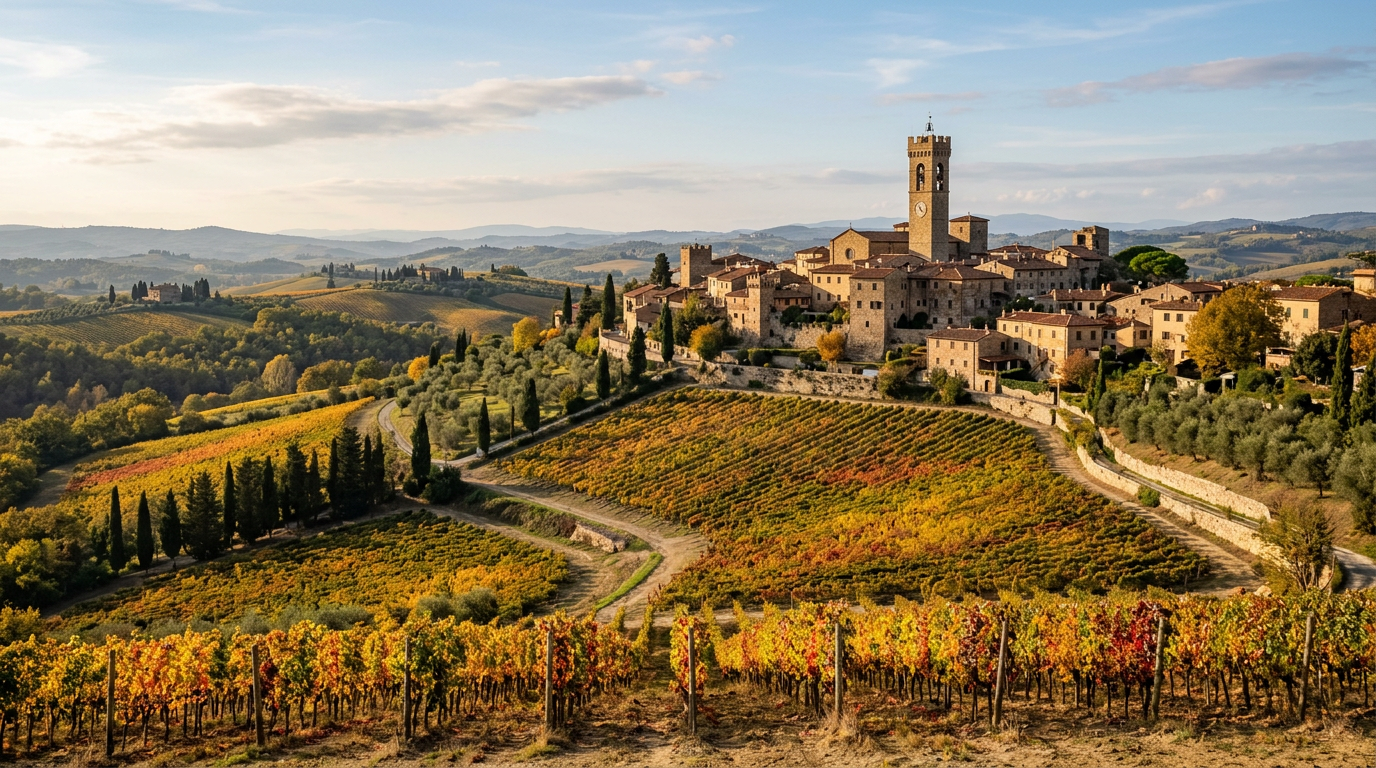
San Casciano Val di Pesa: what to see
San Casciano Val di Pesa is a small town of about 17,000 people on the northern edge of the Chianti Classico zone, roughly midway between Florence and Barberino Val d’Elsa. It is 15 km from Barberino and about 18 minutes by car.
It is not a dramatic hilltop village like San Gimignano or Monteriggioni. San Casciano is a working town with a real economy: wine production, agriculture, some industry. But the historic centre has genuine medieval buildings, a remarkable Sacred Art Museum, and a position at the heart of some of the best Chianti Classico wine country.
San Casciano Val di Pesa: what to see
The historic centre of San Casciano Val di Pesa is compact and well preserved in its central area. The main street, Via Roma, runs through the heart of the old town from one gate to the other.
The town sits on a ridge between the Pesa and Greve river valleys. The surrounding landscape is classic northern Chianti: rolling hills planted with Sangiovese vines, punctuated by cypress trees, stone farmhouses, and occasional towers.
San Casciano was part of the Florentine territory from the 14th century onwards. The town walls, still largely intact, date from this Florentine period. The defensive perimeter follows the ridge and has three main gates.
The town is more visited by Italians than by international tourists, which means the atmosphere is authentic and prices in restaurants and shops are more moderate than in tourist-heavy Chianti towns.
Historic centre and walls
The historic centre of San Casciano Val di Pesa has several buildings worth seeing, concentrated in the area around the main square and the town walls.
Piazza della Repubblica is the main square. It is surrounded by medieval and post-medieval buildings and has a fountain in the centre. The area is used for the weekly Thursday market and various local festivals.
The town walls date primarily from the 14th and 15th centuries. Three towers survive: the Torre dei Portici, the Torre del Trecento, and a third tower incorporated into a private building. Walking the outer edge of the walls takes about 20 minutes and gives views over the Pesa valley to the west.
The Porta Senese at the south end of the main street is the best-preserved gate. It has a pointed arch and flanking towers in local stone. Photography here is good in the late afternoon light.
The Church of Santa Maria del Gesù, inside the walls on Via Machiavelli, has a 14th-century facade and an interior with works from the same period. Nicolo Machiavelli, the political philosopher, owned a property just a few kilometres from San Casciano. His house, the Sant’Andrea in Percussina farm, is about 5 km north of town and can be visited.
Sacred Art Museum
The Museo di Arte Sacra di San Casciano Val di Pesa is one of the most significant small art museums in the Chianti area. It is housed in the Church of Santa Maria del Gesù and the adjacent convent buildings.
The collection contains works from churches in San Casciano and the surrounding territory, spanning the 13th to 17th centuries. The quality of several pieces is exceptional.
The most important work is a Crucifix by Simone Martini, painted around 1315 to 1320. Simone Martini was one of the leading Sienese painters of the 14th century, known for his refined Gothic style and expressive figures. The San Casciano crucifix is one of the few panel paintings by him outside major museums.
The collection also includes works attributed to Ambrogio Lorenzetti, Lippo di Benivieni, and several other Florentine and Sienese painters of the Trecento and early Quattrocento.
Entrance to the museum costs around 5 euros. Opening hours are Tuesday to Sunday, 10:00 to 13:00 and 15:00 to 19:00. Closed Mondays.
Nearby Chianti Classico wineries
San Casciano Val di Pesa is surrounded by Chianti Classico estates. The town is at the northern end of the wine zone, where the wines tend to be slightly lighter and more aromatic than those from the warmer southern part of the area near Gaiole.
Antinori nel Chianti Classico, one of the most architecturally distinctive wineries in Tuscany, is about 8 km south-east of San Casciano near Bargino. The winery is built partially underground, integrated into the hillside. Tours and tastings are available by appointment, starting at around 35 euros.
Castello di Gabbiano, about 5 km south of San Casciano, is a large estate with a medieval castle. Tastings are available and tours of the castle can be arranged. The Chianti Classico wines here are consistent and well priced.
Villa Cerna, about 4 km from San Casciano on the road to Greve in Chianti, is owned by the Cecchi family and produces reliable Chianti Classico. Visits are available by appointment.
For a less formal tasting, the Enoteca del Chianti in San Casciano town centre offers wines by the glass from local producers. It is a good starting point for understanding the range of styles produced in this northern Chianti territory.
How to get there from Barberino Val d’Elsa
San Casciano Val di Pesa is about 15 km from Barberino Val d’Elsa. By car the drive takes around 18 minutes.
The most direct route follows the SP20 north from Barberino towards Tavarnelle Val di Pesa, then continues on the SP1 north towards San Casciano. The road passes through the heart of the Chianti Classico countryside.
By bus, the Busitalia network connects San Casciano to Florence on a relatively frequent service. From Barberino Val d’Elsa, direct connections are limited. The car is the practical choice.
Parking in San Casciano is available in several car parks outside the historic centre. The most convenient is near the Porta Senese. Parking is generally free.
Where to stay
Sogno d’Oro is positioned near Barberino Val d’Elsa in the Val d’Elsa landscape. San Casciano is 15 km to the north, at the edge of the Chianti area closest to Florence.
This proximity makes San Casciano a natural stop on a day that combines a morning in Florence with an afternoon of wine and art in the Chianti countryside. The driving distances are short and the roads are pleasant.