Val d'Elsa local festivals 2026: what to see and eat
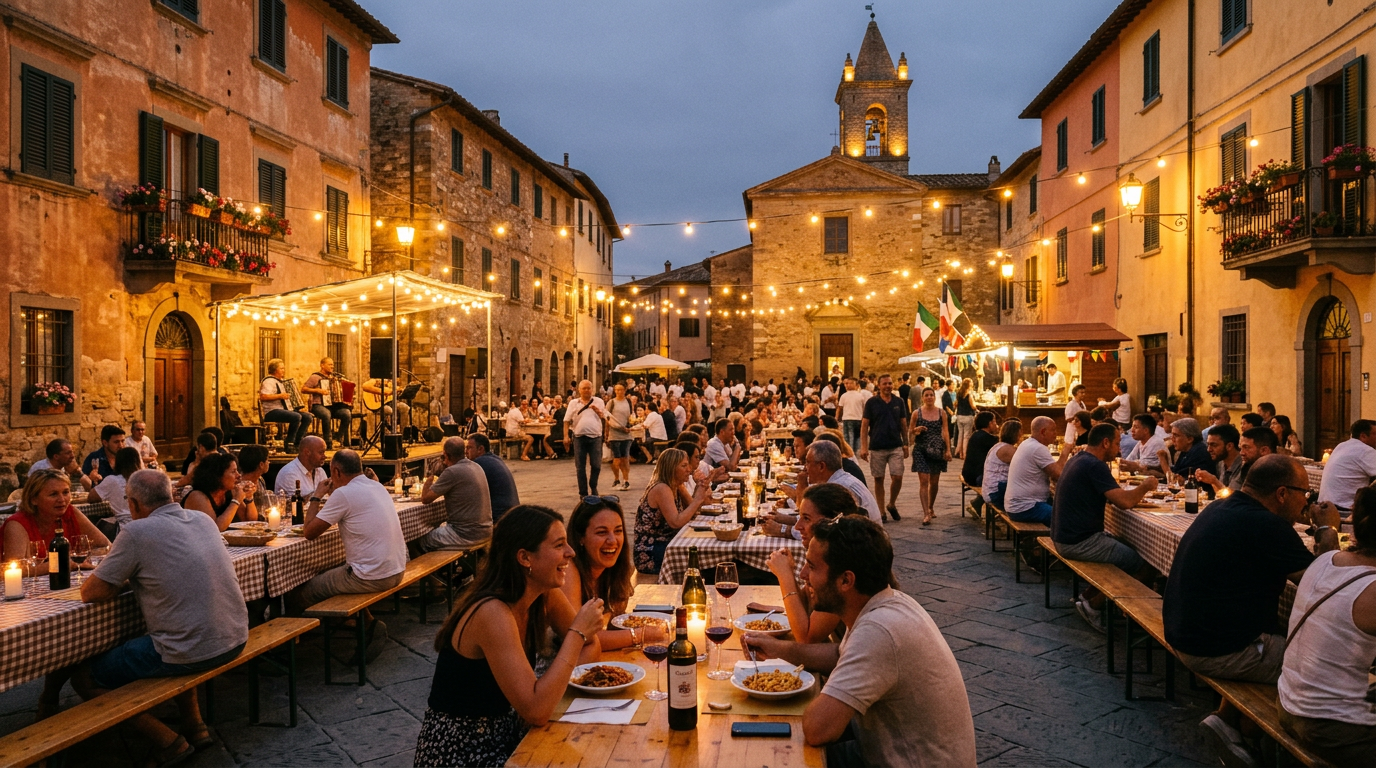
Local festivals, called sagre, are one of the most unfiltered ways to experience daily life in rural Tuscany. They are organised by Pro Loco associations and local volunteers, run in village squares or under long tents at the edge of town, and focus on a specific local food or tradition.
The Val d’Elsa has a dense calendar of sagre from spring through autumn. If you are staying near Barberino Val d’Elsa, you are likely to have two or three within 15 km of you on any given weekend between June and October.
Val d’Elsa local festivals in 2026
The sagra calendar in the Val d’Elsa follows a reliable seasonal rhythm. Spring brings the first events in May. The summer months are the most active, with events in June, July, and August. Autumn festivals, often centred on the harvest, mushrooms, or truffles, run through October and into November.
Each sagra is independent and locally organised. There is no central booking system. You simply arrive, queue at the counter, order your food, and find a seat at the long communal tables.
The atmosphere is casual and welcoming. Families with children, elderly couples, groups of friends: this is a cross-section of the local population eating together outdoors on a summer evening. Visitors who arrive without expectations and are willing to communicate through gesture and goodwill are almost always welcomed warmly.
The festivals not to miss
The sagra della bistecca in the Chianti and Val d’Elsa area is one of the most celebrated annual events. Enormous T-bone steaks from Chianina cattle are grilled over wood coals and sold by weight. The setting is usually a field or a sports facility edge, the smoke is visible from a kilometre away, and the queues are part of the ritual.
Certaldo, 12 km from Barberino, holds the Mercato Medievale in summer and has a strong tradition of local food events in the historic upper town. The town is built on a hill and the evening view over the Val d’Elsa is excellent.
San Donato in Poggio, about 8 km from Barberino, is a walled medieval village that organises events tied to the grape harvest and local wine in September. The village is small enough that the festival fills every corner of it.
Tavarnelle Val di Pesa, about 8 km away, holds its own summer sagre including pasta events and grilled meat evenings. These attract a mix of locals and visitors from the wider area.
Nearby Poggibonsi, 10 km from Barberino, hosts the Palio di Poggibonsi and various other community events throughout the summer. The town is not a tourist destination but its events are lively and authentic.
What you eat at local festivals
The menu at a Val d’Elsa sagra is rooted in Tuscan tradition and priced for local budgets. Expect to spend 8 to 15 euros for a full meal.
Typical starters include bruschetta with olive oil or tomato, crostini con fegatino (chicken liver crostini), and panzanella in summer. First courses are usually pasta: pici al ragu, pappardelle with wild boar, or ribollita if the weather is cool.
Second courses feature grilled or roasted meats. Bistecca, salsiccia (pork sausage), pollo arrosto, and trippa (tripe) all appear on different menus. Some sagre focus on a single ingredient and build the entire menu around it.
Desserts at sagre are unpretentious: cantucci with vin santo, crostata with jam, or simple fruit tarts. House wine is served in ceramic jugs or carafes and costs 1 to 2 euros per glass.
Everything is prepared by volunteers. The quality varies but it is always honest. The context of eating under a tent with strangers on a warm night, with the sound of conversation around you, adds something no restaurant can replicate.
How to find the updated calendar
There is no single comprehensive digital calendar for Val d’Elsa sagre. The most reliable sources are local.
The Pro Loco websites for individual towns in the area often publish their own event calendars. The websites for Barberino Val d’Elsa, Tavarnelle Val di Pesa, Certaldo, Colle di Val d’Elsa, and Poggibonsi are all worth checking in the week before your visit.
The Toscana Promozione Turistica website and regional tourism portals sometimes aggregate sagra listings, but these are often incomplete and not updated in real time.
Asking locally is the most reliable method. Your host at Sogno d’Oro, the person at the bar in Barberino, or the staff at a local alimentari will know what is happening in the area that weekend. This knowledge is often not online anywhere.
Look at physical notice boards in villages. The annuncio (notice) for a local sagra is often printed on a simple A4 sheet and pinned to a board near the church or the town hall a week or two before the event.
Why local festivals are worth the detour
Sagre exist outside the tourism infrastructure. They are funded by community contributions, organised by people who live there, and attended primarily by locals. This makes them different from wine fairs or food festivals designed around visitor spending.
You eat food that reflects what people in the area actually choose to eat when they celebrate. You sit at tables set for a community dinner, not for a curated experience. The conversations that start accidentally at a shared table can be among the best of a trip.
Bring cash. Most sagre do not accept card payment. A simple phrase in Italian, even just grazie and buonasera, goes a long way.
Where to stay
Sogno d’Oro in Barberino Val d’Elsa is at the centre of this network of local festivals. Several of the best sagre in the Val d’Elsa are within 10 to 15 minutes by car.
Staying here means you can attend an evening festival, return on foot or by a short drive, and wake up the next morning ready for whatever the day holds.