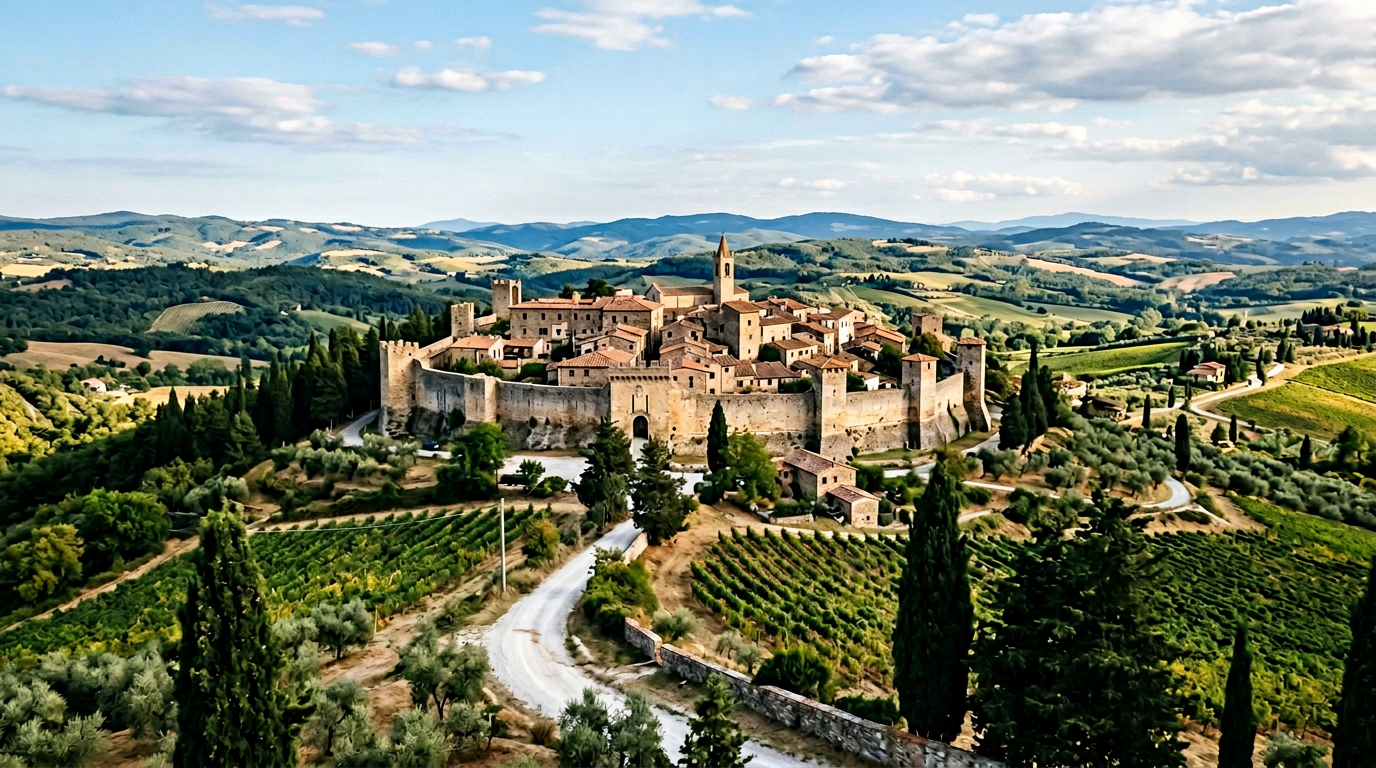
Radda and the medieval villages of Chianti
The area around Radda in Chianti contains some of the best-preserved medieval villages in Tuscany. While Radda itself is the main town, the real gems in this territory are the tiny hamlets scattered across the Chianti hills within a radius of 10 to 15 km.
Volpaia and Vertine are the most outstanding. Both have intact medieval walls, stone buildings unchanged for centuries, and an atmosphere of quiet completeness that is rare in a region as visited as Tuscany.
Radda and the medieval villages of Chianti
The territory of Radda in Chianti covers about 85 square kilometres of hills and valleys between the Pesa and Arbia rivers. The altitude ranges from about 250 to 700 metres, creating different microclimates and soil conditions across a relatively small area.
The medieval settlement pattern in this territory consisted of a network of small fortified villages and isolated farmhouses connected by mule tracks and later by white gravel roads. Many of these settlements survive today, though some have only a handful of permanent residents.
Radda itself is the main service centre, with shops, restaurants, a pharmacy, and a wine bar. From Radda you can reach all the villages described in this article within 15 to 20 minutes by car.
The best way to explore this territory is by combining short drives between villages with walks through the countryside. The roads are mostly paved but narrow. The landscape between the villages is beautiful enough to justify slowing down.
Nearby villages to visit
Several hamlets in the Radda territory are worth a detour. Each has its own character and offers a different view of medieval rural Tuscany.
Badia a Coltibuono, about 7 km north of Radda, is a former Benedictine abbey that has functioned as a wine estate for over a century. The monastery complex is largely intact, with a Romanesque church, a cloister, and original medieval buildings. The estate produces excellent Chianti Classico. Tastings are available by appointment.
Ama, about 10 km south of Radda, is the hamlet that gives its name to Castello di Ama, one of the most prestigious estates in the Chianti Classico zone. The tiny hamlet itself is worth seeing. The winery is known not only for its wines but for an extraordinary collection of contemporary art installations by international artists, integrated into the estate buildings.
San Polo in Rosso, about 8 km south-east of Radda, is a hamlet with a 12th-century Romanesque chapel in excellent condition. The setting, in a narrow valley surrounded by forest and vineyard, is particularly beautiful in autumn.
Campomaggio, a few kilometres from Radda on a gravel road, is a tiny cluster of stone houses that feels almost abandoned. A handful of residents remain. The surrounding countryside, visible from the edge of the hamlet, is pure, unmodified Chianti landscape.
Volpaia: the fortress village
Volpaia is about 6 km north of Radda. It is one of the finest and best-preserved small medieval villages in Tuscany. The entire hamlet is essentially a fortified compound built in the 12th century and subsequently modified without ever losing its medieval character.
The entrance gate leads directly into a small piazza surrounded by stone buildings. The main tower, the Torre di Volpaia, rises above the cluster of houses. Several of the buildings in the village are occupied by the Castello di Volpaia wine estate, which produces some of the most respected Chianti Classico in the zone.
The village has a small osteria where you can eat and taste local wines. The combination of the medieval setting, the quality of the wine, and the quietness of the place makes it one of the most rewarding stops in the entire Chianti.
Tasting at Castello di Volpaia starts at around 25 euros and must be booked in advance by phone or email. The Riserva and Gran Selezione are the highlights of the range.
Volpaia is best visited on a weekday. At weekends in summer it can be surprisingly busy for such a small village.
Vertine: the intact village
Vertine is about 5 km north of Gaiole in Chianti and about 15 km from Radda. It is arguably the most intact medieval village in the entire Chianti zone. The walls are complete, the buildings inside are all original, and the population is so small that the village feels on the edge of abandonment.
The entrance gate, a pointed arch in grey stone, leads to a small square with a wellhead in the centre. From the square, two alleys lead to the far end of the village. Every building is medieval stone construction. No modern intervention has altered the fabric.
Views from the village walls look east over the Arbia valley and south towards Gaiole. The landscape is open and agricultural, with the characteristic Chianti mix of vineyard, olive grove, and oak woodland.
Vertine has no restaurant or wine bar. Bring your own food and water. The best time to visit is a morning in spring or autumn, when the light is soft and the village is likely to be empty.
How to plan a multi-village itinerary
A practical multi-village itinerary in the Radda area works well over a full day.
Morning: Start at Radda in Chianti. Walk the town, visit the Palazzo del Podesta, and have coffee in the main square.
Mid-morning: Drive to Volpaia (15 minutes from Radda). Walk the village and visit the Castello di Volpaia enoteca if you have booked a tasting.
Lunch: Return to Radda or stop at a winery along the way. Alternatives include Badia a Coltibuono restaurant (reservation required) or a picnic in the countryside.
Afternoon: Drive to Vertine via Gaiole (about 30 minutes from Radda). Walk the medieval village. Continue to Gaiole for a brief stop.
Late afternoon: Return to Radda or head back towards Barberino Val d’Elsa on the SR222 and SR429.
Total driving is about 70 km. The itinerary takes six to seven hours including stops and lunch.
How to get there from Barberino Val d’Elsa
Radda in Chianti is about 28 km from Barberino Val d’Elsa. By car the drive takes around 30 minutes via San Donato in Poggio and the SR429.
From Radda, Volpaia is 15 minutes north, Vertine is 30 minutes south-east, and Badia a Coltibuono is 20 minutes north-east. All routes pass through exceptional Chianti countryside.
A car is essential for this itinerary. Public transport does not serve these villages.
Where to stay
Sogno d’Oro is set in the Val d’Elsa near Barberino Val d’Elsa. The medieval villages around Radda are 30 to 45 minutes by car from the guesthouse, depending on which village you visit.
Planning a full day in this territory, with unhurried stops at two or three villages and a winery visit, is one of the most rewarding experiences the Chianti area offers. Return in the evening to the quieter landscape of the Val d’Elsa.