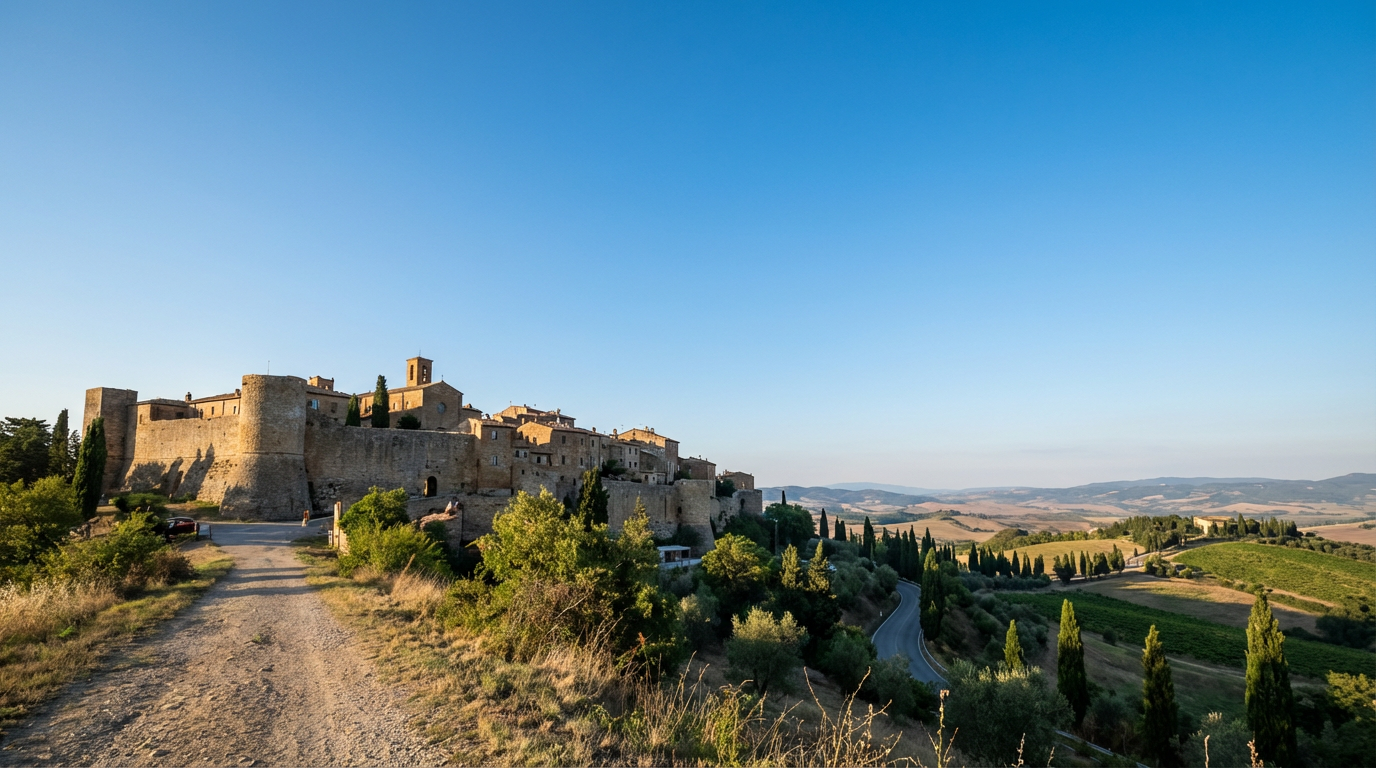
Pienza: what to see in the Renaissance city
Pienza is one of those places that feels almost too perfect to be real. Built in the 15th century on the orders of Pope Pius II, it sits on a ridge in the Val d’Orcia with views that seem painted rather than natural. The entire historic centre is a UNESCO World Heritage Site, and for good reason.
You can walk through the main streets in a couple of hours. But if you slow down, explore the side alleys, and stop to eat well, a full day is just the right amount of time.
Pienza: the ideal Renaissance city
Pope Pius II was born nearby, in a village called Corsignano. When he became pope in 1458, he commissioned architect Bernardo Rossellino to transform his birthplace into a model Renaissance city. The project was completed in just three years, between 1459 and 1462.
The result is a compact urban core planned from scratch. Every building follows precise proportions. The streets are laid out to frame views of the surrounding landscape. This was not just architecture - it was a statement about how a city should look and feel.
Today Pienza has about 2,200 inhabitants. It is small enough to explore on foot and well-preserved enough to give you a genuine sense of what Renaissance urban planning looked like in practice.
The historic centre is largely traffic-free during the day. You can walk from the main gate to the far end of town in less than ten minutes. The main street, Corso il Rossellino, runs straight through the middle and is lined with shops selling local products.
The Cathedral and Piazza Pio II
The Cathedral of Pienza sits at the centre of Piazza Pio II and is the most important building in town. Its facade is Renaissance in style, with clean white stone and classical proportions. The interior is bright, with tall windows that flood the space with light.
Inside you will find five altarpieces commissioned directly by Pius II, each painted by a different Sienese artist. The combination of Sano di Pietro, Giovanni di Paolo, and Matteo di Giovanni makes the church feel like a small gallery of 15th-century Sienese painting.
The crypt beneath the cathedral holds medieval sculptures. The baptismal font dates from the 14th century and is worth a few minutes of attention.
Piazza Pio II itself is one of the most harmonious squares in Tuscany. The Palazzo Piccolomini, the Palazzo Vescovile, and the Palazzo Comunale all face the cathedral. Each building reflects the same proportional system. Standing in the centre of the square, you can see how Rossellino designed each facade to relate to the others.
Entrance to the cathedral is free. Opening hours vary by season, but you can usually visit between 9:00 and 13:00 and 14:30 and 19:00.
Palazzo Piccolomini: what to see
Palazzo Piccolomini was the private residence of Pius II and his family. Today it functions as a museum. You can visit the papal apartments, which retain much of their original furniture and decoration.
The most striking feature is the hanging garden at the rear of the building. It extends on a terrace supported by arches and offers a sweeping view over the Val d’Orcia. On a clear day you can see Monte Amiata to the south.
The building also houses a collection of papal vestments, historical weapons, and family memorabilia. The courtyard is a fine example of 15th-century palazzo architecture and worth seeing even if you do not go inside.
Tickets cost around 7 euros per adult. The palace is open from Tuesday to Sunday, 10:00 to 18:00 in summer. Closed Mondays and in February.
The well in the courtyard dates from the 15th century and still looks exactly as it did when the palazzo was first built. These small details, unchanged over five centuries, are what make Pienza feel genuinely historic rather than just restored.
Pienza pecorino: where to buy it
Pienza is famous throughout Italy for its pecorino cheese. This sheep’s milk cheese is produced in various stages of aging, from fresh (fresco) to semi-aged (semi-stagionato) to fully aged (stagionato). Each version has a different texture and flavour.
You will find pecorino in almost every shop on Corso il Rossellino. The best way to choose is to ask for a tasting. Most shops offer small samples. Try at least two or three versions before deciding.
Some producers age their pecorino in walnut leaves, in terracotta pots, or under ash. These variations produce distinct flavours that you will not find elsewhere.
A 300g piece of good stagionato costs around 8 to 12 euros. If you are travelling by car, you can easily bring home a few pieces. The cheese travels well when wrapped properly.
Also look for other local products: pici pasta, local olive oil, honey from the surrounding hills, and wine from nearby Montepulciano and Montalcino.
The Caseificio Cugusi on Via della Madonnina is one of the most respected producers. Another good option is La Bottega del Naturista near the main square. Both offer tastings and a wide range of aging levels.
What to do beyond the main sights
Pienza rewards slow exploration. Walk along the town walls on the south side. The views over the Val d’Orcia here are some of the best in Tuscany. In spring the fields below are a deep green. In summer they turn golden. In autumn the light turns soft and warm.
The Diocesan Museum next to the cathedral holds a collection of Flemish tapestries, illuminated manuscripts, and local church art. It is small but well-curated and rarely crowded. Entrance costs around 4 euros.
If you have extra time, drive a few kilometres south to San Quirico d’Orcia. This small town has a beautiful Romanesque collegiate church and a walled Italian garden called the Horti Leonini. It is less visited than Pienza and worth an hour of your time.
For lunch or dinner in Pienza, try Trattoria Latte di Luna on Via San Carlo. Expect to spend around 30 to 40 euros per person with wine. Their pici al ragu is reliable and the portions are generous.
Another option is Osteria Sette di Vino near the main square. It is smaller and more informal. A meal here costs around 25 euros per person.
How to get there from Barberino Val d’Elsa
Pienza is about 65 km from Barberino Val d’Elsa. By car, the drive takes around 55 minutes depending on the route you choose.
The most direct route takes you south on the SR2 through Poggibonsi and Siena, then south-east on the SP146. This last stretch, the Strada della Val d’Orcia, is one of the most scenic roads in Tuscany. It passes through San Quirico d’Orcia and then climbs gently to Pienza.
There is no direct public transport connection from Barberino Val d’Elsa to Pienza. The most practical option is a car. If you do not have one, you can take a bus from Barberino to Siena and then connect to a Tiemme bus towards Pienza, but the journey will take over two hours and requires a change.
Parking in Pienza is available outside the historic centre. The main car parks are on the northern side of town, near Porta al Prato. Parking is free in most spots.
The best time to visit is a weekday in spring or autumn. Summer weekends can be crowded, especially in August. The town is at its quietest in the early morning.
Where to stay
Sogno d’Oro sits in the Val d’Elsa landscape near Barberino Val d’Elsa, making it a comfortable base for day trips throughout Tuscany. From here you can reach Pienza in under an hour by car, with the scenic Val d’Orcia road at the end of the journey.
After a long day of exploring Renaissance squares and tasting aged pecorino, coming back to a quiet countryside setting is exactly what slow travel is about.