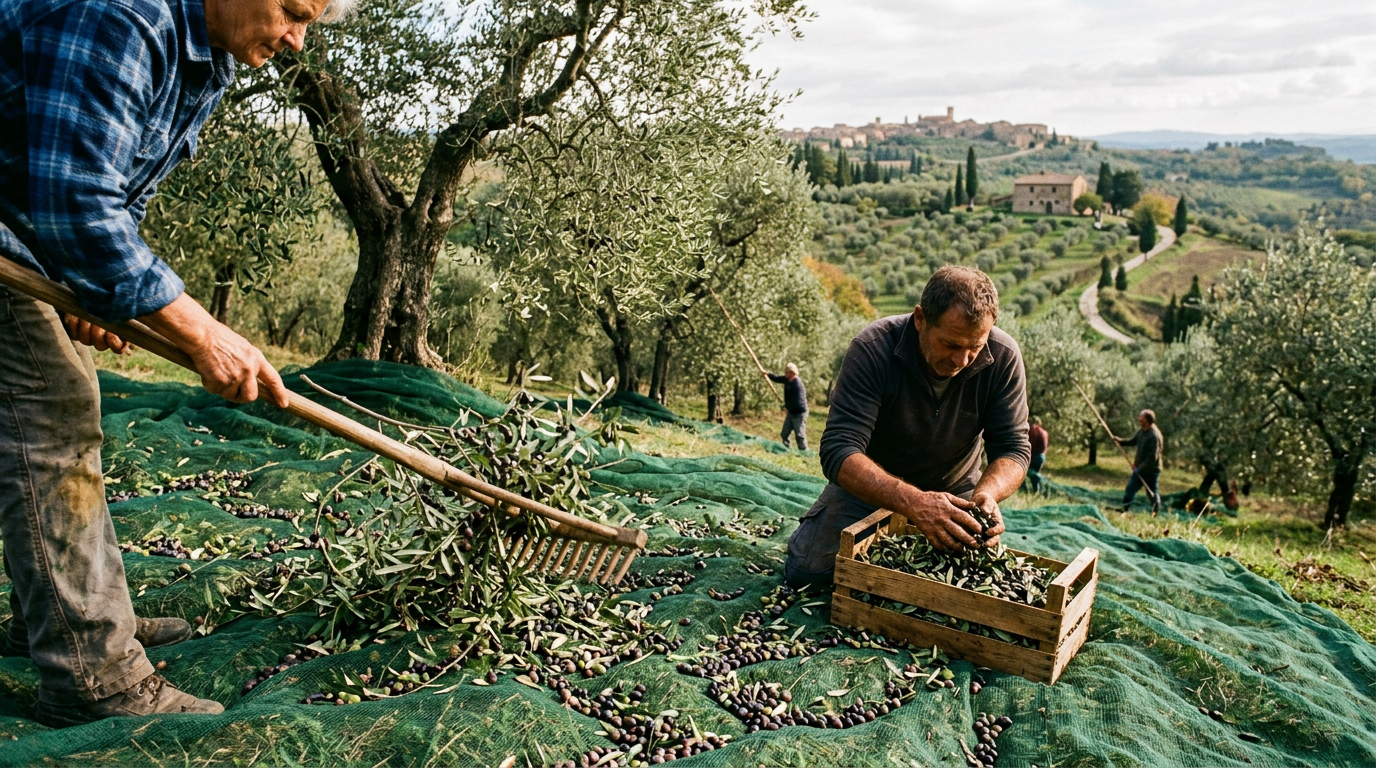
Tuscany extra virgin olive oil: local producers near Barberino
Tuscan extra virgin olive oil is one of the most prized in the world. It is known for its intensity, its peppery finish, and the freshness of its grassy, artichoke-like aromas. The best examples come from small estates where olives are harvested by hand and pressed within hours of picking.
The Val d’Elsa and the surrounding Chianti hills are prime olive-growing territory. If you are staying near Barberino Val d’Elsa, you are in the middle of it. Some of Italy’s finest olive oils are produced within a few kilometres of where you sleep.
Val d’Elsa extra virgin olive oil
The Val d’Elsa sits within the broader Chianti Classico IGP olive oil zone, one of the most respected in Italy. Varieties grown here include Frantoio, Moraiolo, Leccino, and Pendolino, often used in blends that balance bitterness, fruitiness, and pungency.
Harvest typically happens in late October or November, before full ripeness, to preserve the polyphenols responsible for the peppery kick and the health properties. The earlier the olives are picked relative to full ripeness, the more intense and bitter the oil. Oils pressed in late October tend to be greener and more assertive. Those pressed in November are typically rounder and more delicate.
A truly fresh Tuscan olive oil, pressed within the same week, is one of the most visceral food experiences in Italy. It is poured green, almost opaque, over warm bread or ribollita. The flavour is direct and uncompromising.
Local producers
Several farms in and around Barberino Val d’Elsa produce olive oil for direct sale. These are not large commercial operations. Most are family estates with olive groves alongside their vineyards.
Look for farms that describe their oil as IGP Chianti Classico. This protected indication guarantees origin and production methods. Not all local oils carry this certification, but those that do offer an extra layer of traceability.
Some Chianti Classico wine estates also produce olive oil from their own groves. Buying at the same visit where you taste wine is efficient. The estate can tell you exactly when the harvest happened and how the oil was pressed.
Farms near Tavarnelle Val di Pesa, about 8 km from Barberino, and around San Donato in Poggio, about 10 km away, have a strong tradition of olive oil production. These are quiet working farms that welcome visitors who contact them in advance.
Ask your hosts at Sogno d’Oro which nearby producers they trust. This kind of local knowledge leads you to oils you will not find in any guidebook.
How an olive oil tasting works
An olive oil tasting, or degustazione di olio, follows a specific protocol. You are given a small dark glass or a white ceramic tasting cup warmed in both hands. The warmth encourages the volatile compounds to release.
You smell the oil first, looking for fresh grass, green tomato, almonds, or artichoke. Off-aromas like mustiness or rancidity are immediate disqualifiers.
Then you sip a small amount, drawing air through the oil to spread it across the palate. You assess fruitiness first, then bitterness on the sides of the tongue, then the peppery finish at the back of the throat. A quality Tuscan oil will make you cough slightly. This is not a problem. It indicates the presence of oleocanthal, the same anti-inflammatory compound found in ibuprofen.
Between samples you cleanse the palate with a slice of plain bread or a piece of green apple. Avoid eating cheese or salumi before a tasting. Strong flavours interfere with your ability to assess subtle differences.
What to buy and at what prices
A 500 ml bottle of quality extra virgin olive oil from a small Tuscan producer typically costs between 12 and 20 euros. Oils with IGP Chianti Classico certification tend to be at the higher end of this range.
If you visit a farm directly and buy a 5-litre tin, the price per litre drops significantly. A 5-litre tin from a good producer costs 50 to 70 euros and will supply a household for several months.
Buy in dark glass bottles or tins. Light degrades olive oil. If you see it sold in clear glass bottles on a sunny shelf, that is a sign the retailer does not prioritise quality preservation.
Check the harvest date on the label, not just the best-before date. A best-before date of two years from production is standard but tells you nothing about freshness. The harvest year is the useful number. Oil from the most recent harvest (ottobre or novembre of the preceding year) is what you want.
Carry oil home in your checked luggage rather than hand luggage. Wrap the bottle or tin in clothing, place it in a sealed plastic bag, and position it in the centre of your suitcase. Breakage is rare but the precaution is worthwhile.
Farms near Barberino Val d’Elsa
The hills between Barberino Val d’Elsa, San Donato in Poggio, and Tavarnelle Val di Pesa are dotted with olive groves. Many estates here combine viticulture and olive oil production.
Some farms open their oil-pressing facilities (frantoi) during the harvest period. Visiting a frantoio in November lets you see the centrifuge extraction process and taste oil that was pressed hours earlier. This is a brief, sensory, and irreplaceable experience.
If you are visiting outside harvest season, the estates still sell their previous year’s oil. It will not have the raw intensity of a freshly pressed product but a well-stored oil from a quality producer is still exceptional.
Contact farms in the first half of October if you want to time your visit with the harvest. Many estates welcome visitors who want to help pick olives and watch the pressing. Unlike the grape harvest, olive picking requires less physical effort and is accessible to almost anyone.
Where to stay
Sogno d’Oro in Barberino Val d’Elsa places you directly in Tuscany’s finest olive oil territory. The countryside around the guesthouse is the same landscape that has produced olive oil for centuries.
A stay here gives you the access, the time, and the proximity to explore local production and bring home something genuinely good.