Monticchiello complete guide: history, walks, food, and travel
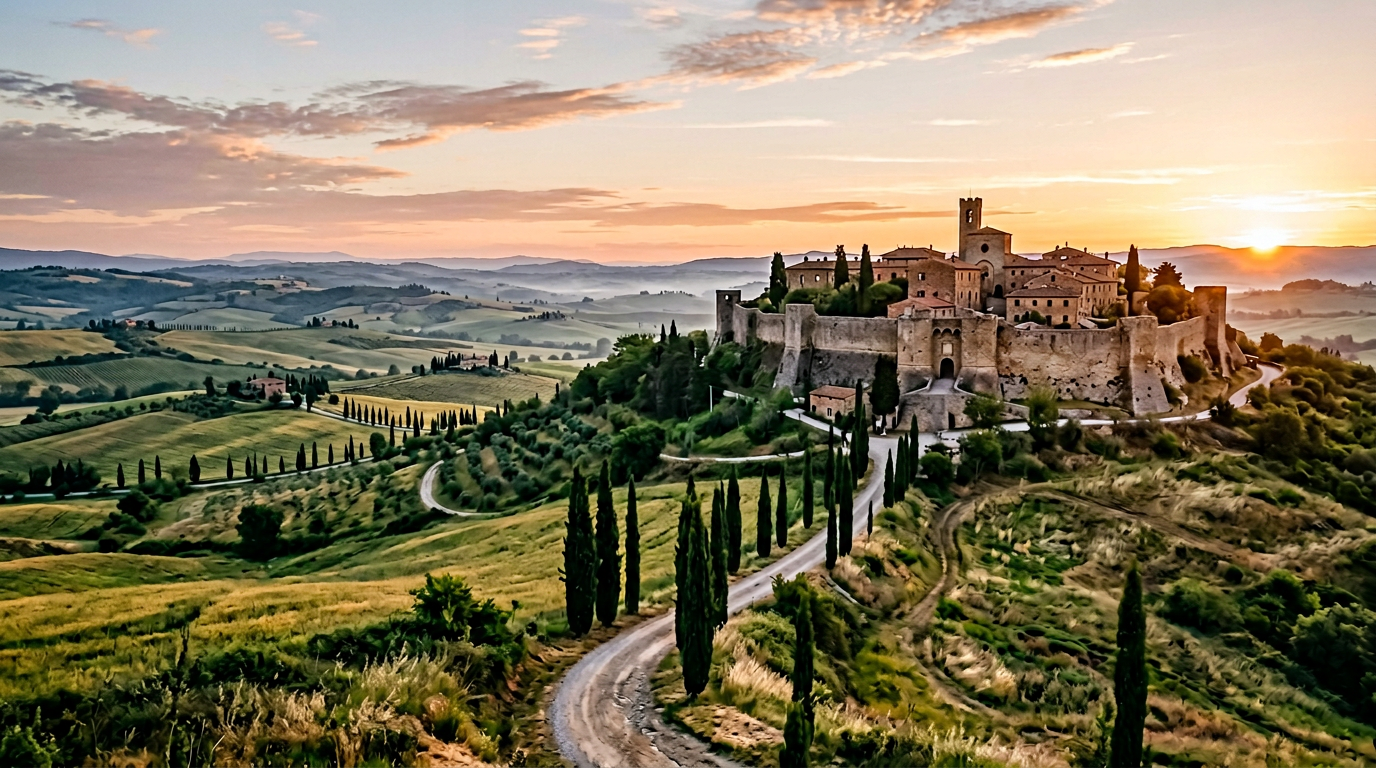
Monticchiello is a small walled village in the southwestern corner of the Val d’Orcia. It sits at 520 metres on a ridge between the plains of the Chiana valley to the east and the Orcia river valley to the west. The village has around 200 permanent residents, an intact set of medieval walls, and a community theatre tradition that is unique in Italy.
From Barberino Val d’Elsa the distance is approximately 70 km and the drive takes about 60 minutes on roads heading south through Siena and then east toward the Val d’Orcia.
Monticchiello: the complete guide
This guide covers everything you need for a satisfying visit: the history of the village, the Teatro Povero theatre tradition, the walking circuit around the walls, where to eat, and the practical logistics of getting there and back in a day.
Monticchiello rewards visitors who arrive without a tight schedule. The village is small enough to feel immediately familiar but layered enough in its history and character to keep your attention for a full day.
The light here in the late afternoon, falling across the Val d’Orcia from the west, is among the most photographed in Tuscany. The viewpoints from the walls and the access roads leading up to the village put the UNESCO landscape literally at your feet.
The history of the village
Monticchiello appears in documented records from the 9th century. Its strategic position on a ridge controlling the route between the Val d’Orcia and the Chiana valley made it a contested point between Siena and other regional powers throughout the medieval period.
The walls were built in the 13th and 14th centuries, with reinforcement campaigns in subsequent centuries. The circuit is unusually complete. The original structure survives almost entirely, including several towers, the main gate, and long sections of curtain wall.
The village came under Sienese domination in the 14th century and remained within the Sienese sphere of influence until the Florentine conquest of Siena in 1555. The subsequent period of Medici and then Habsburg-Lorraine rule brought economic marginalisation to the Val d’Orcia. This relative poverty was ultimately responsible for the preservation of the medieval structure: there was no money to rebuild.
The church of Santi Leonardo e Cristoforo, at the upper end of the village, contains a fresco attributed to Pietro Lorenzetti, a Sienese painter active in the early 14th century. The attribution is debated among art historians but the quality of the work is evident.
The 20th century brought depopulation as agricultural workers moved to urban centres. The number of residents fell from several hundred in the early 1900s to around 200 today. The community that remained developed a strong identity built partly around the Teatro Povero project.
Teatro Povero and its uniqueness
The Teatro Povero di Monticchiello was founded in 1967 by a group of villagers who wanted to create a collective form of theatrical expression about their own lives and circumstances.
Every year the community writes and performs a new play, developed through collective discussion and rehearsal from early spring to the summer performances. The actors are not trained. They are farmers, retirees, teachers, and young people who live in the village and surrounding area.
The plays are written in local dialect and standard Italian, sometimes with English or other language elements when the theme demands it. They address questions relevant to the community’s experience: the loss of agricultural traditions, the impact of tourism on rural culture, the tension between economic development and landscape preservation, and the experience of a small community in a rapidly changing Italy.
Performances take place in the village square, using the walls, the church facade, and the landscape as a stage set. The audience sits in tiered seating looking out over the Val d’Orcia. The effect is theatrical in a way that no purpose-built stage can replicate.
The Teatro Povero season runs in July and early August. Performances happen several times a week. Tickets are sold in advance through the company’s website. They sell out well before the season begins, particularly for weekend performances.
If you are unable to attend a performance, the company maintains an archive and offers documentation of past productions. The theatre building on the main street of the village is open during the season and has a permanent exhibition.
The walking path around the village
A well-maintained path follows the outer perimeter of the walls of Monticchiello. The circuit is approximately 1.5 km and takes 30 to 45 minutes at an unhurried pace.
The path begins at the car park below the Porta Nova and circles the village counterclockwise, passing under the tower sections and following the base of the walls through a mix of open ground and light woodland.
From the western section of the path, the view extends over the Orcia valley and toward Monte Amiata to the south. This is one of the finest low-level viewpoints in the Val d’Orcia and requires no special effort to reach.
From the northern section, the view opens toward Pienza (9 km north-northwest) and the cypress-lined roads that have become the visual signature of the area. On a clear day the tower of Montepulciano is visible to the northeast.
The path is accessible for most fitness levels. The terrain is mostly flat with a few short uneven sections near the towers. Sturdy footwear is sufficient.
An extended walk is possible by continuing from the walls down into the agricultural land below the village. Unmarked tracks follow the ridge south toward the locality of Macchie and the Orcia river valley. This extension adds 45 minutes to two hours depending on how far you go.
How to get there and where to eat
The route from Barberino Val d’Elsa to Monticchiello goes south on the SR2 Cassia through Siena, then south toward Buonconvento and Torrenieri. At Torrenieri turn east toward Montepulciano, pass through Pienza, and then take the secondary road south toward Monticchiello (7 km from Pienza).
Total distance: approximately 70 km. Drive time: approximately 60 minutes. The approach from Pienza on the secondary road is beautiful and worth driving at reduced speed.
Parking is in the small lot below the Porta Nova. On weekends and during the theatre season the lot fills quickly. Arrive before nine in the morning or after six in the evening to find space easily.
For food, Osteria La Porta is the main restaurant in the village and has been consistently well regarded for many years. The menu changes with the season. Typical dishes include pici al ragu di cinghiale (pasta with wild boar), ribollita, bistecca di Cinta Senese, and seasonal desserts made in house. Reservations are essential on weekends and throughout the theatre season.
A smaller bar near the gate serves coffee, cold drinks, and light snacks. For a more modest lunch, buying supplies in Pienza before arriving in Monticchiello and eating at a table outside the walls is a practical and pleasant alternative.
Where to stay
Sogno d’Oro in Barberino Val d’Elsa is a 60-minute drive from Monticchiello. The guesthouse in the Val d’Elsa gives you a Chianti base with easy access to the entire southern arc of Tuscany, from the Val d’Orcia to Montalcino and the Crete Senesi.
Monticchiello is a fitting conclusion to any Tuscan itinerary that prioritises substance over convenience. Staying at Sogno d’Oro gives you the proximity to make it a day rather than a detour.