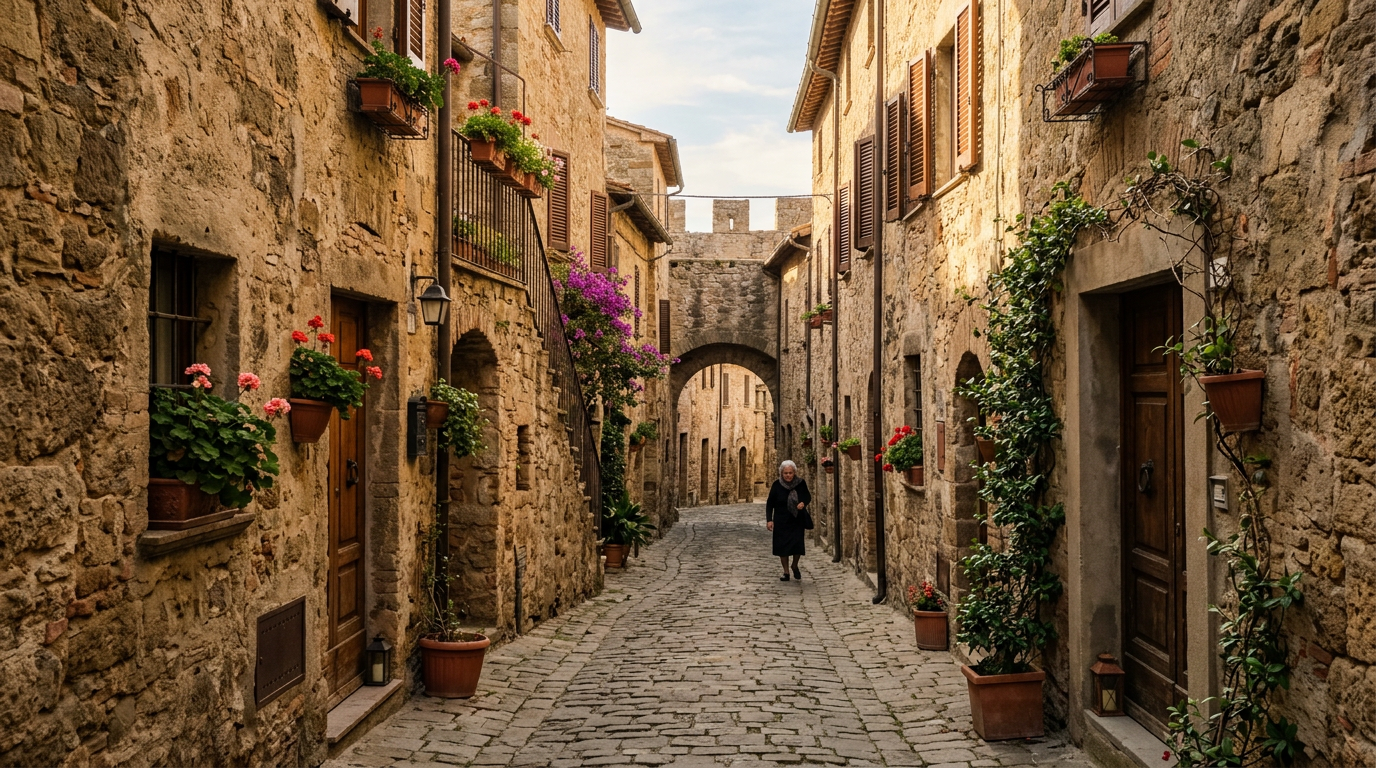
Monticchiello: what to see in the intact Val d'Orcia village
Monticchiello is a small walled village on the southern edge of the Val d’Orcia. It sits at about 520 metres on a ridge above the Orcia valley, looking north toward Pienza and south toward Monte Amiata. The village has around 200 permanent residents and an unusual community theatre tradition that has made it known well beyond its size.
From Barberino Val d’Elsa the drive is about 70 km and takes roughly 60 minutes on the SR2 south through Siena and then toward Montepulciano.
Monticchiello: the intact village
Monticchiello has preserved its medieval structure almost completely. The circuit of walls, built in the 13th and 14th centuries, is intact and walkable. The main gate, the Porta Nova, opens onto a single main street that runs the length of the village.
Inside the walls the scale is intimate. The streets are two or three metres wide. Stone buildings lean over the pavement. The church of Santi Leonardo e Cristoforo, at the top of the village, has a fresco attributed to Pietro Lorenzetti and a peaceful interior with a bare stone floor.
The village has no traffic inside the walls. Quietness is one of its defining qualities. Even in summer the volume of visitors is nothing like Pienza or Montepulciano. You can walk the entire circuit in 30 minutes without meeting more than a handful of people.
The landscape visible from the walls is exceptional. North toward Pienza and the cypress-lined roads of the Val d’Orcia. South toward Monte Amiata, whose volcanic dome rises above the surrounding hills. East toward Montepulciano. This is the UNESCO landscape at its widest.
The Teatro Povero di Monticchiello
The Teatro Povero (Poor Theatre) is a community theatre company founded in Monticchiello in 1967. Every summer it creates and performs an original theatrical work written collectively by the village residents about their own lives, history, and present situation.
The performances take place in the main square of the village, using the natural backdrop of the walls and the surrounding countryside. The actors are not professionals. They are farmers, teachers, shopkeepers, and students from the village itself.
Each year the theme is new. Past productions have addressed migration, climate change, the disappearance of rural culture, and the relationship between the village and the outside world. The work is not nostalgic. It is engaged and sometimes uncomfortable.
Performances run during July and early August. Tickets sell out quickly, especially for the later performances when word has spread. If you want to attend, book as soon as the programme is published, usually in June.
The Teatro Povero is one of the most original cultural institutions in Tuscany. Attending a performance connects you to a living community in a way that visiting monuments alone does not.
The view over Val d’Orcia
The best viewpoint in Monticchiello is the open section of the wall on the northern side of the village, about 50 metres past the main gate. Here the parapet offers an unobstructed view across the Val d’Orcia toward Pienza.
At sunset the light falls on the clay hills from the west and the landscape turns gold, then orange, then violet. In autumn the colours are at their most saturated. The cypress-lined approach roads to the south and west of Pienza are visible from here on a clear day.
The viewpoint is accessible at any time of day and requires no ticket. It is simply part of the village’s public space. Bring a camera or simply sit on the stone parapet and watch the light change.
In spring, from March to May, the hills are green. Wildflowers line the tracks below the walls. This is a different and equally beautiful version of the same view.
Where to eat in the village
Monticchiello has one main restaurant and an osteria within the village walls.
Osteria La Porta is the best-known eating place and has been consistently good for many years. The menu follows the season and the local territory. Pici all’aglione (pasta with garlic and tomato), ribollita, and grilled Cinta Senese pork are typical dishes. The wine list focuses on local Montepulciano d’Abruzzo and Brunello.
Reservations are recommended, especially on weekends and during the Teatro Povero season. The restaurant is small and tables fill quickly.
A small bar near the entrance gate sells coffee, cold drinks, and basic sandwiches. For a picnic, buy supplies in Pienza (9 km away) before arriving in Monticchiello.
How to get there from Barberino Val d’Elsa
Take the SR2 Cassia south from Barberino toward Siena. Follow the Siena ring road and continue south toward Buonconvento. At Torrenieri, turn east toward Montepulciano. Follow the road through Pienza (a worthwhile stop) and then take the secondary road south toward Monticchiello.
The village is signposted from the main Pienza-Montepulciano road. The approach road climbs for 3 km through open farmland.
Total distance: approximately 70 km. Drive time: approximately 60 minutes without stops.
Parking is outside the village walls. A small free car park is located just below the Porta Nova. In summer it fills quickly on weekend mornings.
Where to stay
Sogno d’Oro in Barberino Val d’Elsa is 60 minutes from Monticchiello, making it a practical base for a day in the southern Val d’Orcia.
The contrast between the busy tourist circuit of Florence and Siena and the quietness of a village like Monticchiello is exactly the kind of contrast that makes a Tuscan trip complete. Staying in the Val d’Elsa gives you access to both.