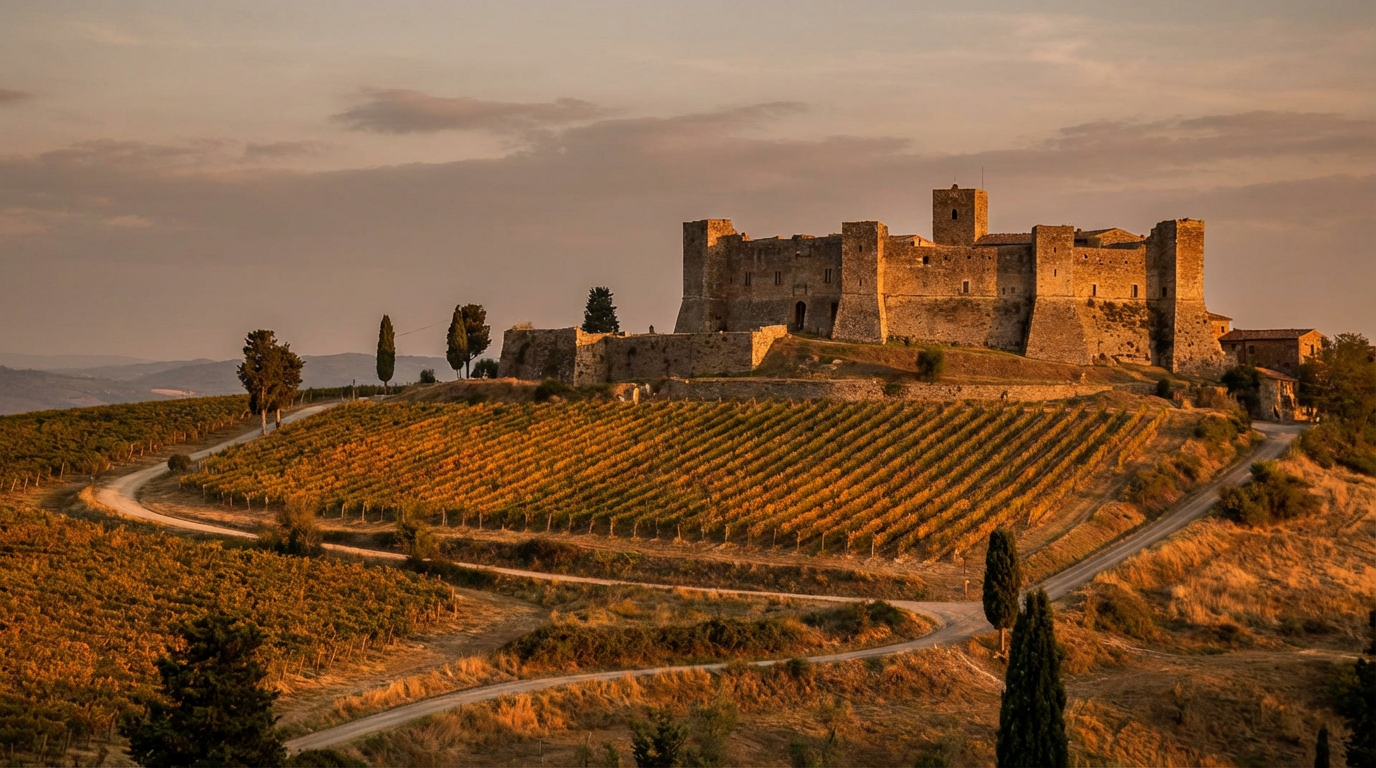
Montalcino: what to see, home of Brunello
Montalcino sits on a hill at 564 metres above sea level, surrounded by vineyards and cypress trees. It is a small town of about 5,000 people, but its name is known by wine lovers around the world. Brunello di Montalcino is one of Italy’s most celebrated red wines, and the town is the centre of its production.
Beyond wine, Montalcino has a genuine medieval character. The streets are quiet, the views are remarkable, and the pace is slow. A day here is enough to understand why people keep coming back.
Montalcino: home of Brunello
Brunello di Montalcino was created in the second half of the 19th century by Clemente Santi and later developed by his grandson Ferruccio Biondi-Santi. It is made entirely from Sangiovese Grosso grapes, known locally as Brunello.
The wine requires a minimum of five years of aging before release, or six for the Riserva version. This long maturation produces wines of great depth and longevity. Good Brunello can age for 30 years or more.
The DOCG (Denominazione di Origine Controllata e Garantita) zone covers the hills surrounding Montalcino on all sides. Different sub-zones produce wines with distinct characteristics. Some are more tannic and structured; others are more elegant and aromatic.
A bottle of current-release Brunello from a respected producer typically costs between 40 and 80 euros. Older vintages and single-vineyard selections can cost significantly more. The Rosso di Montalcino, made from the same grape but aged for less time, offers similar character at a more accessible price point, usually 15 to 25 euros.
The medieval fortress
The fortress of Montalcino, known as the Fortezza, dominates the southern end of town. It was built in 1361 by the Sienese republic and is one of the best-preserved medieval fortifications in Tuscany.
You can walk along the walls and climb the towers. The views from the top extend over the Val d’Orcia to the south and the Crete Senesi to the east. On clear days you can see Monte Amiata, the highest peak in southern Tuscany at 1,738 metres.
Inside the fortress there is a well-stocked enoteca where you can taste and buy wines from across the Montalcino DOCG. The selection covers dozens of producers and includes both Brunello and Rosso di Montalcino. A flight of three wines costs around 12 to 18 euros depending on the selection.
Entrance to the fortress walls costs around 4 euros. The enoteca inside is free to enter and open daily from 10:00 to 20:00 in summer and 10:00 to 18:00 in winter.
The Fortezza is the last fortress in Italy to have held out for the Sienese republic, surrendering to the Medici only in 1559. This piece of history gives the building an extra layer of meaning.
Historic centre and museums
The main street of Montalcino, Via Mato Civitali, runs through the heart of the historic centre from the fortress to the main square. The architecture is medieval and largely unaltered. Stone arches, narrow alleys, and small churches appear at regular intervals.
The Museo Civico e Diocesano d’Arte Sacra on Via Ricasoli holds a collection of Sienese paintings, wooden sculptures, and illuminated manuscripts from the 14th to 17th centuries. The collection is modest in size but well displayed. Entrance costs around 6 euros.
The Church of Sant’Agostino near the museum has a fine Gothic facade and a decorated interior. Admission is free. The Church of the Madonna del Soccorso on the south side of town has a terrace with panoramic views.
The Piazza del Popolo at the centre of town is the main gathering place. The 13th-century loggia and the Torre Civica give the square its character. Sit at one of the outdoor cafes and watch the pace of daily life in a small Tuscan hill town.
Montalcino is also a good place to shop for local food products. Look for pici pasta, honey from the surrounding hills, saffron from the nearby village of San Gimignano area, and jarred specialties like wild boar sauce.
Wineries to taste Brunello
Visiting a winery is one of the best reasons to come to Montalcino. The surrounding countryside is dotted with estates, from small family producers to large international operations. Most offer tastings by appointment, and some accept walk-in visitors.
Biondi-Santi in Greppo is the historic estate that created Brunello. Tours and tastings are available but must be booked in advance. Expect to pay 50 euros or more for a tasting here. The experience is exceptional if you have a serious interest in Italian wine.
Poggio Antico, a few kilometres south of town, is one of the most beautiful estates in the zone. They offer cellar tours and tastings starting at around 20 euros. The wines are consistent and the setting is impressive.
Altesino to the north of town is another reliable choice. Their Brunello is known for elegance and long aging potential. Tastings start at around 25 euros.
For a more informal experience, the Enoteca Grotta del Brunello in the centre of town offers wines by the glass from many local producers. This is a good option if you want to compare styles without committing to a single estate visit. Prices start at around 6 euros per glass for Rosso di Montalcino and 12 euros for Brunello.
If you are travelling with a car and have two to three hours, combine a cellar visit with lunch at Trattoria Il Pozzo in Sant’Angelo in Colle, a village about 10 km south of Montalcino. The food is traditional and the setting is quiet. Expect to spend around 30 euros per person.
How to get there from Barberino Val d’Elsa
Montalcino is about 70 km from Barberino Val d’Elsa. By car the drive takes around 60 minutes.
The most direct route follows the SR2 south through Poggibonsi, then continues towards Siena and further south on the SS223. From there you take the local roads east towards Montalcino. The final approach climbs through vineyards and gives you a good preview of the landscape.
Public transport connections are limited. You can take a bus from Barberino or nearby San Casciano to Siena, and from Siena there are Tiemme buses to Montalcino. The total journey by public transport takes around two to two and a half hours and requires at least one change.
If you are planning a wine tasting, a car is essential. Many of the best wineries are outside town and not accessible on foot or by public transport.
Parking in Montalcino is available outside the town walls. The car parks at Porta Burelli and Piazza Cavour are the most convenient. Parking is free in most areas.
Montalcino is most pleasant in spring (April to June) and autumn (September to November). Summer can be warm and busy. The wine harvest in September and October is a particularly atmospheric time to visit.
Where to stay
Sogno d’Oro is set in the Val d’Elsa landscape near Barberino Val d’Elsa, roughly one hour from Montalcino by car. It sits at the northern edge of the great Tuscan wine country, with easy access to Brunello, Chianti Classico, and Vernaccia di San Gimignano.
Using Sogno d’Oro as your base, you can plan a full day in Montalcino without rushing. Drive down in the morning, taste wine in the afternoon, and return in the evening with a bottle or two and a head full of countryside views.