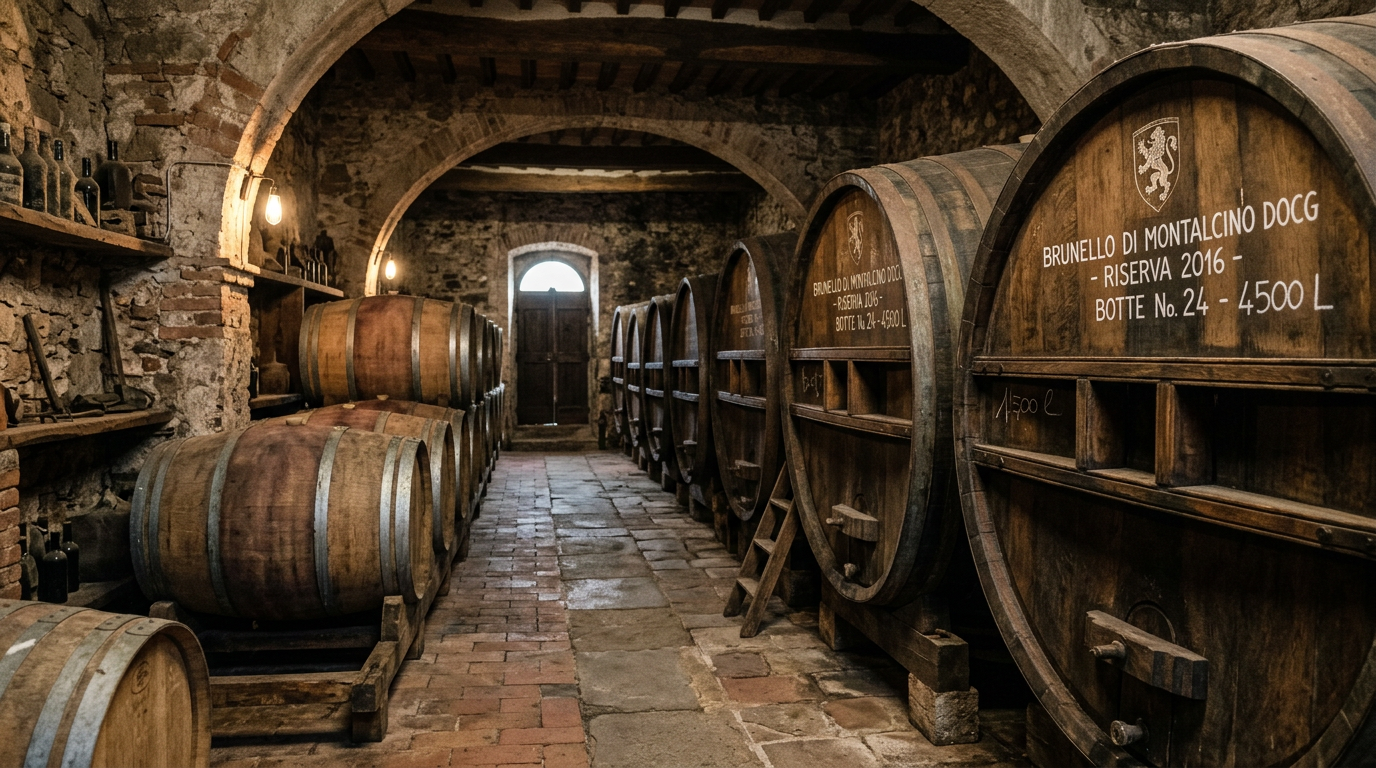
Montalcino Brunello winery visit: a complete guide
Montalcino sits on a hill in the Val d’Orcia at about 570 metres above sea level. The town is small, quiet, and entirely focused on wine. Everything here revolves around Brunello, one of Italy’s most celebrated reds.
From Barberino Val d’Elsa the drive is about 70 km and takes roughly 60 minutes via the Siena ring road. You can do it as a day trip. You can also make it the centrepiece of a longer journey south through the Val d’Orcia.
Montalcino and Brunello
Brunello di Montalcino is made exclusively from Sangiovese Grosso, a local clone of Sangiovese. The denomination requires a minimum ageing of five years, including two in oak barrels and four months in bottle. For the Riserva category the total rises to six years.
The result is a wine with remarkable structure and longevity. Bottles from good producers age easily for 20 to 30 years. Even young Brunellos, though often austere, carry an intensity that sets them apart from most other Italian reds.
Montalcino also produces Rosso di Montalcino, a younger and more approachable wine from the same grape. It uses shorter ageing and offers a more immediate way into the territory’s character.
The town itself is worth a visit beyond the wine. The 14th-century Rocca fortress dominates the skyline. The enoteca inside the Rocca sells wines from dozens of local producers. The views from the walls stretch over rolling hills covered in vineyards, olive groves, and cypress trees.
Wineries to visit
The Montalcino area counts more than 200 producers. The range runs from tiny family estates making a few thousand bottles to internationally known names shipping hundreds of thousands.
For a first visit, smaller estates are usually more rewarding. Producers with 5 to 15 hectares offer personal tours guided by family members or the winemaker. You see the cellar, the barrels, and the bottling area without passing through a visitor centre designed for groups.
Some names that welcome individual visitors include estates in the zones of Sant’Angelo in Colle to the south, Camigliano to the west, and the slopes directly below the town. These are not necessarily the most famous labels. They are often the ones where a visit feels like a conversation rather than a presentation.
Biondi-Santi is the most historically significant producer in the denomination. Visits require booking well in advance and come with a higher price. If Brunello history matters to you, this is where to go.
Casanova di Neri, Poggio di Sotto, and Cerbaiona are names that serious wine travellers seek out. Each has a different approach to the grape and the ageing process.
How to book a tasting
Most Montalcino producers require advance booking for cellar visits. Walk-ins are occasionally possible during harvest season or at smaller estates, but relying on them wastes your day.
The easiest approach is to contact estates directly by email. Explain that you are visiting from Barberino Val d’Elsa, mention the date and the number of people in your group, and ask about available slots. Most producers respond within a day or two.
A standard visit at a small estate lasts 60 to 90 minutes. It typically includes a tour of the production area, an explanation of the ageing process, and a tasting of three to five wines. The cost ranges from 20 to 50 euros per person depending on the producer and the wines poured.
Some estates offer food pairings with local salumi, cheese, and bread alongside the tasting. This adds to the cost but turns the visit into a proper mid-morning or early afternoon experience.
If you prefer not to drive, a taxi from Montalcino to nearby estates costs around 15 to 20 euros each way. This lets both people in a couple enjoy the tasting fully.
Brunello di Montalcino: characteristics
Understanding a few basic elements helps you get more out of a tasting.
Brunello has high tannins, especially when young. In the first three to five years after release the wine can feel tight and austere. This is not a flaw. It is the structure that allows long ageing.
Aromas in younger bottles tend toward red cherry, dried flowers, and tobacco with mineral notes. Older wines shift toward dried fruit, leather, liquorice, and earthy complexity.
The vintage matters significantly. 2010, 2012, 2015, and 2016 are considered exceptional recent years. 2014 was more difficult due to rain during harvest. Ask your host which vintages they feel best represent their estate.
The wine is best served at 18 degrees Celsius in a large Burgundy-style glass. Opening the bottle 30 to 60 minutes before serving helps it open up.
Rosso di Montalcino, served slightly cooler at around 16 degrees, is a more accessible introduction. Many visitors start with the Rosso before moving to the Brunello in a tasting sequence.
How to get there from Barberino Val d’Elsa
The most direct route takes you south on the SR2 toward Siena. From Siena take the SR2 Cassia toward Buonconvento, then the SR2 toward Montalcino turning off at the signed junction. The total distance is approximately 70 km and the drive takes about 60 minutes without stops.
A slightly longer but more scenic option goes through Pienza and the Val d’Orcia. This adds 15 minutes but lets you drive through one of Italy’s most beautiful landscapes.
Parking in Montalcino is available outside the town walls. The historic centre is mostly closed to non-resident traffic. Leave the car near the main gate and walk in. The town is small enough to explore entirely on foot in two hours.
If you combine Montalcino with a visit to Pienza or San Quirico d’Orcia you can make a full day of it. Both towns are within 20 km of Montalcino and add context to the Val d’Orcia landscape surrounding the wine country.
Fuel up before you leave Barberino Val d’Elsa. Petrol stations along the SR2 through the Crete Senesi are infrequent.
Where to stay
Sogno d’Oro in Barberino Val d’Elsa is a comfortable base for a Montalcino day trip. You are 70 km away, close enough to leave after breakfast and return in the evening with a few bottles in the boot.
The guesthouse sits in the Val d’Elsa, surrounded by the Chianti Classico countryside, giving you wine country on your doorstep and easy access to the wider Tuscan landscape.