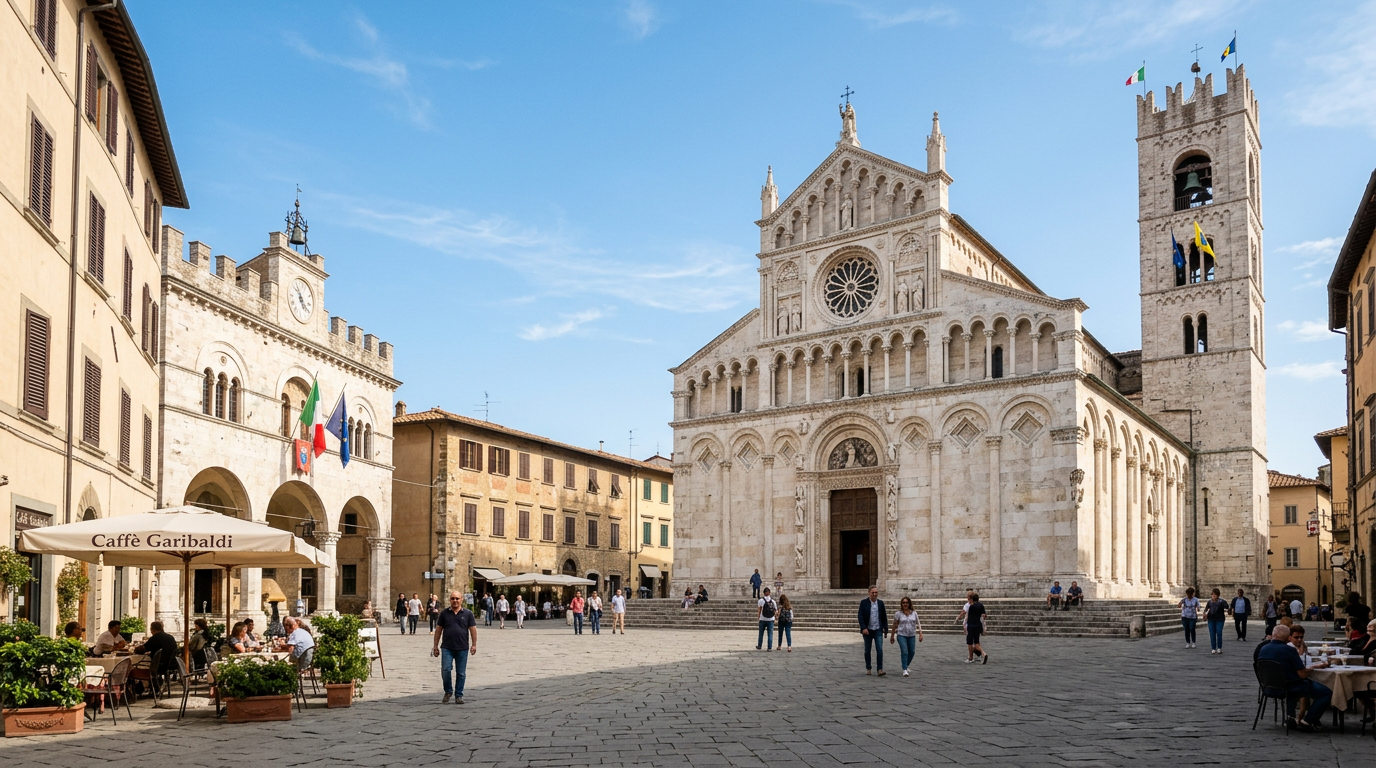
Massa Marittima: the hidden gem of the Maremma
Massa Marittima is one of the most undervisited medieval towns in Tuscany. While better-known places fill with tourists in summer, this small city in the Colline Metallifere sits largely undisturbed, offering a genuinely authentic experience of Tuscany without the crowds.
It is about 90 km from Barberino Val d’Elsa, around 75 minutes by car. The drive takes you through the Chianti hills and then down into the distinctive landscape of the Maremma, a territory of rolling hills, mines, and thermal springs.
Massa Marittima: the hidden gem
The city divides into two distinct parts: the Citta Vecchia, the medieval lower town, and the Citta Nuova, the upper extension added in the 13th century. Most of the main sights are in the Citta Vecchia, concentrated around Piazza Garibaldi.
Massa Marittima was a free commune in the 13th and 14th centuries and grew wealthy from mining. The Colline Metallifere, the metalliferous hills around the city, contain deposits of copper, silver, lead, and iron that have been exploited since Etruscan times.
The city’s relative isolation has preserved its medieval character better than many better-known Tuscan towns. The streets are quiet, the buildings are largely unrestored in the cosmetic sense, and the atmosphere is genuinely lived-in.
Population today is about 8,500. The city has a university department, a modest but consistent tourist infrastructure, and a local economy still partly connected to mining and agriculture.
Piazza Garibaldi and the Cathedral
Piazza Garibaldi is the heart of the Citta Vecchia and one of the most beautiful medieval squares in Tuscany. It is an irregular shape, sloping slightly uphill towards the Cathedral at the far end. The proportions feel organic rather than planned.
The Cathedral of San Cerbone was built in stages from the 11th to 14th centuries. The lower part of the facade is Pisan Romanesque. The upper part transitions into Gothic. The overall effect is harmonious despite the different periods of construction.
Inside the Cathedral, the main altar area holds the Arca di San Cerbone, a carved marble sarcophagus completed in 1324 by Goro di Gregorio. It depicts scenes from the life of the local bishop saint in high relief. The quality of the carving is exceptional and worth careful examination.
Also inside the Cathedral is a small panel painting of the Madonna delle Grazie attributed to Duccio di Buoninsegna. It dates from around 1316 and is one of the treasures of the collection.
The Palazzo del Podesta on the other side of the square houses the Museo Civico. The collection includes the Maesta by Ambrogio Lorenzetti, a large-format altarpiece painted in 1335 and one of the finest surviving works of Sienese Gothic painting. Museum tickets cost around 5 euros.
The Mine and sacred art museum
The Museo delle Miniere is one of the most unusual and interesting museums in southern Tuscany. It occupies a network of actual mine tunnels carved into the hill below the Citta Vecchia.
You can take a guided tour through about 700 metres of tunnel, with reconstructions of mining equipment, explanations of extraction techniques from the medieval period to the 20th century, and geology exhibits. The temperature inside the mine stays around 14 degrees Celsius year-round, so bring a layer.
Tours run at regular intervals from 10:00 to 17:00 in summer (10:00 to 16:00 in winter). Tickets cost around 8 euros for adults and 5 euros for children. The tour lasts about 50 minutes.
The Museo di Arte Sacra, housed in the convent of San Pietro all’Orto near the main square, contains a collection of Sienese religious art from the 13th to 18th centuries. The standout piece is another large altarpiece attributed to Ambrogio Lorenzetti. Entrance is included with the Museo Civico ticket or available separately for around 3 euros.
The Fortezza dei Senesi e dei Sani in the Citta Nuova upper district is a 14th-century fortification with a distinctive arch bridge connecting two towers. It is visible from many points in the city and worth a walk up to see from close.
What to do in the area
The countryside around Massa Marittima offers several worthwhile activities beyond the city itself.
The Parco Naturale delle Colline Metallifere covers much of the surrounding territory. It has marked walking trails, mountain bike routes, and areas for birdwatching. The park office in Massa Marittima can provide maps and route descriptions.
The thermal area of Petriolo is about 30 km to the east. The natural hot springs flow into the Farma river at around 43 degrees Celsius. You can bathe in the outdoor natural pools for free. This is a popular local spot and can be busy in summer.
Follonica, about 25 km to the south, is the nearest beach town. It is a working-class Tuscan resort without much architectural interest, but the sea is clean and the beaches are good. Useful if you want to combine a morning in Massa Marittima with an afternoon at the sea.
The wine area of Morellino di Scansano is about 40 km further south. Morellino is a Sangiovese-based wine with more approachable tannins than Brunello. Several wineries in this area offer tastings.
For lunch in Massa Marittima, Osteria da Tronca on Vicolo Porte has a simple menu focused on local ingredients. Expect around 25 to 35 euros per person.
How to get there from Barberino Val d’Elsa
Massa Marittima is about 90 km from Barberino Val d’Elsa. By car the drive takes around 75 minutes.
The most direct route heads south on the SR2, then west past Siena towards Grosseto, and then north into the Colline Metallifere on the SP39 and SP1. The final approach involves winding hillside roads that are scenic but require attentive driving.
An alternative route avoids Siena by taking the A1 motorway south to the Colle Val d’Elsa junction and then heading west. This is slightly longer in distance but can be faster during busy periods.
Public transport connections from Barberino Val d’Elsa to Massa Marittima are poor. You would need multiple connections and the journey would take three hours or more. A car is strongly recommended.
Parking in Massa Marittima is available in several car parks outside the historic centre. The most convenient is the car park near the Porta Senese entrance. Parking is generally free or very cheap.
Where to stay
Sogno d’Oro is positioned in the Val d’Elsa near Barberino Val d’Elsa. It sits in open countryside, surrounded by the typical Tuscan landscape of vineyards, olive groves, and cypress trees.
Massa Marittima is a rewarding destination for a full day trip from this base. You get a taste of a very different part of Tuscany - the Maremma’s hills, its mining history, and its quieter pace - and return to the Val d’Elsa in the evening.