Greve in Chianti: what to see
Greve in Chianti is the main town in the northern Chianti Classico zone. With a population of about 14,000, it functions as the commercial and administrative centre of the Chianti Classico area. It is more town than village, with a full range of shops, restaurants, and services.
It is 22 km from Barberino Val d’Elsa and about 25 minutes by car. Close enough for a relaxed half-day, useful enough to combine with wine purchases and a proper meal.
Greve in Chianti: what to see
Greve in Chianti sits in the valley of the Greve river, at a junction of roads connecting the Chianti hills to Florence, Siena, and the Val d’Elsa. Its position made it a natural market town for the surrounding wine estates from the medieval period onwards.
The town is not primarily an architectural destination. There are no major museums or monuments. What Greve offers is the atmosphere of a working Chianti town: the weekly market, the wine shops, the butchers selling bistecca from Val di Chiana cattle, and the general sense of a place where the local economy still revolves around what the land produces.
For wine tourism, Greve is one of the best bases in the Chianti Classico zone. The town has more wine bars and wine shops per square kilometre than almost anywhere else in Tuscany. You can taste and buy wines from dozens of local producers without leaving the centre.
The surrounding countryside is excellent for cycling. The SR222 (the Chiantigiana road) runs through Greve and connects the main Chianti towns. Gravel roads through the vineyards connect the estates and villages off the main road.
Piazza Matteotti with its arcades
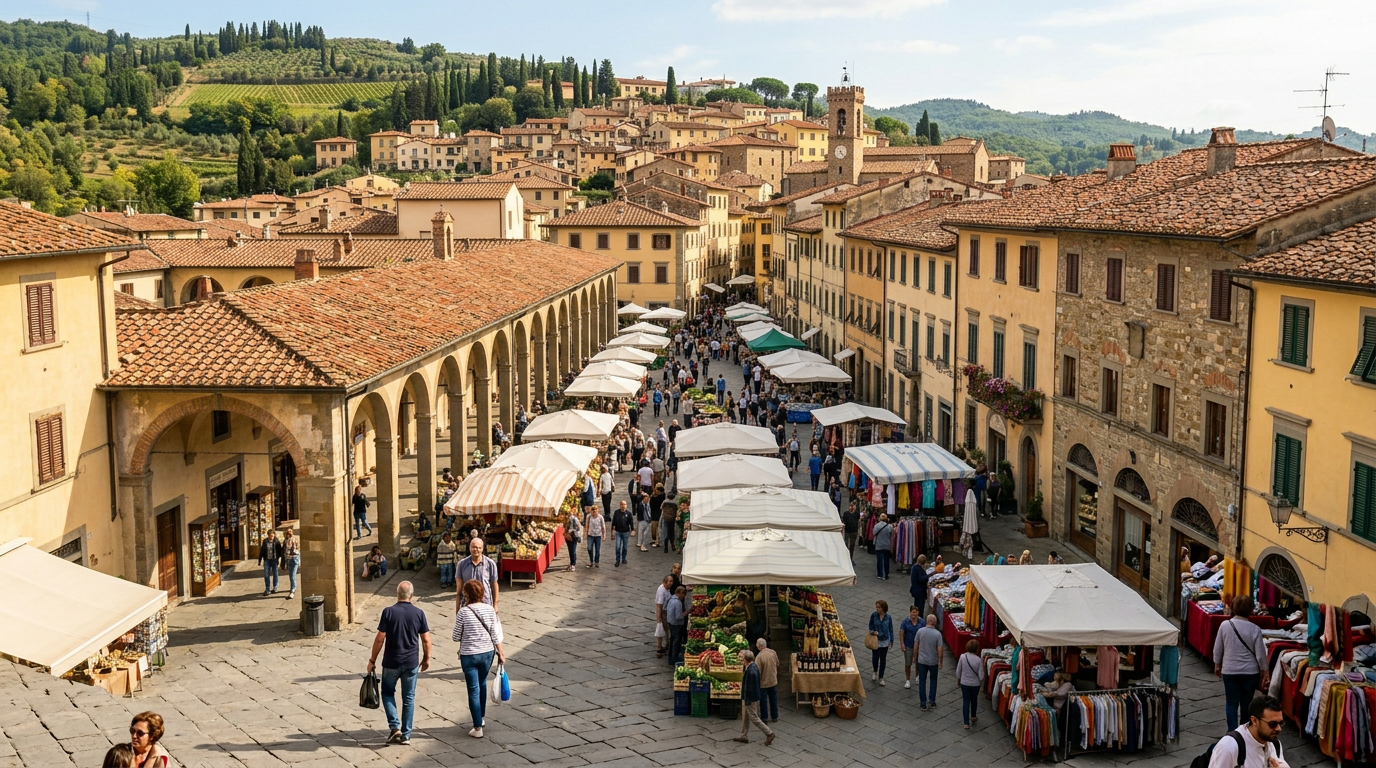
Piazza Matteotti is the main square of Greve in Chianti and one of the most distinctive public spaces in the Chianti area. It is an irregular triangle, wider at one end and narrowing at the other, with arcaded buildings on most sides.
The arcades (logge) were built to shelter the market activities that have taken place here for centuries. Under the arches you will find butchers, delicatessens, wine shops, and cafes. The arcade architecture varies in style from building to building, reflecting different construction periods.
At one end of the square stands a statue of Giovanni da Verrazzano, the explorer who was born near Greve in 1485 and later mapped much of the North American coast. The town celebrates this connection with some pride.
The square is at its most atmospheric on market day, which is Saturday morning. The weekly market fills the square with produce stalls, clothing, and local specialties. It is a genuinely local market, not a tourist market.
Even on quiet days, the square is pleasant for an outdoor coffee or aperitivo. The bars under the arcades have outdoor seating that works in all but the worst weather.
The Mercatale di Greve
The Mercatale di Greve is the most important wine fair in the Chianti Classico zone. It takes place annually in late May. For several days, the main square and surrounding areas host open tastings, wine competitions, and food stalls from local producers.
During the Mercatale, you can taste wines from dozens of Chianti Classico producers, buy directly from the estates, and attend seminars on Tuscan wine and food. Entrance to the general tasting area costs around 20 to 25 euros and includes a tasting glass.
The Mercatale attracts wine professionals and enthusiasts from across Europe. If you are visiting in late May, timing your trip to coincide with the fair is worthwhile.
Outside the fair period, the town has a permanent wine fair character. The Enoteca del Chianti Classico in the main square stocks hundreds of bottles from producers across the entire DOCG zone. Staff can advise on producers, vintages, and food pairings. Tastings by the glass are available for most of the range.
Wineries and wine bars
The area around Greve in Chianti has a high concentration of Chianti Classico estates. Several of the most important producers are within 10 km of the town centre.
Fontodi is one of the most respected estates in the zone. Located on the hill above Greve in the Conca d’Oro area, it produces Chianti Classico Gran Selezione and single-vineyard wines that consistently receive top critical scores. Visits by appointment, around 30 euros.
Vignamaggio, about 5 km from Greve on the road to Panzano, is a historic estate in a beautiful Renaissance villa. There is a tradition, not universally accepted, that Leonardo da Vinci painted the Mona Lisa model here. Visits and tastings are available by appointment.
Castello di Querceto, about 7 km from Greve, is a large estate in a medieval castle. It produces a wide range of wines and offers tastings and accommodation.
For wine by the glass in town, Enoteca Falorni under the arcades of Piazza Matteotti is the most established option. It has a wide selection and helpful staff. Prices start at around 5 euros per glass for basic Chianti Classico.
How to get there from Barberino Val d’Elsa
Greve in Chianti is about 22 km from Barberino Val d’Elsa. By car the drive takes around 25 minutes.
The most direct route goes north on the SP20 from Barberino to Tavarnelle Val di Pesa, then east on the SP92 into the Chianti hills, and finally north-east on the SR222 to Greve.
The SR222, known as the Via Chiantigiana, is one of the classic drives in Tuscany. The road connects Florence to Greve, Panzano, Castellina in Chianti, and Siena through the heart of the wine country. The drive from Barberino to Greve via this route is longer in distance but rewarding for the scenery.
Parking in Greve is available in several car parks near the centre. The main car park on Via Cesare Battisti is the most convenient for Piazza Matteotti. Parking is generally free in surface lots. Some zones near the centre charge 1 to 1.50 euros per hour.
Where to stay
Sogno d’Oro is set in the Val d’Elsa near Barberino Val d’Elsa. Greve in Chianti is 22 km to the east, at the heart of the Chianti Classico territory.
From this base you can explore the entire Chianti Classico zone without long drives. Greve, Panzano, and Radda are all within 30 minutes. The wine country is your immediate landscape.