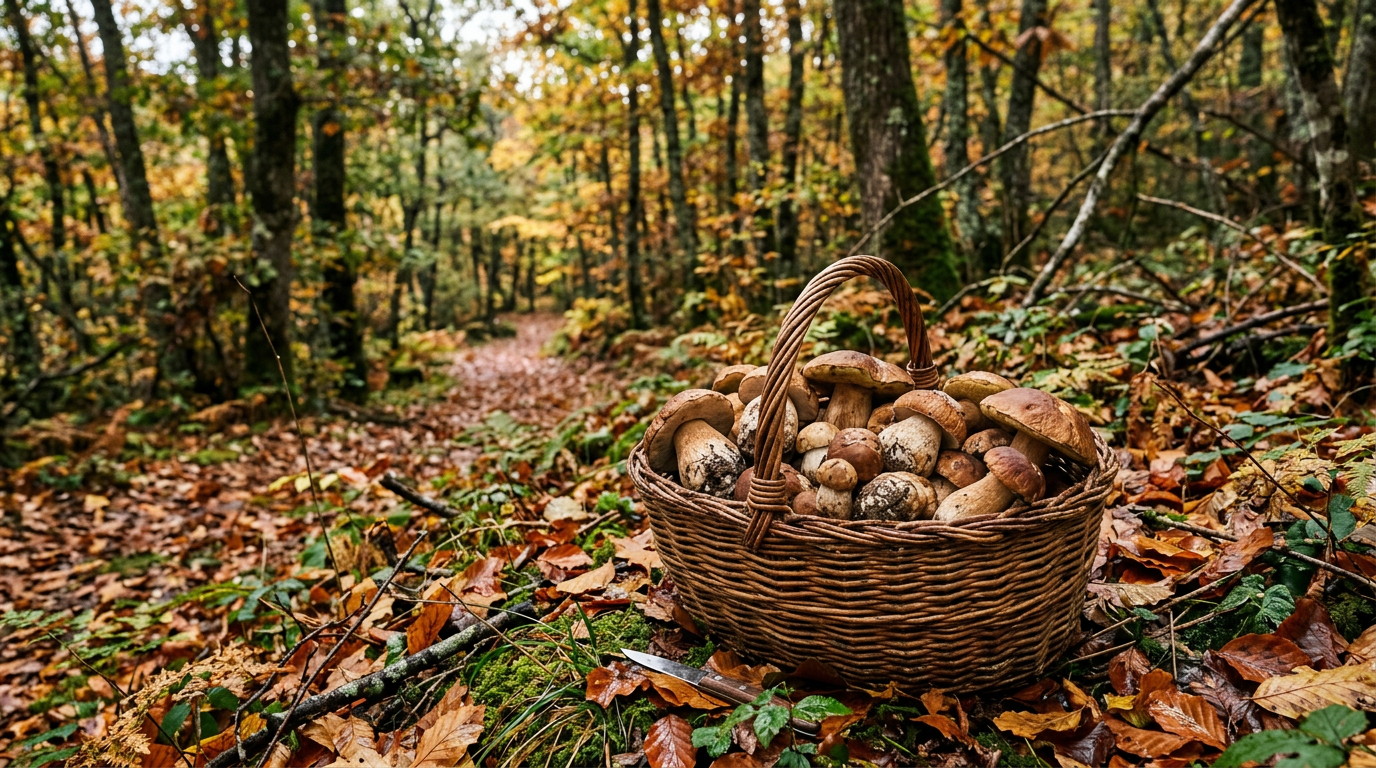
Porcini mushrooms in Tuscany: season, forests, and restaurants
Porcini season in Tuscany is one of the most anticipated moments of the autumn food calendar. The forests come to life with mushroom hunters in early morning, and restaurant menus shift almost overnight to feature porcini in pasta, risotto, and grilled preparations.
If you are staying near Barberino Val d’Elsa in September or October, you are well placed to experience this season at its best: close to productive forests, local trattorias, and markets where freshly picked mushrooms appear in the morning.
Porcini mushrooms in Tuscany
The Boletus edulis, known in Italian as porcino, is the most prized wild mushroom in Tuscany. It grows under chestnut, oak, and fir trees in woodland at altitudes between 400 and 1,500 metres.
The porcino has a thick, barrel-shaped stem and a rounded brown cap. Young specimens have caps that remain closed and firm. Older ones open wide and develop a spongy underside. Both are edible but the younger ones are better for slicing and drying.
The flavour is deep, earthy, and slightly nutty. When fresh and grilled simply with olive oil, garlic, and parsley it is one of the clearest expressions of forest flavour in Italian cooking.
Tuscany also produces smaller quantities of ovoli (Amanita caesarea), finferli (chanterelles), and chiodini (honey fungus). These appear alongside porcini at market stalls in autumn.
When the season is right
The main porcini season in Tuscany falls between late August and October. The precise timing depends on rainfall and temperature.
A warm August followed by rain in the last week of the month typically triggers the first good flush in the higher forests above 700 metres. By mid-September the season extends to lower elevations.
October is generally the most reliable month. Nights are cooler, soil moisture is higher, and the mushrooms that emerge are often of better quality than the early August specimens.
A second, less predictable flush sometimes occurs in spring, between April and June. Spring porcini are found in similar zones but the quantities are lower and less consistent.
The season can fail entirely in dry years. If August and September see little rain, the mushrooms do not appear in significant numbers. Locals follow this closely, and asking at a market stall or trattoria gives you the best real-time picture of what the season is producing.
Forests near Barberino Val d’Elsa
The highest elevation forests most productive for porcini in this part of Tuscany are found in the Chianti hills east and southeast of Greve in Chianti, about 20 km from Barberino.
The area around Panzano in Chianti and the forests above Radda in Chianti, roughly 30 km away, have chestnut and oak woodland at 400 to 600 metres that produces good autumn mushrooms.
Further afield, the Pratomagno massif east of the Arno valley and the forests of the Casentino nature reserve, about 80 km northeast of Barberino, are among the most productive in central Italy. These require a longer drive but the woodland is extensive and the fungal biomass is correspondingly rich.
Closer to home, the mixed woodland in the Colle di Val d’Elsa and Certaldo hills can produce porcini in good years. These forests are less celebrated than the high Chianti or the Casentino but they are accessible without a long journey.
Restaurants with mushroom dishes
During porcini season, trattorias throughout the Val d’Elsa and Chianti area update their menus with fresh mushroom dishes. Some kitchens switch to a more or less mushroom-only focus in October.
The classic preparations are simple. Porcini trifolati, sliced mushrooms sauteed with garlic and parsley in olive oil, appears as a side dish or antipasto. Tagliatelle al porcino features fresh pasta with a sauce based on mushrooms and a small amount of cream or butter. Porcini grillati, whole caps grilled over wood and dressed with olive oil, are served as a second course.
Some restaurants offer mushroom tasting menus in October that run through five or six courses. These are worth booking in advance. Ask about availability when you contact to reserve.
Look for restaurants that specify funghi freschi (fresh mushrooms) on the menu. Some kitchens use dried or frozen porcini year-round. Both are fine ingredients but they are not what you travel to Tuscany for.
Certaldo, Barberino Val d’Elsa, and San Donato in Poggio all have trattorias that take mushroom season seriously. Ask your hosts at Sogno d’Oro for a current recommendation.
How to pick mushrooms safely
Picking wild mushrooms in Tuscany is regulated. You need a permit, called a tesserino, issued by the local municipality or forestry authority. The cost is modest, around 5 to 15 euros per day for non-residents. This permit limits the daily quantity you can collect, typically 3 kilograms, and defines the zones where picking is permitted.
Without the permit you risk a fine from the forestry guards, who do patrol popular areas in season.
The most important safety rule is identification. Never eat a mushroom you cannot identify with complete certainty. Tuscany has several toxic species that superficially resemble porcini. The most dangerous is Boletus satanas, which has a red pore surface rather than the white or yellow of the edible porcino.
Take a reference guide with photographs or use a verified app. If you are not confident, take your collection to a local pharmacy or the ASL (local health authority) office. In Tuscany many municipalities offer free mushroom identification services during the season. The pharmacist or inspector will check your basket and remove any species that are unsafe.
Go with someone who knows the forest if it is your first time. Local knowledge about which zones are productive and what species grow there is invaluable.
Where to stay
Sogno d’Oro in Barberino Val d’Elsa is a well-located base for mushroom season in the Val d’Elsa and Chianti hills. The forests and trattorias of the area are within easy reach.
Autumn in this part of Tuscany is a season in itself, worth visiting for the light, the food, and the quiet that follows the summer crowds.