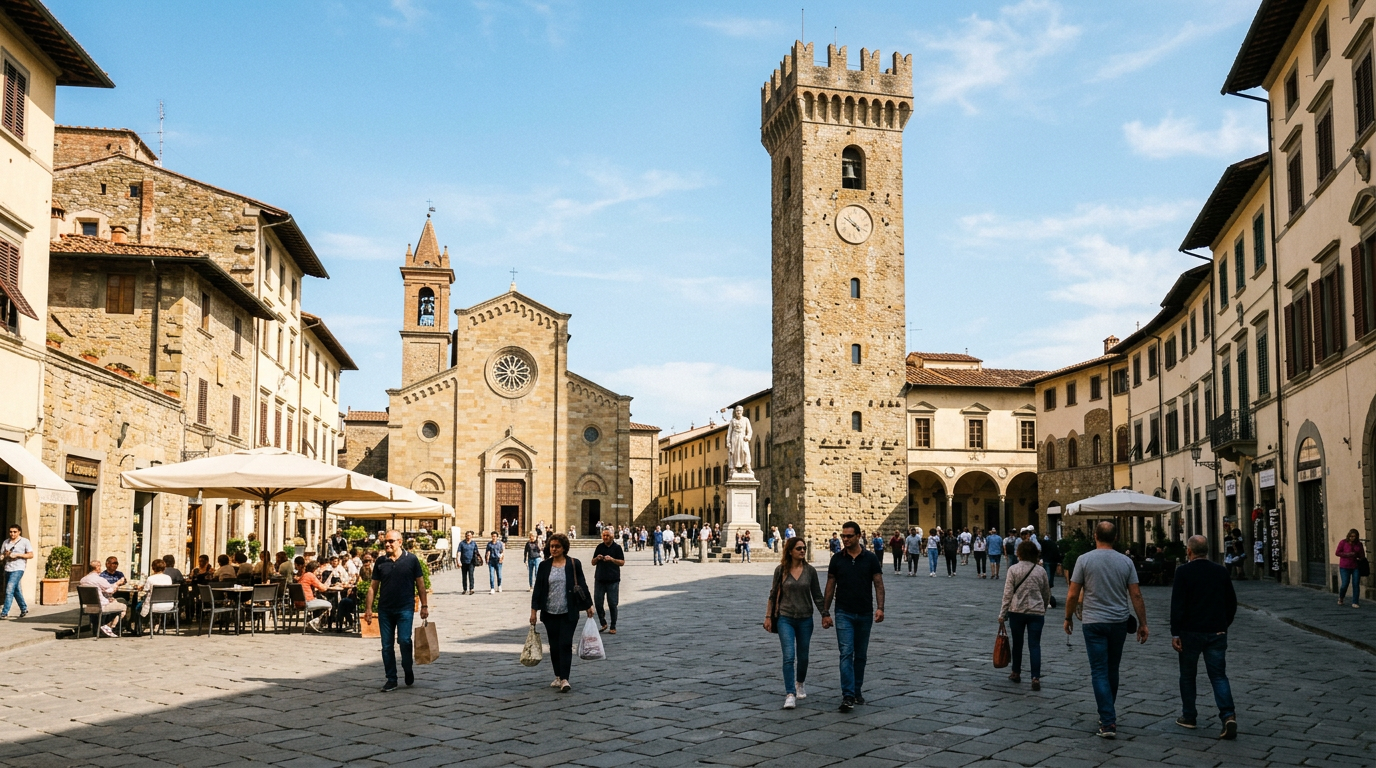
Empoli: what to see on a day trip from Barberino Val d'Elsa
Empoli is a medium-sized town in the lower Arno valley, about 30 km southwest of Florence. It is primarily a working town and sees few foreign visitors relative to its size and historical significance. This means the quality and character of a visit here is different from the more famous destinations of the region: more Italian, less curated, and with a sense of normal life continuing around you.
From Barberino Val d’Elsa the distance is about 25 km and the drive takes roughly 25 minutes on the road northwest through Certaldo and the Arno plain.
Empoli on a day trip from Barberino
Empoli rewards a half-day or full-day visit. The main concentration of interest is in the historic centre around Piazza Farinata degli Uberti, which is one of the better-preserved medieval and Renaissance piazzas in the lower Arno valley.
The town has two cultural highlights of genuine quality: the Museo della Collegiata, which holds some of the most important Early Renaissance paintings in Tuscany, and the Museo del Vetro, a museum dedicated to the local glass-blowing tradition.
Beyond these two museums, the town offers a functional and unhurried urban experience: good bars, local food shops, a covered market, and the character of a place where the priority is not tourism but the daily life of its 50,000 residents.
Plan to arrive by nine-thirty. Spend the morning at the Collegiate and its museum. After lunch, visit the Glass Museum. By four you have covered the main sites and have time to browse the central streets before returning.
The Glass Museum and the Collegiate Church
The Museo del Vetro di Empoli occupies the former convent of Santo Stefano degli Agostiniani, a short walk from the central piazza. The museum documents the long history of glass production in the Empoli area, which dates from at least the medieval period.
Empoli was historically one of the main centres of fiasco production: the round-bottomed straw-wrapped glass flask used for Chianti wine from the 18th century onward. The museum explains this tradition and places it in the broader context of Italian glass-blowing history.
The collection includes historical pieces, production tools, artisan examples, and contemporary works that continue the local glass tradition. It is a focused museum that does not outstay its welcome. Budget one hour.
The Collegiata di Sant’Andrea stands in the central piazza of Empoli. Its Romanesque facade, in the green-and-white marble banding characteristic of Pisan-influenced Tuscan Romanesque, is one of the most recognisable in the Arno valley.
The Museo della Collegiata attached to the church houses a collection of Early Renaissance paintings of unusual importance. Works by Filippo Lippi, Lorenzo Monaco, Masolino da Panicale, and Pontormo are among the highlights. For a museum in a town this size, the quality is remarkable.
The painted pietà by Masolino (1424) and several works by the local artist Jacopo Chimenti, known as Empoli, are the most distinctive pieces. The museum is small and often uncrowded, which lets you spend time with individual works without competition.
The historic centre on foot
The area around Piazza Farinata degli Uberti and the adjacent streets north of the Arno is compact and walkable. The medieval tower of the Palazzo Pretorio, the Loggia of the Cathedral, and the mix of medieval and Renaissance buildings around the piazza create a coherent ensemble.
Walking north from the piazza along Via Giuseppe del Papa takes you toward the covered market hall. Continuing west toward the Arno you reach the older parts of the town.
The area along the river was heavily reconstructed after Second World War bombing that destroyed large sections of central Empoli in 1944. The rebuilt sections mix 1950s Italian modernism with older surviving buildings. This is not a perfectly preserved medieval centre but a functioning city with layers of history visible at close range.
The Palazzo Ghibellino, associated with the famous Ghibelline parliament held in Empoli in 1260 after the Battle of Montaperti, is visible near the central piazza. The building itself is mostly later than the medieval period but marks a historically significant location.
Where to have lunch in Empoli
Empoli has several good options for a mid-morning espresso and a proper lunch. The bars around the central piazza serve coffee at the standing counter in the correct Italian manner.
For lunch, the trattorias and restaurants in the streets radiating from Piazza Farinata are the most practical. These are not tourist restaurants. They serve the standard Tuscan lunch of antipasto, pasta, and a second course to working locals and nearby residents.
Prices are noticeably lower than in tourist centres like Siena or San Gimignano. A full three-course lunch with wine in a central Empoli trattoria typically costs 20 to 30 euros per person.
The covered market hall a few streets from the central piazza has a small food court area with local products. This is also a good place to buy fresh pasta, cheese, and local salumi to take back to your accommodation.
How to get there from Barberino Val d’Elsa
The most direct route from Barberino Val d’Elsa to Empoli goes north through Certaldo on the SP4 and then north toward Castelfiorentino, joining the main road northwest to Empoli. The total distance is approximately 25 km and the drive takes about 25 minutes.
By train, the Empoli-Siena line runs through Barberino Val d’Elsa station. The journey to Empoli takes about 20 minutes with several services per day. This is a practical option if you want to avoid parking. Empoli station is about 10 minutes on foot from the historic centre.
Parking in Empoli is available in the outer ring of the historic centre. Look for the paid parking areas near the hospital and the railway station for the most convenient access.
Where to stay
Sogno d’Oro in Barberino Val d’Elsa is 25 minutes from Empoli by car and even less by train. The proximity makes Empoli one of the easiest half-day options from the guesthouse, accessible without effort for a morning of museums or an afternoon of local exploration.