Tuscan wine tasting: a practical guide
Tuscany is one of the great wine regions of the world. If you are staying near Barberino Val d’Elsa, you are positioned at the heart of three distinct wine zones: Chianti Classico, Vernaccia di San Gimignano, and the broader Val d’Elsa area. Within an hour’s drive you can add Brunello di Montalcino, Vino Nobile di Montepulciano, and Morellino di Scansano.
A wine tasting in Tuscany does not require specialist knowledge. The wineries here are accustomed to visitors of all experience levels. What matters is curiosity and the willingness to pay attention.
Wine tasting in Tuscany
Tuscan wine tasting has a culture of its own. Unlike some wine regions where visits are formal and require professional credentials, most Tuscan producers welcome individual travellers.
The tasting is typically conducted by the winemaker or a family member at smaller estates. At larger operations there may be dedicated tasting staff. In both cases, you can ask questions and expect honest answers.
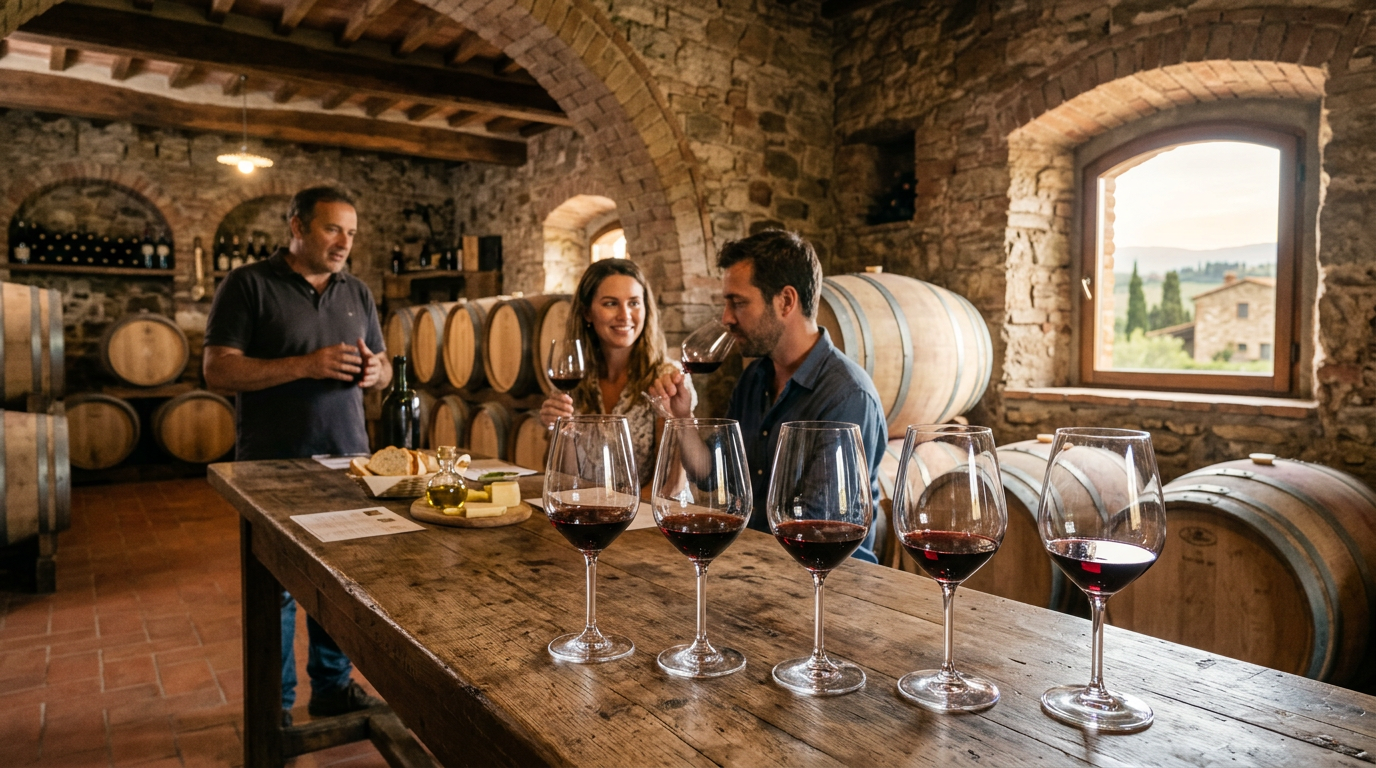
A standard tasting lasts 45 to 90 minutes. It includes a cellar or vineyard tour, an explanation of the production philosophy, and the tasting of three to five wines. Food is often served: bread, local olive oil, cold cuts, and sometimes cheese.
Booking in advance is strongly recommended for most estates and essential for the most prestigious ones. Booking can be done by email or phone. Most wineries have a website with booking information. A few days’ notice is usually enough outside the high season. In July and August, book at least two weeks ahead.
Most tastings in the Chianti Classico zone cost between 15 and 40 euros per person. The price reflects the quality of wines poured, the quality of the food, and the overall experience. The best value is often at medium-sized family estates.
How a tasting is organised
A typical winery visit at a Tuscan estate follows a predictable structure.
You arrive at the appointed time and are met by your host. If the estate has a vineyard accessible by car, you may start with a brief drive or walk through the vines. Your host will explain the grape varieties, the soil, and the recent vintages.
The cellar visit shows you the fermentation tanks (typically stainless steel or concrete for white wines, or oak and concrete for reds), the barrel room where the wine ages in oak, and the bottling area. The scale of the operation varies enormously: from a single room with a few barrels to purpose-built facilities with thousands of barrels.
The tasting takes place either in the cellar, in a dedicated tasting room, or outdoors on a terrace. Glasses are set up for the number of wines to be tasted. The host pours and describes each wine: the vintage, the grape composition, the aging method, and the best food pairings.
You are expected to taste carefully and ask questions. It is entirely acceptable to say that you prefer one wine over another or that you find a particular wine too tannic, too acidic, or not to your taste. Producers appreciate honest feedback.
At the end of the tasting, you are free to buy. There is no obligation to purchase, but buying at least one bottle is a courteous way to thank the producer for their time.
Wine areas near Barberino
From Barberino Val d’Elsa, three wine zones are within 30 minutes by car.
Chianti Classico is the closest. The DOCG zone begins at the eastern edge of the Val d’Elsa. Estates in San Donato in Poggio, Tavarnelle, and Barberino itself are within 10 to 15 minutes. The main Chianti towns (Greve, Panzano, Radda, Castellina, Gaiole) are 25 to 40 minutes away.
Vernaccia di San Gimignano is about 28 km to the west. San Gimignano and its surrounding wine estates are accessible for a morning tasting combined with a visit to the towers and the historic centre.
Colli dell’Etruria Centrale is a broad DOC that covers much of the Val d’Elsa and surrounding areas. Wines produced here include Sangiovese-based reds, Trebbiano-based whites, and blends. Quality varies widely but good producers exist throughout the zone.
Within an hour’s drive, you can reach Montespertoli (known for its local Chianti), the Morellino di Scansano zone in the Maremma, and the fringe areas of the Brunello zone near Montalcino.
For a serious multi-day wine itinerary, the position near Barberino Val d’Elsa is almost unbeatable. You can taste a different major Tuscan wine denomination each day without more than an hour of driving.
Wineries that accept walk-in visits
Most serious Chianti Classico estates require advance booking. But there are options for spontaneous visits, especially outside July and August.
Rocca delle Macie, near Castellina in Chianti, has a welcoming approach to walk-in visitors. The estate is large and well organised. Tastings start at around 15 euros.
The enoteca in the Fortezza di Montalcino accepts walk-in visitors for tastings of Brunello and Rosso di Montalcino. A flight of three wines starts at around 12 euros. No booking required.
The Enoteca del Chianti Classico in Greve in Chianti (Piazza Matteotti) and the enoteca in San Donato in Poggio both serve wines by the glass from many local producers. These are not winery visits but are excellent for tasting and buying without planning.
Several estates in the Barberino and Tavarnelle area operate informal tastings at the cellar door. Look for signs on the local roads saying “vendita diretta” (direct sales) or “degustazione”. This means they are open to visitors without prior arrangement.
The Strada del Vino Chianti Classico association publishes a list of estates that accept visits. Their website (stradavinochianticlassico.it) is a useful resource for planning.
What to taste and how
If you are new to Tuscan wine tasting, a practical approach is to focus on one or two zones rather than trying to cover everything.
For a first Chianti Classico tasting, ask to compare a standard Annata and a Riserva from the same estate and vintage. This shows you how aging changes the wine. The Annata is usually fresher and more immediately approachable. The Riserva has more structure and secondary flavours.
For Vernaccia di San Gimignano, taste both the standard version and the Riserva if available. The difference in body, colour, and flavour is significant.
When tasting, notice the colour first. Red wines should be clear, not cloudy. The colour intensity tells you something about the grape concentration. Sangiovese is typically medium ruby to garnet.
Then swirl the glass and smell. Take a short sniff first, then a deeper one. Typical Sangiovese aromas: sour cherry, dried herbs, leather, earth, sometimes a hint of tobacco. With aging these evolve towards dried fruit, leather, and spice.
Finally taste. Take a small sip and let it move around your mouth. Notice the acidity (how much your mouth waters), the tannins (the drying sensation), the body (the weight on the palate), and the finish (how long the flavour lasts after you swallow).
A long finish is generally a sign of quality. Good Chianti Classico should leave a flavour impression for 20 to 30 seconds after you swallow. Great Chianti Classico lingers much longer.
Where to stay
Sogno d’Oro is located near Barberino Val d’Elsa, surrounded by the landscape that produces the wines described in this article. The Val d’Elsa and the Chianti Classico hills are visible from the property.
Whether you want a structured multi-day wine itinerary or a single casual afternoon tasting, the guesthouse puts you in the right place. The wine estates are your neighbours, the roads are short, and the experience of drinking great wine in the landscape where it was made is available every day of your stay.