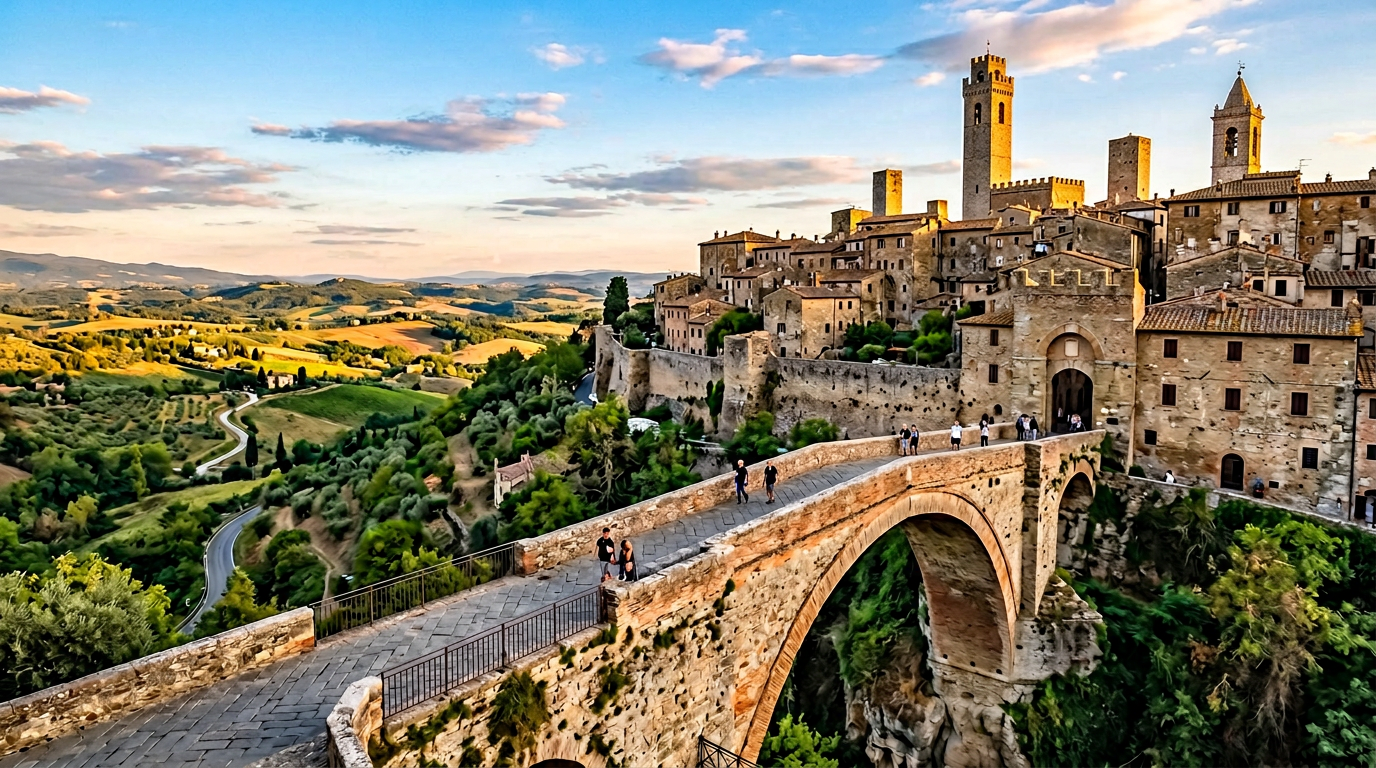
Colle Val d'Elsa: what to see
Colle Val d’Elsa is one of those Tuscan towns that punches well above its size. It has a population of about 22,000, making it the largest town in the Val d’Elsa. But its medieval upper district, Colle Alta, is a world apart from the modern lower town: a narrow ridge of medieval buildings, towers, and churches with views over the surrounding valley.
It is about 18 km from Barberino Val d’Elsa and 20 minutes by car. An easy half-day trip, or a full day if you combine the upper town with the Crystal Museum and a good meal.
Colle Val d’Elsa: what to see
Colle Val d’Elsa divides into two distinct parts. Colle Bassa, the lower modern town, sits in the Elsa valley and is a working industrial and commercial centre. Colle Alta, the upper medieval district, occupies a long narrow ridge above.
The lower town has little of architectural interest, but it is practical: you will find supermarkets, pharmacies, banks, and the bus station here. The upper district is where all the historic sights are concentrated.
The medieval ridge of Colle Alta is about 800 metres long and 60 to 80 metres wide. A single main street, Via del Castello, runs the length of the ridge. Off this street, narrow alleys drop steeply to the valley below on both sides.
The atmosphere in Colle Alta is less touristy than San Gimignano, which is only 15 km to the west. You will encounter some visitors, particularly at weekends, but the town retains a genuine daily life alongside the tourism.
The medieval upper town
The historic buildings of Colle Alta are mostly medieval and Renaissance, concentrated along Via del Castello and the streets immediately adjacent.
The Torre di Arnolfo stands at the far end of the main street. It was part of a medieval palace and according to tradition contains the room where Arnolfo di Cambio was born in 1240. Arnolfo went on to design the Florence Cathedral (Santa Maria del Fiore), the Palazzo Vecchio (then called the Palazzo dei Priori), and the Basilica of Santa Croce. He is one of the most important architects and sculptors of the 13th century.
The Palazzo dei Priori, on the main street, dates from the 14th century and has a facade decorated with carved stone details. It now houses the Civic Museum and the Crystal Museum. Tickets for both cost around 6 euros combined.
The Cathedral of Colle Val d’Elsa faces a small square at the centre of the upper district. The facade was rebuilt in the 17th century in a somewhat plain baroque style. The interior, however, contains some fine works including a bronze crucifix attributed to Giambologna.
The Torre Arnolfo bridge connecting the upper district to the newer section of Colle Alta gives a dramatic view over the steep valley walls when you cross it.
The Crystal Museum
The Museo del Cristallo is the only museum in Italy dedicated to the art of crystal glass-making. Colle Val d’Elsa has been a centre of crystal production since the 18th century and today produces about 15 percent of the world’s crystal glass.
The museum is located in a renovated former factory building in the lower section of Colle Alta. The collection covers the history of crystal production in Colle Val d’Elsa, with examples ranging from 18th-century hand-blown pieces to industrial production methods of the 20th century.
The most spectacular section displays historical pieces commissioned for royal households and diplomatic gifts. The craftsmanship is extraordinary. Even if you have no particular interest in glass-making as an industry, the museum is visually compelling.
Entrance to the Crystal Museum costs around 4 euros. It is open Tuesday to Sunday from 10:00 to 13:00 and 15:00 to 19:00. Closed Mondays.
Several crystal workshops in the industrial area of Colle Bassa offer factory visits and outlet shopping. Prices for crystal products are lower here than in the tourist shops of the upper town. Worth a stop if you want to buy quality table glassware or decorative pieces.
Arnolfo di Cambio: born here
Arnolfo di Cambio (1240 to 1310) is one of the most significant figures in the history of Italian architecture and sculpture. He was born in Colle Val d’Elsa and moved to Florence, where he became the master architect responsible for the city’s most iconic buildings.
The Florence Cathedral was his design. The Palazzo Vecchio, completed after his death, followed his plans. His sculptures include works in Rome (the tomb of Boniface VIII, the ciboria of San Paolo fuori le Mura and Santa Cecilia in Trastevere) and in Florence.
His influence on Florentine Gothic architecture was foundational. The Florence Cathedral’s distinctive octagonal drum and the general spatial concept of the building were all Arnolfo’s work, completed by later architects after his death.
In Colle Val d’Elsa, a small monument in the main square of Colle Alta commemorates his birth. The Torre di Arnolfo, the tower bearing his name, is the most visible monument to the connection.
The Civic Museum in the Palazzo dei Priori has a small section dedicated to Arnolfo and his contribution to medieval Italian art. If you are interested in this period, the display is informative, though the collection does not include any original works.
How to get there from Barberino Val d’Elsa
Colle Val d’Elsa is about 18 km from Barberino Val d’Elsa. By car the drive takes around 20 minutes on the SR2 heading south.
The most direct route follows the SR2 (Via Cassia) south from Barberino through Poggibonsi and then to Colle Val d’Elsa. The road is fast and straightforward.
Parking in Colle Val d’Elsa is available in the lower town near the bus station and in several car parks near the access road to Colle Alta. Once you park, you can walk up to the upper district in about 10 minutes. A small shuttle bus also connects the lower and upper town during peak hours.
By bus, the Busitalia network connects Colle Val d’Elsa to Poggibonsi, Siena, and Florence. Direct connections from Barberino Val d’Elsa are limited. Check timetables on the Busitalia website.
The upper district of Colle Alta is mostly pedestrianized. Parking inside the walls is not permitted except for residents. The walk from the lower town car parks to the main street of Colle Alta is about 10 to 15 minutes.
Where to stay
Sogno d’Oro is set in the Val d’Elsa near Barberino Val d’Elsa. Colle Val d’Elsa is one of the closest day trip destinations, just 18 km down the valley.
The two towns are connected by a road that passes through the heart of the Val d’Elsa countryside: open fields, vineyard slopes, and occasional farmhouses. The drive itself is part of the experience.