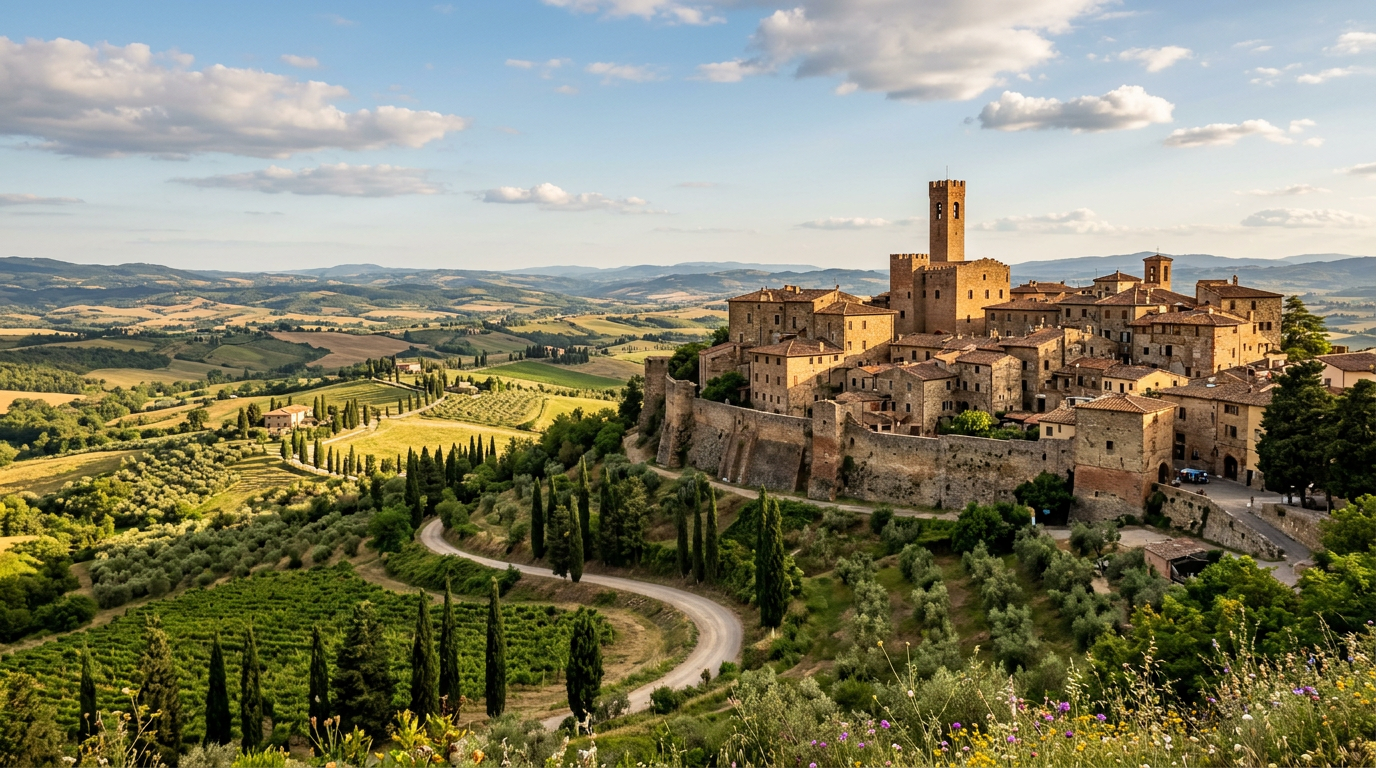
Certaldo: what to see in Boccaccio's town
Certaldo is one of the closest worthwhile destinations from Barberino Val d’Elsa. Just 12 km away and about 15 minutes by car, it is an easy half-day trip or a relaxed full day if you combine it with a meal and a walk through the old town.
The town divides into two distinct parts: Certaldo Basso, the modern lower town in the valley, and Certaldo Alto, the medieval brick village on the hilltop above. Most visitors come for the upper part, and that is where almost everything worth seeing is located.
Certaldo: Boccaccio’s town
Giovanni Boccaccio, author of the Decameron, was born in either Certaldo or Florence around 1313 and spent much of his later life here. He died in Certaldo in 1375. The town has embraced his memory completely.
The Decameron is one of the most influential works in European literature. Written in the wake of the Black Death, it consists of 100 stories told by ten young people sheltering from the plague in a country villa. Boccaccio’s realism and humour shaped European prose writing for centuries.
In Certaldo Alto you will find his house, his tomb, and a museum dedicated to his life and work. The medieval atmosphere of the upper town is well preserved, which makes the visit feel genuinely connected to the writer’s world.
Certaldo also holds an annual summer festival, the Mercantia, which fills the streets of Certaldo Alto with street theatre, music, and markets. It typically takes place in July and draws large crowds.
Certaldo Alto and Certaldo Basso
Certaldo Basso is the modern part of town in the valley floor. It has shops, restaurants, the train station, and the lower terminus of the funicular. There is not much to see here architecturally, but it is functional and easy to navigate.
Certaldo Alto sits on the ridge above, connected by the funicular and by a steep road that also allows cars. The upper town is small: you can walk from one end to the other in about 15 minutes. But the density of medieval buildings, towers, and narrow lanes makes it feel substantial.
The brick architecture is distinctive. Most buildings in Certaldo Alto are built from red and brown brick rather than stone, which gives the village a warm, slightly unusual appearance compared to other Tuscan hilltowns.
The main street, Via Boccaccio, runs through the centre and connects the main gate to the far end of the village. Off this main axis, narrow alleys lead to small courtyards and unexpected viewpoints over the surrounding countryside.
The funicular and medieval centre
The funicular connecting Certaldo Basso to Certaldo Alto runs every 15 to 20 minutes during opening hours. A single ticket costs 1.50 euros. The ride takes about three minutes and saves you a steep walk uphill.
If you prefer to walk, the road from the lower town to the upper gate takes about 20 to 25 minutes on foot. The path is paved but steep in places.
Once in Certaldo Alto, the main sights are all within easy walking distance. The Palazzo Pretorio is the most prominent civic building. Its facade is decorated with coats of arms, and the interior holds a small but interesting museum of local history and medieval artefacts.
The museum inside Palazzo Pretorio also displays a reconstruction of the room where Boccaccio is believed to have spent his final years. The building is open daily except Tuesdays. Entrance costs around 6 euros.
The church of Santi Jacopo e Filippo is one of the oldest buildings in the upper town. It contains Boccaccio’s tomb and an inscription placed there by his fellow citizens. The church interior is simple and somewhat austere, which suits the medieval surroundings.
Views from the town walls extend over the Val d’Elsa in one direction and the Chianti hills in the other. On a clear day you can see as far as San Gimignano to the south-west.
Boccaccio’s house
Casa Boccaccio, the house museum dedicated to the writer, stands on Via Boccaccio in the heart of the upper town. The building is a reconstruction: the original house was largely destroyed during World War II and rebuilt in the 1960s.
The museum inside covers Boccaccio’s life, his literary output, and the historical context of 14th-century Tuscany. The collection includes manuscript reproductions, illustrations from various editions of the Decameron, and documentary material about medieval life.
Even if you are not a specialist in medieval literature, the museum gives a clear and accessible account of why Boccaccio matters. The Decameron predates the printing press, yet it circulated widely across Europe. The museum explains how this was possible.
Entrance to Casa Boccaccio costs around 5 euros. It is open daily except Mondays. Combined tickets with Palazzo Pretorio are usually available.
A small garden behind the house offers views over the valley. It is a good place to sit for a moment before continuing your walk through the village.
Where to eat in Certaldo
Certaldo Alto has a handful of restaurants and one or two wine bars. For a meal with good local ingredients, try Osteria del Vicario, which occupies a converted medieval convent on Via Rivellino. Expect to spend around 35 to 45 euros per person including wine.
The osteria is housed in one of the most beautiful buildings in Certaldo Alto. Even if you just stop for a glass of local wine and a plate of cold cuts, the setting is worth the visit.
For something simpler and cheaper, there are a couple of small bars along Via Boccaccio that serve sandwiches and light meals.
If you prefer to eat in the lower town, Certaldo Basso has several trattorie and pizzerias near the train station area.
How to get there from Barberino Val d’Elsa
Certaldo is just 12 km from Barberino Val d’Elsa. By car the drive takes about 15 minutes. Take the SP1 road north-west towards Certaldo. The road follows the Val d’Elsa and is easy to drive.
Parking is available in the lower town near the train station. From there you can take the funicular up to Certaldo Alto. There is also limited parking at the upper gate for those who prefer to drive up.
By train, Certaldo is on the Florence-Siena line. From Barberino Val d’Elsa, however, there is no local train service. The most practical option is to drive. If you are arriving from Florence, the train is a good alternative.
By bus, the Busitalia network connects some Val d’Elsa towns, but direct connections from Barberino to Certaldo are limited. Check current timetables before planning a bus trip.
The walk from the lower car park to Certaldo Alto via the funicular takes about ten minutes total, including the ride. If the funicular is closed for maintenance, there is a pedestrian path that follows the hillside.
Where to stay
Sogno d’Oro is located near Barberino Val d’Elsa, in the heart of the Val d’Elsa. Certaldo is one of the closest meaningful destinations from the property, making it an ideal first stop on your Tuscan itinerary.
You can drive there for a morning visit, return for lunch at the guesthouse, and still have the afternoon free for another excursion. The proximity makes it easy to revisit in the evening as well, especially during the summer festival season.