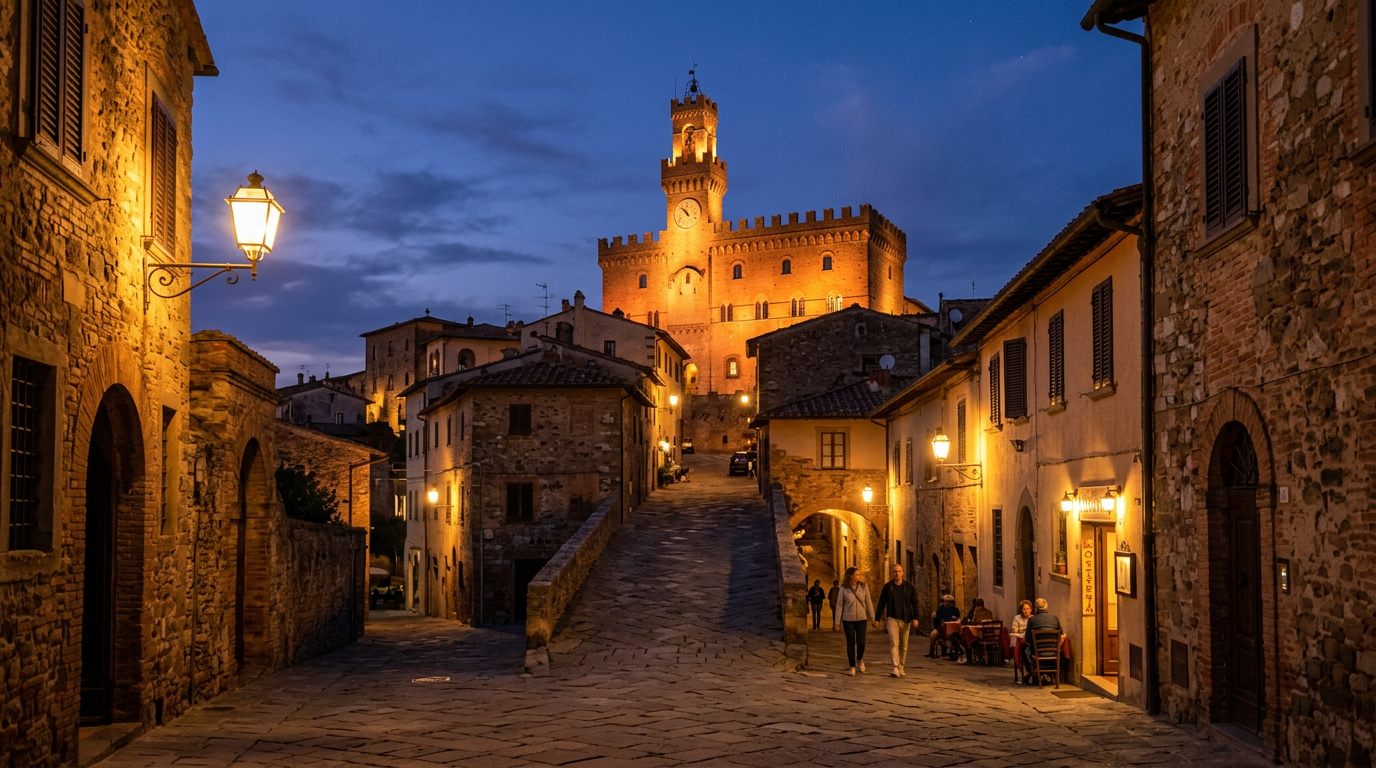
Certaldo Alto: the medieval village
Certaldo Alto is the medieval upper village of Certaldo, one of the most authentic and least commercialised hilltowns in Tuscany. Its distinctive red brick architecture, narrow lanes, and medieval towers make it unlike most other Tuscan hilltowns, which are typically built in grey or white stone.
It is just 12 km from Barberino Val d’Elsa and about 15 minutes by car. Close enough for a morning visit or an evening stroll, far enough to feel like a genuine discovery.
Certaldo Alto: the medieval village
Certaldo Alto sits on a ridge above the Elsa river valley at about 130 metres above the valley floor. The village is compact: roughly 400 metres long and 80 metres wide. You can walk from one end to the other in ten minutes.
What makes it feel larger is the density and quality of the medieval fabric. Almost every building on the main street, Via Boccaccio, is medieval or early Renaissance. The street level, the building heights, and the relationship between buildings and street are all unchanged from the 14th century.
The brick construction gives Certaldo Alto a warm visual character. In the afternoon light, the walls glow a deep orange-red. At dusk, with the valley visible below and the sky darkening, the village has a quietly spectacular quality.
The permanent population of Certaldo Alto is small, probably fewer than 200 people. But the village feels lived-in rather than museumified. Local people shop at the small alimentari on the main street, sit on the benches in the small square, and use the ancient buildings as ordinary homes.
How to reach it by funicular
The funicular connecting Certaldo Basso to Certaldo Alto is the most practical way to reach the upper village if you arrive by car. Park in the lower town near the train station and take the funicular from there.
The funicular runs every 15 to 20 minutes during operating hours. A single ticket costs 1.50 euros. The ride takes about three minutes and saves a steep 20-minute walk uphill.
Operating hours in summer (June to September) are approximately 7:30 to 20:00 on weekdays and 10:00 to 20:00 on weekends. In winter hours are reduced. Check current hours on the Certaldo Città website before planning your visit.
The funicular station at the top opens directly onto the main street of Certaldo Alto, close to the Palazzo Pretorio. It is one of the most immediate entries into a medieval village you will find anywhere in Tuscany.
If the funicular is not operating, you can reach the upper village by car via the steep road from the lower town. Limited parking is available near the upper gate. Alternatively, the pedestrian path alongside the road takes about 20 to 25 minutes to walk.
What to see in the historic village
The Palazzo Pretorio is the main civic building of Certaldo Alto. It stands near the funicular exit, on the main street. The facade is decorated with dozens of ceramic coats of arms, the symbols of the governors who administered the town during Florentine rule.
Inside the Palazzo Pretorio, the Museo Civico has a small but well-organised collection of local history, medieval artefacts, and a reconstruction of the room where Boccaccio is said to have spent his final years. Entrance costs around 6 euros.
The Church of Santi Jacopo e Filippo is one of the oldest buildings in the upper village. Boccaccio’s tomb is inside. A Latin inscription placed by his fellow citizens marks the burial site. The church interior is simple and slightly austere, which suits the medieval atmosphere.
The town walls can be walked in part. The best views from the wall walk are to the south and west, over the Val d’Elsa and towards San Gimignano. On a clear day the towers of San Gimignano are visible about 15 km to the south-west.
The Osteria del Vicario on Via Rivellino occupies a converted medieval convent with a cloister garden. It is one of the best places to eat in Certaldo Alto. Prices are around 35 to 45 euros per person for a full meal.
Boccaccio’s house and the museum
Casa Boccaccio, the house museum on Via Boccaccio, is dedicated to the life and work of Giovanni Boccaccio (around 1313 to 1375). The original building was damaged in World War II and carefully reconstructed in the 1960s.
The museum covers Boccaccio’s literary career, his connections to Florence and the Florentine intellectual world of the 14th century, and the international influence of the Decameron.
The Decameron, Boccaccio’s most famous work, was written in the aftermath of the Black Death of 1348. It consists of 100 short stories told over ten days by a group of young Florentines sheltering in a country villa. The stories range from comic to tragic, from realistic to fantastical. They established a model of vernacular Italian prose that influenced European literature for centuries.
The museum displays reproductions of manuscript pages, historical maps, portraits, and documentary material about medieval Florence and Certaldo. The exhibition is clear and accessible even for visitors not already familiar with Boccaccio’s work.
Entrance costs around 5 euros. Combined tickets with the Palazzo Pretorio are available and usually represent better value. The museum is open daily except Mondays from 10:00 to 13:00 and 14:30 to 19:00 in summer.
A small garden at the back of Casa Boccaccio has a few benches and a view over the valley. It is a quiet place to sit and read before continuing your walk through the village.
How to get there from Barberino Val d’Elsa
Certaldo Alto is about 12 km from Barberino Val d’Elsa. By car the drive takes around 15 minutes on the SP1 heading north-west.
The SP1 follows the Val d’Elsa from Barberino towards Certaldo. It is a pleasant drive through vineyards and farmland. The road is mostly flat until the approach to Certaldo, where it climbs slightly into the lower town.
Park in the lower town near the train station. Parking here is free or very cheap. From the car park, walk to the funicular station and take the funicular up. Total time from car to upper village: about 10 minutes.
By train from Florence, Certaldo is on the Florence-Siena local line. The journey from Florence takes about 35 minutes. The train station is in Certaldo Basso, directly connected to the funicular.
From Barberino Val d’Elsa, there is no convenient direct bus to Certaldo. The car is the most practical option.
Where to stay
Sogno d’Oro is located near Barberino Val d’Elsa, in the Val d’Elsa countryside between the guesthouse and Certaldo Alto. The proximity makes it easy to visit in the early morning before other visitors arrive, or in the evening when the light on the brick buildings is at its best.
Returning from Certaldo Alto to the Sogno d’Oro takes 15 minutes by car. You pass through the same valley landscape that Boccaccio himself would have known.