Castelfiorentino: what to see on a day trip
Castelfiorentino is a town of about 18,000 people in the lower Val d’Elsa, 18 km from Barberino Val d’Elsa and about 20 minutes by car. It is not a classic Tuscan hilltown: the historic centre is modest, the streets are functional, and there is no dramatic skyline of towers.
What Castelfiorentino has, however, is one of the most important collections of Benozzo Gozzoli’s work anywhere in Tuscany. If you care about 15th-century Florentine painting, this is a destination worth planning around.
Castelfiorentino: what to see on a day trip
The main reason to visit Castelfiorentino is the Museo Benozzo Gozzoli. Beyond the museum, the historic centre has a couple of interesting churches and a pleasant main square. The combination makes for a comfortable half-day, or a full day if you add lunch and explore the surrounding area.
The town sits on the right bank of the Elsa river, in the flat valley floor. The historic centre is on slightly raised ground above the valley. It is walkable and compact, though much less picturesque than the hilltowns to the east.
The Val d’Elsa in this stretch is agricultural and working-class. You will not find many tourist shops or high-end restaurants. What you will find is an authentic Tuscan market town with good food, local wine, and people going about their daily lives.
A weekly market takes place on Thursdays in the main square. It sells produce, clothing, and local specialties. If you can plan your visit for a Thursday, the market adds life and colour to the centre.
The Benozzo Gozzoli museum
The Museo Benozzo Gozzoli in Castelfiorentino is devoted entirely to the work of Benozzo Gozzoli (1420 to 1497), a Florentine painter who was a student of Fra Angelico and a collaborator with Ghiberti on the Baptistery doors in Florence.
Gozzoli is best known for his fresco cycle in the Palazzo Medici-Riccardi in Florence, depicting the journey of the Magi. But his work for the Castelfiorentino area is equally significant, even if less famous.
The museum houses two sets of detached tabernacle frescoes that were originally painted on outdoor shrines in the surrounding countryside. These tabernacle paintings, created in the 1480s, depict scenes from the lives of the Virgin Mary and the Assumption. They were detached from their original locations in the 19th century to protect them from weathering.
The colours are extraordinary. Gozzoli used bright reds, deep blues, and rich greens that have survived remarkably well. The figures are lively and detailed, painted in a narrative style that is easy to follow even without specialist knowledge.
The museum building is modern and well designed, built specifically to house and display these large-scale frescoes. The lighting is controlled, the temperature is stable, and the presentation is clear.
Entrance costs around 5 euros. Opening hours are Tuesday to Sunday, 10:00 to 13:00 and 15:00 to 19:00. Closed Mondays.
The historic centre and main square
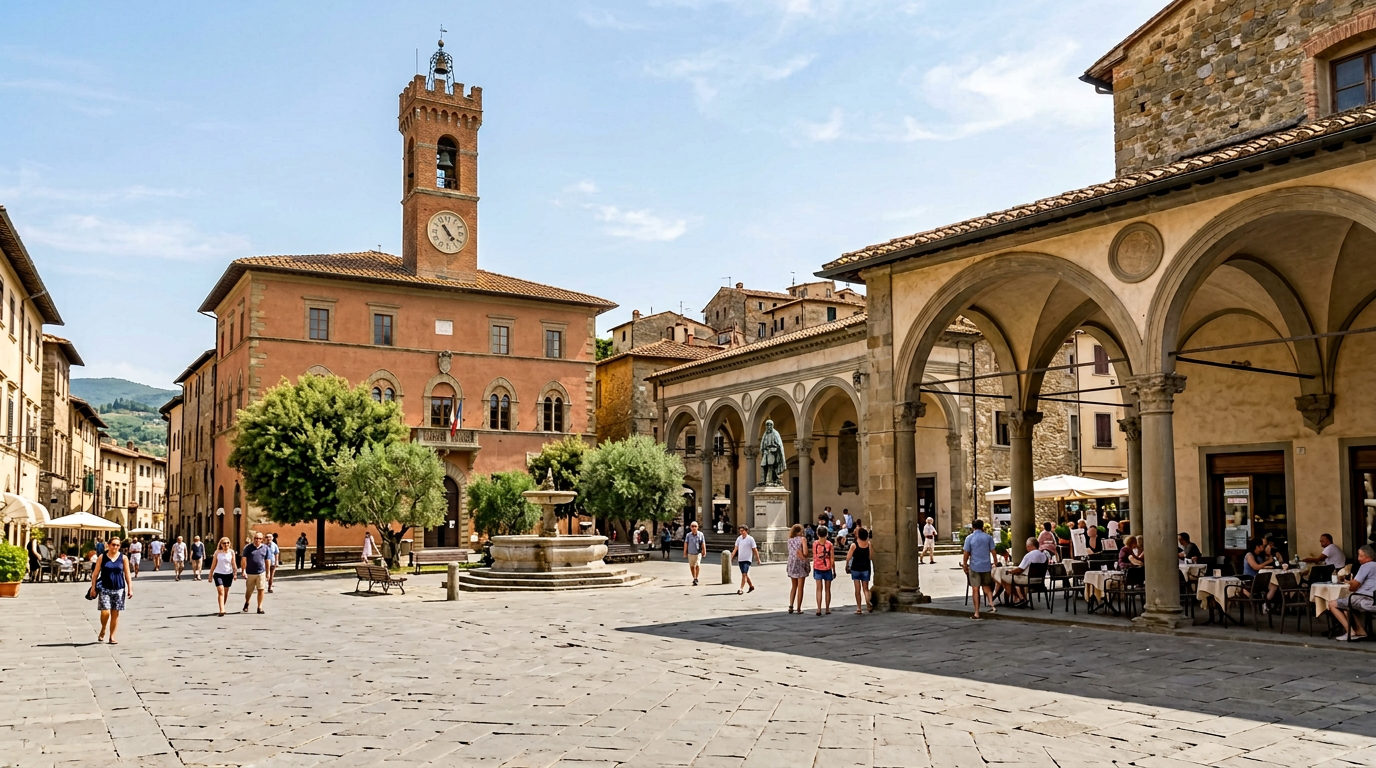
The main square of Castelfiorentino, Piazza del Popolo, is the centre of civic life in the town. It has a few cafes, a couple of shops, and benches where local people sit in the morning sun.
The Collegiata di San Lorenzo on one side of the square has a baroque facade and an interior with works from the 16th and 17th centuries. The organ is one of the finest in the Val d’Elsa area.
Via Testaferrata, the main shopping street, runs from the square towards the old town gate. It is a functional but pleasant street with a mix of independent shops and small bars.
The Logge, a 19th-century arcade along one side of the square, gives the square its character. The arches frame views of the surrounding streets and provide shade in summer.
For lunch, Trattoria da Beppe on Via Roma is a solid local option. Expect around 20 to 25 euros per person for a full meal with house wine. The pasta is made fresh daily and the secondi focus on local meat.
Churches with fresco cycles
Beyond the Benozzo Gozzoli museum, Castelfiorentino has several churches with significant fresco cycles.
The Church of Santa Verdiana, just outside the historic centre, is dedicated to the town’s patron saint. Verdiana was a 12th-century hermit who, according to legend, lived for 34 years in a small cell attached to a tower. The church built on this site has 17th and 18th-century frescoes depicting her life.
The Church of SS Ippolito e Biagio, within the historic centre, has a series of medieval frescoes in the crypt. The paintings date from the 13th and 14th centuries and include scenes from the lives of the patron saints. The crypt is cool, slightly damp, and genuinely evocative.
The tabernacle of the Madonna della Tosse, from which one set of the Benozzo Gozzoli frescoes now in the museum originally came, is located on the outskirts of the town. The original fresco was detached, but the tabernacle structure itself is still in place. Worth a brief visit to see the original setting.
The Church of Santa Chiara has a small museum of sacred art with devotional paintings, vestments, and liturgical objects from local churches. Entrance is free or by donation.
How to get there from Barberino Val d’Elsa
Castelfiorentino is about 18 km from Barberino Val d’Elsa. By car the drive takes around 20 minutes.
The most direct route follows the SR2 north from Barberino, then takes the SP3 west towards Castelfiorentino. The road passes through the Val d’Elsa countryside and is easy to drive.
By bus, the Busitalia network connects Castelfiorentino to Empoli, Florence, and other towns in the lower Val d’Elsa. Direct connections from Barberino Val d’Elsa are limited. The car is the most practical option.
By train, Castelfiorentino is on the Florence-Siena line via Empoli. If you are coming from Florence, the train is a convenient option. The journey from Florence takes about 40 minutes.
Parking in Castelfiorentino is available near the historic centre in several free car parks. The most convenient is near the Collegiata on Piazza del Popolo.
Where to stay
Sogno d’Oro is set in the Val d’Elsa near Barberino Val d’Elsa. Castelfiorentino is 18 km to the north, making it an easy morning trip before returning for lunch or continuing to another destination in the valley.
The Benozzo Gozzoli museum is one of those quiet cultural rewards that slow travel tends to uncover. You are unlikely to share the gallery with more than a handful of other visitors, which makes the experience of standing in front of those large-scale frescoes particularly direct.