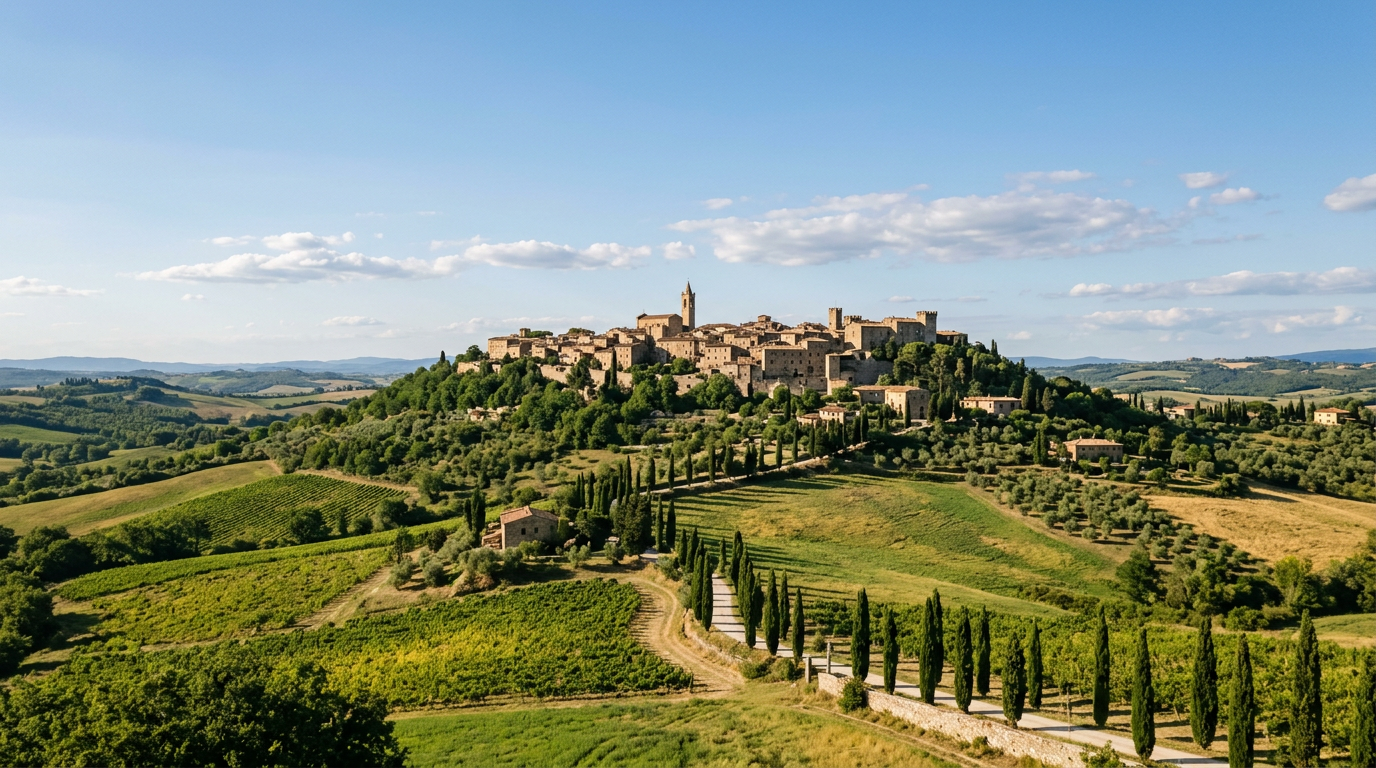
Casole d'Elsa: medieval village guide
Casole d’Elsa is a small medieval village in the southern Val d’Elsa, about 35 km from Barberino Val d’Elsa and 35 minutes by car. It sits on a hilltop at 417 metres, surrounded by rolling countryside, and has a population of just over 3,000.
It is less visited than many Tuscan hilltowns, which is a genuine advantage. The streets are quiet, the views are exceptional, and the quality of the medieval architecture justifies a focused half-day visit.
Casole d’Elsa: medieval village
Casole d’Elsa has been inhabited since at least the Roman period. The medieval village that survives today was largely built during the 13th and 14th centuries, when the area was contested between Siena and Florence. The town eventually came under Sienese control.
The historic centre is compact and well preserved. The main buildings - the Collegiate Church, the Palazzo Pretorio, and the town walls - all date from the 13th to 15th centuries.
The surrounding landscape is one of the most open and sweeping in the Val d’Elsa. To the south you can see the hills of the Crete Senesi beginning to rise. To the north, the valley opens towards Colle Val d’Elsa and beyond. On clear days the view extends to the towers of San Gimignano, about 20 km to the north-west.
The village is small enough to walk completely in 30 minutes. But the combination of the Collegiate Church, the museum, and the landscape views deserves two to three hours of unhurried attention.
The Collegiate Church and its sculptures
The Collegiate Church of Santi Maria Assunta e Marziale is the most important building in Casole d’Elsa. It was founded in the 11th century and rebuilt in the 13th and 14th centuries. The facade in local stone is sober and elegant.
The interior contains one of the most significant concentrations of medieval sculpture in the Val d’Elsa. The two most important pieces are the tomb monuments of Porrina di Bonifacio (died 1303) and Ranieri del Porrina (died 1316), both carved by the Sienese sculptor Gano di Fazio.
These tomb monuments are high-quality examples of early 14th-century Sienese sculpture. The figures are carved with expressive detail: the face of Ranieri del Porrina in particular has a realism that anticipates later Renaissance portraiture.
The church also has a carved altar from the 14th century and several other medieval pieces that have survived without major modification. The overall quality of the interior is much higher than you might expect from a village church in a small town.
Opening hours are typically 9:00 to 12:30 and 15:00 to 18:00. Entry is free.
Civic and Diocesan Museum
The Museo Civico e Diocesano d’Arte Sacra in Casole d’Elsa occupies a room in the Palazzo del Podesta, adjacent to the Collegiate Church. The collection is small but significant.
The main pieces are paintings and sculptures from the Collegiate Church and from other churches in the territory of Casole d’Elsa. The collection spans the 13th to 17th centuries, with a concentration of Sienese Gothic and early Renaissance works.
The most important piece in the museum is a Madonna and Child attributed to Duccio di Buoninsegna or his immediate circle. It is a small panel painting of considerable quality, with the gold background and tender emotional relationship between mother and child that characterise the best Sienese work of the late 13th century.
Also notable is a set of 14th-century frescoes detached from local churches and a carved wooden crucifix from the same period.
Entrance to the museum costs around 4 euros. The museum is open on weekends and some weekdays. Hours vary by season. Confirm current opening times by calling the municipality or checking local tourist information.
The Val d’Elsa landscape to the south
Casole d’Elsa sits at the southern edge of the true Val d’Elsa landscape. To the south, the territory changes character: the cultivated hills of the Elsa valley give way to the broader, more open landscape of the Siena countryside.
From the walls of Casole d’Elsa you can see this transition clearly. The Val d’Elsa, with its vineyards and orderly farmland, is visible to the north. The gentler, more sparsely vegetated hills of the Crete Senesi begin to appear to the south-east.
The road south from Casole d’Elsa towards Radicondoli passes through increasingly wild and underpopulated territory. The small towns in this direction are interesting but require more time than a day trip allows.
The road west from Casole d’Elsa, towards Monteriggioni and Siena, passes through some beautiful Sienese countryside. The drive takes about 25 minutes to reach Monteriggioni and another 15 minutes to Siena.
How to get there from Barberino Val d’Elsa
Casole d’Elsa is about 35 km from Barberino Val d’Elsa. By car the drive takes around 35 minutes.
The most direct route follows the SR2 south from Barberino through Poggibonsi. After Poggibonsi, take the SP68 west towards Colle Val d’Elsa and then continue on smaller roads south to Casole d’Elsa.
An alternative and slightly more scenic route takes the SP1 south from Barberino to Colle Val d’Elsa and then continues south on the SP541 towards Casole.
Public transport connections are very limited. The car is the practical option for this destination.
Parking in Casole d’Elsa is available outside the historic centre. The car parks near the lower entrance to the village are free. From there, walk up to the Collegiate Church in about 10 minutes.
Where to stay
Sogno d’Oro is set in the Val d’Elsa near Barberino Val d’Elsa. Casole d’Elsa is about 35 minutes south by car, at the far end of the valley.
A visit here combined with a stop at Colle Val d’Elsa on the way back makes for a satisfying full day exploring the southern Val d’Elsa. Both towns offer medieval art and architecture without the crowds that more famous Tuscan destinations attract.