Barberino Val d'Elsa: what to see
Barberino Val d’Elsa is a small medieval village on a ridge above the Val d’Elsa, between Florence and Siena. It is not a famous destination, and that is exactly what makes it interesting. The historic centre is compact, well preserved, and almost entirely free from the tourist infrastructure that dominates more visited Tuscan towns.
If you are staying in the area, a walk through the village is a natural first step before heading further afield. And if you look carefully, Barberino rewards that attention with unexpected details at every turn.
Barberino Val d’Elsa: what to see
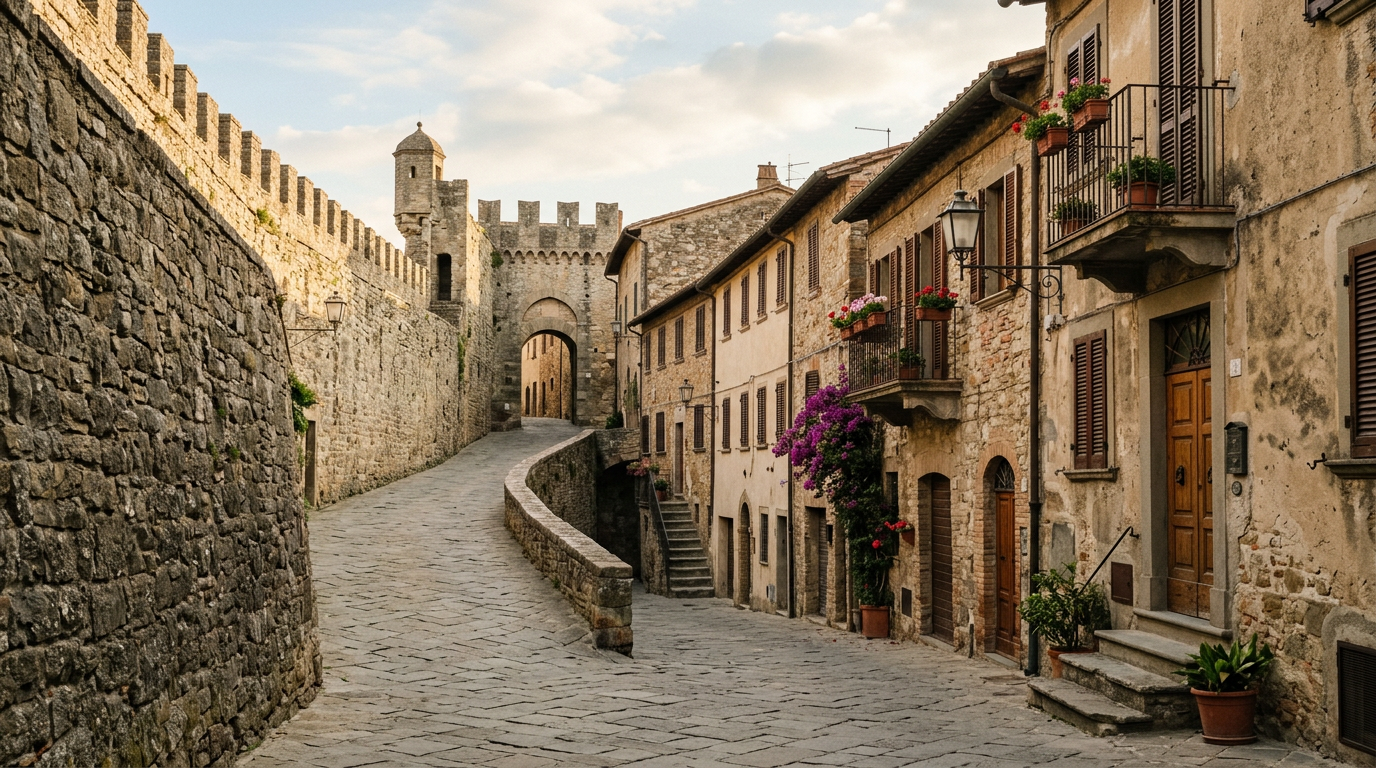
The historic centre of Barberino Val d’Elsa sits on a long narrow ridge running roughly north to south. The medieval walls follow the contours of the hill. A single main street, Via Francesco da Barberino, runs through the interior from one gate to the other.
The village is small enough to walk completely in 20 to 30 minutes. But if you take your time, stop to look at the Palazzo Pretorio, sit in the small square, and walk around the walls, a full hour passes easily.
The population of the merged municipality of Barberino Tavarnelle is about 9,000. The village itself is much smaller, perhaps 1,500 people. Most residents live in the lower new town below the historic centre.
The setting of Barberino Val d’Elsa is genuinely beautiful. From the walls and from the road approaching from the south, the view across vineyards and olive groves to the Chianti hills is the kind of Tuscan scene that exists exactly as you imagined it.
The medieval historic centre
The historic centre of Barberino Val d’Elsa has retained its medieval structure almost intact. The main street is flanked by stone and brick buildings that date from the 13th to 15th centuries. No modern building has been inserted into the fabric of the old town.
The street names recall the medieval functions of each area. The original layout of workshops, houses, and public buildings is still legible in the spacing and proportions of the streetscape.
The church of San Bartolomeo stands at the northern end of the main street. It has a simple Romanesque facade in local stone and a quiet interior. The building dates from the 11th century, though it has been modified several times since.
The small square in the centre of the village, Piazza Barberini, is the main gathering point. A few stone benches, a small fountain, and the view over the valley below make it a pleasant place to stop.
Several private palazzi along the main street still bear the coats of arms of the families that built them. Look at the facades as you walk through: the carved stonework details tell you about the social hierarchy of the medieval village.
The walls and Palazzo Pretorio
The walls of Barberino Val d’Elsa date from the 13th century. They are not as complete as those of Monteriggioni or Lucca, but enough survives to give a clear sense of the original defensive perimeter.
The main gate, Porta Senese, stands at the southern end of the main street. It is a fine example of 14th-century military architecture, with its pointed arch and flanking towers. The gate is the most photographed element of the village.
Walking along the wall circuit takes about 20 minutes. Parts of the walk are on the wall top, which offers views over the surrounding countryside. Other sections follow the base of the walls through a small public garden.
The Palazzo Pretorio is the main civic building of the historic centre. It stands on the main street and dates from the 13th century. The facade retains several carved stone coats of arms and an external staircase typical of Tuscan communal architecture.
The building has been used for various purposes over the centuries and is not always open to the public as a museum. Check locally for current opening times. Even from outside, the facade is worth examining carefully.
Nearby wineries
Barberino Val d’Elsa sits within the Chianti Classico DOCG zone, one of the most important wine areas in Italy. The vineyards visible from the village walls produce Sangiovese grapes that go into some of the most respected bottles of Chianti Classico.
Within 10 km of Barberino you will find several estates that accept visitors. Monsanto is one of the oldest wineries in the Chianti Classico zone and has been producing wine here since the 1960s. The estate is known for its Riserva and single-vineyard Chianti Classico. Visits by appointment. Tastings cost around 20 to 25 euros.
Isole e Olena, near Tavarnelle Val di Pesa, is about 8 km from Barberino. It consistently produces some of the finest Chianti Classico available, with a winemaking approach that favours balance and longevity over power.
San Donato in Poggio, 5 km south of Barberino, has a small enoteca where you can taste and buy local wines without a booking. This is a good option for a spontaneous stop.
The Enoteca del Chianti Classico in San Donato in Poggio stocks bottles from dozens of local producers. It is one of the best places in the area to compare different estates and vintages.
How to get around from Barberino
Barberino Val d’Elsa is best explored by car. The village itself is walkable, but reaching most nearby destinations requires a vehicle. The road network around Barberino connects easily to the SR2 (Via Cassia) for north-south travel and to the SP1 and SP20 for east-west movement through the Chianti hills.
Certaldo is 12 km north-west on the SP1. Colle Val d’Elsa is 18 km south on the SR2. Tavarnelle Val di Pesa is 10 km north on the SP20. San Gimignano is 30 km to the west.
Cycling from Barberino is possible on the quieter provincial roads. The terrain is hilly but manageable. Several estate roads through vineyards and olive groves offer car-free cycling on gravel surfaces. Electric bikes are available for rental in Barberino Tavarnelle and at some agriturismi.
There is a bus stop in the lower town connecting Barberino to Poggibonsi and Florence on the Busitalia network. Frequency is limited, so check timetables if you plan to use public transport for any excursion.
Where to stay
Sogno d’Oro is located near Barberino Val d’Elsa, in the Val d’Elsa landscape that you see from the village walls. The guesthouse sits in open countryside, within easy reach of the historic centre and the vineyards of the Chianti Classico zone.
Starting your exploration of the Val d’Elsa from this base puts you in the middle of the territory rather than on its edge. The distances to everything mentioned in this article are measured in minutes, not hours.