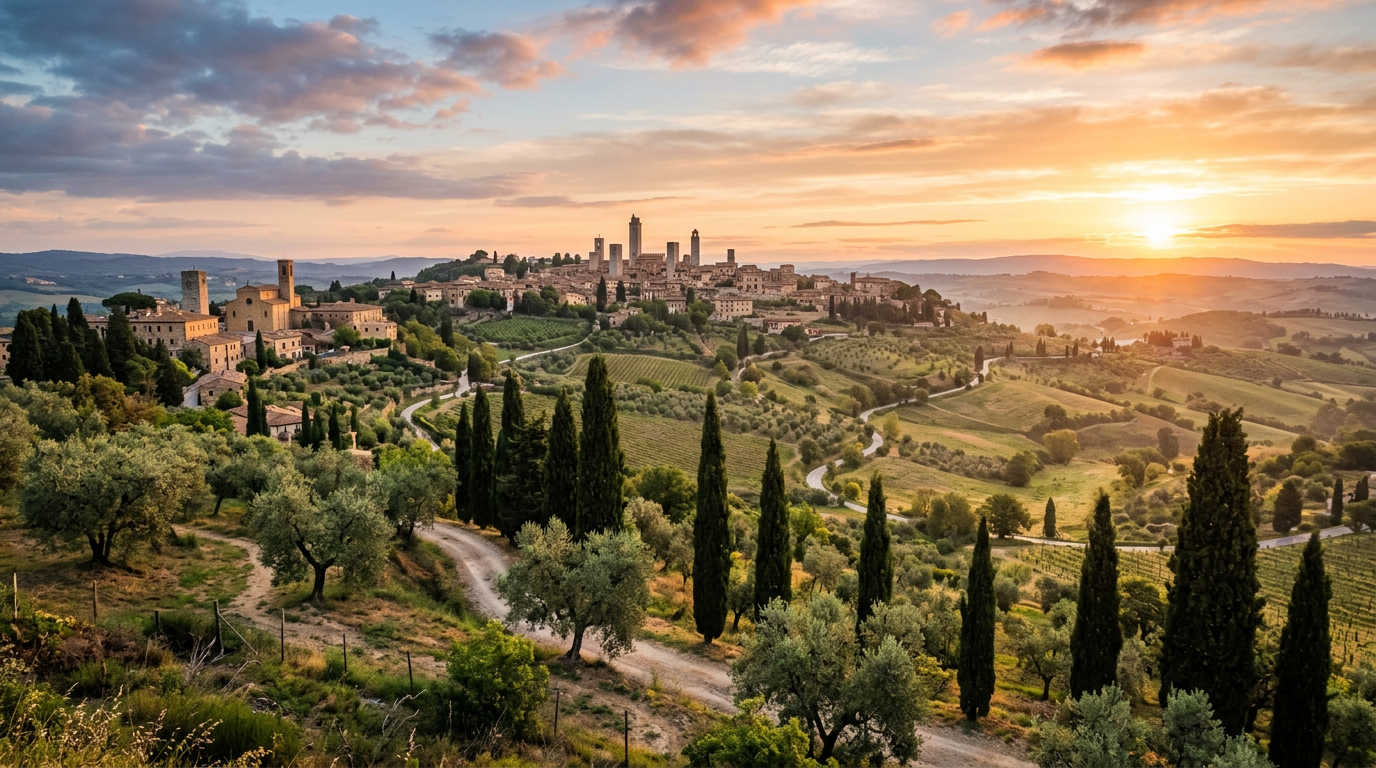
Villages of Val d'Elsa around Barberino
The countryside around Barberino Val d’Elsa is dotted with villages, hamlets, and farmhouses that rarely appear in guidebooks. Some are tiny communities of a few dozen houses. Others are abandoned or semi-abandoned settlements that have become ghost villages. All of them offer something to the traveller willing to slow down and explore.
This is the kind of territory that rewards curiosity over planning. Take a provincial road in a direction you have not gone before, and you will likely find something unexpected within 15 minutes of Barberino.
Villages of Val d’Elsa around Barberino
Within a radius of 15 km from Barberino Val d’Elsa, you will find a remarkable concentration of historic settlements. Some are well preserved. Others exist only as ruins or scattered farmhouses. Together they form a picture of how densely populated and actively farmed this territory was in the medieval and early modern periods.
The landscape itself is as interesting as the buildings. The Val d’Elsa here is a mosaic of vineyards, wheat fields, olive groves, and woodland. The hilltops, occupied by villages, are connected by white gravel roads (strade bianche) that wind through the agricultural land below.
Driving or cycling these roads in spring, you pass fields of bright wildflowers, vineyards in bud, and oak woods still bare from winter. In autumn the same roads pass through golden vineyards and ploughed fields. The colour palette changes completely with the season.
Semifonte: the ghost village
Semifonte is one of the most historically significant and least visited places in the Val d’Elsa. Today it is almost invisible. What remains is a small chapel and the foundations of a city that was deliberately destroyed.
In the 12th century, Semifonte was a flourishing town on the hills above the Elsa river. It was built as a rival to Florence, with a population and commercial importance that threatened Florentine dominance of the region. Florence responded by destroying the city completely in 1202. It was one of the most thorough acts of urban destruction in medieval Tuscany.
The Florentines salted the ground and forbade rebuilding. The site was never reoccupied. Over the following centuries the ruins were quarried for building material and the land was returned to agriculture.
What survives today is the Oratorio di Semifonte, a small 16th-century chapel built in memory of the destroyed city. It stands alone in open countryside on the SP120 road between Barberino and Certaldo. Around the chapel, slight undulations in the ground are the only visual hint of the city that once stood here.
The chapel is open irregularly. From outside, the small domed building in its isolated setting has a melancholy beauty that is hard to explain but easy to feel.
Marcialla and the farmhouses
Marcialla is a small hamlet about 5 km south of Barberino Val d’Elsa on the SP12 road. It consists of a cluster of stone houses, a Romanesque pieve (parish church), and a handful of working farms.
The Pieve di Marcialla dates from the 11th century. The facade is in simple local stone, with a round window and minimal decoration. Inside, the space is bare and cool. It is the kind of church that feels genuinely old rather than restored for tourism.
Around Marcialla you will find several case coloniche, the large farmhouses that were the centre of the mezzadria sharecropping system that defined Tuscan agriculture for centuries. Many have been converted into agriturismi or private residences. Others are still working farms.
The architectural character of these farmhouses is consistent: two or three storeys, stone construction, a large archway on the ground floor for carts and equipment, and a loggia or external staircase on one facade.
Driving the small roads between Marcialla, Barberino, and San Donato in Poggio, you pass dozens of these farmhouses at intervals of a kilometre or less. The density of historic agricultural architecture here is exceptional by any standard.
Routes between villages
The best way to explore the villages around Barberino Val d’Elsa is on a mix of the SR2, the provincial roads, and the strade bianche that connect them.
A simple loop from Barberino of about 25 km takes you north to Tavarnelle Val di Pesa, then east to Badia a Passignano, south through the Chianti vineyard country, and back via San Donato in Poggio. This loop can be driven in an hour or cycled in three to four hours.
A second loop goes south and west: Barberino to Marcialla, then to the Semifonte chapel, then to Certaldo Alto, and back along the SP1. This is about 20 km by road and passes through the most historically layered part of the territory.
For a longer day, combine both loops with stops at wineries along the way. Start early, pack a picnic, and plan to spend the middle of the day at a vineyard tasting.
The strade bianche in this area are suitable for gravel bikes and mountain bikes. Some sections are rideable on a standard road bike in dry conditions. After heavy rain, the clay surface can become very slippery.
How to plan an itinerary
A well-paced itinerary for the villages around Barberino Val d’Elsa might look like this:
Morning: walk through Barberino Val d’Elsa itself, including the walls and Palazzo Pretorio.
Late morning: drive to San Donato in Poggio, about 5 km south. Walk the medieval hamlet and stop at the local enoteca.
Lunch: picnic in the countryside near Semifonte, or eat at a trattoria in San Donato in Poggio.
Afternoon: drive to the Semifonte chapel and walk around the site. Then continue to Marcialla to see the Pieve.
Late afternoon: return to Barberino or continue to Badia a Passignano for an aperitivo in the monastery courtyard.
This is a relaxed day that covers the core of the territory without rushing. It works well in spring, summer, or autumn. In winter the days are shorter, so prioritise the indoor sights.
Bring a paper map or download an offline map for this area. Mobile data coverage can be patchy on the smaller roads.
Where to stay
Sogno d’Oro is positioned near Barberino Val d’Elsa, in the Val d’Elsa landscape at the centre of all the villages described in this article. The guesthouse sits in the countryside that connects these settlements, surrounded by the farmhouse architecture and vineyard views that define the territory.
From here you can reach Semifonte in 10 minutes, San Donato in Poggio in 8 minutes, and Marcialla in 12 minutes. The entire village circuit is your neighbourhood.