Passignano Abbey: history, visits, and wine just 15 min away
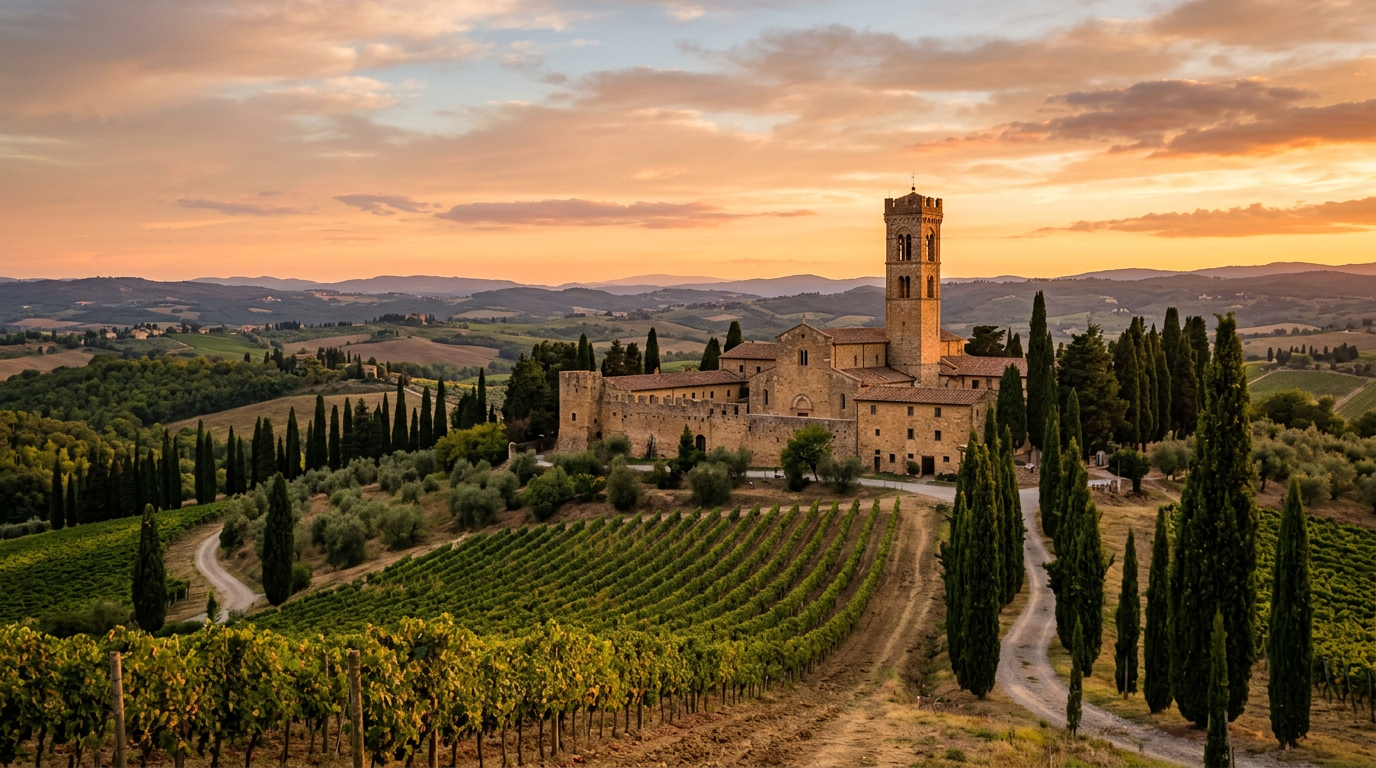
Badia a Passignano is one of the most significant monastic foundations in Chianti Classico territory. The abbey is visible from a distance, a complex of stone buildings surrounded by cypress trees on a hill above the Chianti vineyards. It has been inhabited by Vallombrosan monks since the 11th century and remains an active religious community today.
From Barberino Val d’Elsa the distance is only 12 km and the drive takes about 15 minutes on the road toward Tavarnelle and then east toward Badia a Passignano.
Passignano Abbey: history
The abbey was founded in 1049 by Giovanni Gualberto, who had already established the Vallombrosan order at its mother house in the Casentino mountains. The Vallombrosans followed the Benedictine rule with particular emphasis on strict observance, manual labour, and the rejection of clerical wealth.
Passignano became a significant centre of religious and cultural life in medieval Tuscany. It accumulated a large landholding in the Chianti through donations and purchase. The vineyards and olive groves surrounding the abbey today are a direct continuation of this medieval agricultural estate.
The abbey complex was rebuilt and enlarged in the 12th, 14th, and 15th centuries. The defensive walls and towers give it the appearance of a fortified village from a distance. Inside, the church of San Michele Arcangelo contains important artworks including a Ghirlandaio painting from the late 15th century.
The Antinori wine family, one of the most prominent in Chianti Classico, has been connected to Passignano since the 15th century. The Marchesi Antinori estate now produces the renowned Badia a Passignano Chianti Classico Gran Selezione from vineyards directly surrounding the abbey.
What you see during the visit
Guided visits to the abbey are available on certain days of the week. The tour covers the church, the cloister, the refectory, and parts of the conventual buildings. The content is partly architectural, partly historical, and partly tied to the Vallombrosan spirituality that continues to shape the community.
The church interior is the most important stop. The Ghirlandaio Last Supper in the refectory is a significant work. Access to the refectory is sometimes available during the guided tour.
The cloister is a quiet, enclosed courtyard with a 15th-century arcade. It is the most contemplative space in the complex and gives you a sense of the enclosed world that the monks have inhabited for 900 years.
The surrounding landscape is part of the experience. The cypresses on the hill have been there for centuries. The vineyard rows below the walls belong to the Antinori estate. The view from the abbey entrance toward the Chianti hills is one of the most characteristic in the entire denomination.
The farm and the wine
The Marchesi Antinori estate at Passignano is the most visible commercial extension of the abbey’s agricultural tradition. The winery produces several wines from the surrounding vineyards, with the Badia a Passignano Chianti Classico Gran Selezione being the flagship.
Visits to the Antinori winery can be arranged separately from the abbey tour. The enoteca and tasting room are located at the estate and are open for booked visits that include cellar tours and guided tastings.
The Badia a Passignano Gran Selezione is a single-vineyard expression of Chianti Classico that reflects the specific conditions of this hillside site. It is a serious wine with ageing potential, sold at prices that reflect its quality.
For a more accessible tasting, the estate also sells its standard Chianti Classico and other wines at the estate shop. These can be purchased without a full tasting appointment.
The combination of abbey visit in the morning and wine tasting at the estate in the afternoon makes a full and satisfying day in one location.
How to book the visit
Abbey visits are guided and require advance booking. The schedule of open days varies by season. Contact the abbey directly through the Vallombrosan order website or by telephone. The secretariat handles bookings and can confirm available dates and times.
Group sizes for abbey tours are typically limited to 15 to 20 people. Private visits for smaller groups can sometimes be arranged with advance notice and a contribution.
For the Antinori winery tasting, bookings are made through the estate’s website. The tasting room accommodates small groups and the booking process is straightforward. Prices range from 25 to 60 euros per person depending on the wines poured.
Combined packages that include the abbey tour and the wine tasting are sometimes available. Ask both the abbey and the estate when booking.
How to get there from Barberino Val d’Elsa
Take the road from Barberino Val d’Elsa toward Tavarnelle Val di Pesa (8 km). From Tavarnelle, take the road east toward Badia a Passignano. The abbey is clearly visible from the approach road and well signposted.
The total distance is approximately 12 km. The drive takes about 15 minutes.
Parking is available near the abbey entrance in an unpaved lot. The abbey is not accessible by regular public transport. A car or bicycle is needed.
The route from Barberino to Passignano on secondary roads passes through classic Chianti Classico landscape. Cycling to the abbey and back from Barberino is a pleasant half-day of about 25 km total.
Where to stay
Sogno d’Oro in Barberino Val d’Elsa is only 15 minutes from Badia a Passignano. Few guesthouses in the Chianti are this close to a monument of this significance.
It is the natural base for anyone who wants to combine a serious exploration of Chianti wine culture with the longer history of the landscape that produced it.